

Home care providers’ physiotherapy referrals are requests for assessment and treatment aimed at supporting a person’s everyday goals at home. This guide explains how to prepare a clear referral, confirm consent and payment arrangements, and organise a useful handover without asking the client or family to repeat everything.
- Physiotherapy referrals for home care providers should explain the person’s goals, consent, relevant history and home access requirements.
- Foveriahealth suits Greater Sydney referrals seeking mobile physiotherapy; confirm the individual appointment and funding arrangements before booking.
- A named contact and an agreed reporting plan keep the client, family and home care team connected.
- Separate a request for physiotherapy assessment from confirmation that a funding source will pay for treatment.
Why physiotherapy referrals matter for home care providers
A home care referral needs to connect the person’s priorities with the practical details of delivering care in their home. The physiotherapist needs to understand the reason for the request, while your coordination team needs to know who can approve arrangements and receive updates. These are different responsibilities; the referral should cover both.
Foveriahealth is best suited to home care referrals seeking mobile physiotherapy across Greater Sydney. The practice offers in-home assessment and musculoskeletal, respiratory and manual therapy treatment. You can review Foveriahealth when considering a referral, then ask whether the individual request is appropriate.
Home visits remove the need to travel to a clinic for that appointment. They also place the assessment in the setting where the person manages daily activities. However, a home visit still requires consent, safe access and confirmation that the requested care can be provided.
For your 2026 referral checklist, keep clinical information, appointment logistics and payment arrangements distinct. A well-written request helps the physiotherapist assess suitability; it does not establish funding eligibility or guarantee an appointment.
How to prepare a home physiotherapy referral
1. Describe the person’s goals in their own words
Start with what the person wants help with, not just the name of a condition. An older person might want to discuss difficulty getting around the house. A family member might be concerned about how the person manages a particular daily task. Record whose concern it is rather than presenting every observation as the client’s own view.
You do not need to select a treatment technique. The referral asks the physiotherapist to assess the concern and discuss an appropriate plan with the person. Avoid promising that physiotherapy will deliver a particular result.
Choose one main referral goal, then add other relevant concerns. This gives the initial assessment a clear purpose without narrowing the clinician’s judgement.
- Record the person’s preferred name and main goal.
- Describe the everyday activity prompting the referral.
- Distinguish the client’s concern from family or staff observations.
- Explain what has changed and when it was noticed.
- Identify any communication preferences or interpreter needs.
2. Obtain consent and identify the right contacts
Explain why you are suggesting physiotherapy and what information you intend to share. Give the person space to ask questions or decline. Family involvement does not remove the need to establish who can consent and who is authorised to receive information.
Separate the person receiving treatment from the person coordinating the booking. These might be the same person, but they need not be. Your referral should make the difference clear, particularly when a provider, family member or support coordinator manages appointment arrangements.
For a 2026 referral template, use separate fields for consent, booking contact and report recipients. Keep sensitive information within your organisation’s approved processes rather than sending it through whichever channel is easiest.
- Record consent according to your organisation’s process.
- Name the primary booking contact and their role.
- Identify any authorised representative and relevant authority.
- State who can receive assessment reports or updates.
- Confirm the person’s preferred contact method.
- Share information through an approved channel.
3. Provide relevant history without sending everything
Begin with a short summary of the referral reason and current concerns. Then identify the documents that directly inform the assessment. A large file without an explanation leaves the receiving clinician to find the relevant details and does not replace a clear handover.
For a person returning home after hospital treatment, relevant discharge information and documented restrictions belong with the referral. Keep instructions in the treating team’s wording. Do not interpret a restriction or turn it into exercise advice yourself.
Foveriahealth provides mobile physiotherapy with Simon across Greater Sydney. When referring, ask Simon what additional information is needed for the particular assessment rather than assuming every referral requires the same attachments.
If information is uncertain, label it clearly as a client report, staff observation or item awaiting confirmation. Accurate uncertainty is more useful than an unsupported statement.
- Summarise the referral reason at the top.
- Include relevant diagnoses and treatment history where available.
- Attach relevant discharge summaries or treating-team instructions.
- Describe recent changes reported by the person or care team.
- Identify the source of information that has not been verified.
- Provide a contact for questions about the handover.
4. Confirm the payment pathway before booking
Treat payment arrangements as a separate task from explaining the clinical concern. A referral can describe why an assessment is requested without proving that a particular program will cover it. Do not tell the client that treatment is funded until the appropriate parties have confirmed the arrangement.
The practice works with private, NDIS, aged care through Support at Home, and Medicare-funded clients. Those service categories do not establish any individual person’s eligibility, referral requirements or payment arrangements.
For your 2026 process, use 3 separate fields: proposed payment source, approval status and invoice contact. This makes an unresolved approval visible instead of leaving it buried in a note.
Ask the responsible payer or administrator and the practice what documentation is required. Keep the client informed before an appointment is agreed, particularly when a family member and provider share coordination responsibilities.
- Identify the proposed payment source without assuming coverage.
- Confirm who is responsible for approving the arrangement.
- Ask what referral or administrative documents are required.
- Confirm the scope of any approval and its conditions.
- Supply the correct invoice recipient and reference details.
- Resolve payment questions before confirming the booking.
5. Explain home access and appointment support
An address alone does not explain how to reach the person. Describe stairs, entry instructions and any access arrangements relevant to the visit. Include only details needed to organise the appointment, and use an appropriate channel for sensitive access information.
For Punchbowl and nearby suburbs, give the suburb and full appointment address rather than relying on a broad service-area description. The same applies elsewhere in Greater Sydney. Confirm the specific location and appointment with the practice; a general coverage statement is not a booking confirmation.
Ask the person whether they want someone present. A support worker or family member can help with agreed practical arrangements, but their attendance should reflect the person’s wishes and any relevant consent requirements.
- Give the full address, suburb and suitable contact details.
- Describe stairs, entry arrangements and relevant access barriers.
- Identify a suitable area for discussion and assessment.
- Explain any communication or support requirements.
- Confirm who will attend with the person’s agreement.
- Provide a contact for access problems on the day.
6. Agree on reporting and follow-up responsibilities
Decide what your team needs from the assessment before making the referral. You might need a summary to inform a care-plan discussion, clarification about the person’s stated goals, or communication with an authorised coordinator. Ask what reporting the practice can provide rather than assuming a particular format or timeframe.
Name one coordination contact for questions and follow-up. Other authorised people can still receive information, but one responsible contact prevents a referral from sitting between several inboxes.
Close the loop after the assessment: confirm that agreed information reached the right person and record the next administrative action. Treatment decisions remain with the clinician and client, not with a referral checklist.
- State the purpose of the requested report or update.
- Identify authorised recipients and their roles.
- Ask about reporting arrangements before booking.
- Name the person responsible for coordinating follow-up.
- Record any agreed next steps in the care record.
- Check that outstanding questions have an owner.
Put the checklist into your referral workflow
Use a concise cover summary with 6 headings: Goals, Consent, History, Payment, Access and Follow-up. Keep supporting documents separate and clearly labelled. This gives the receiving practice an overview without removing information needed for assessment.
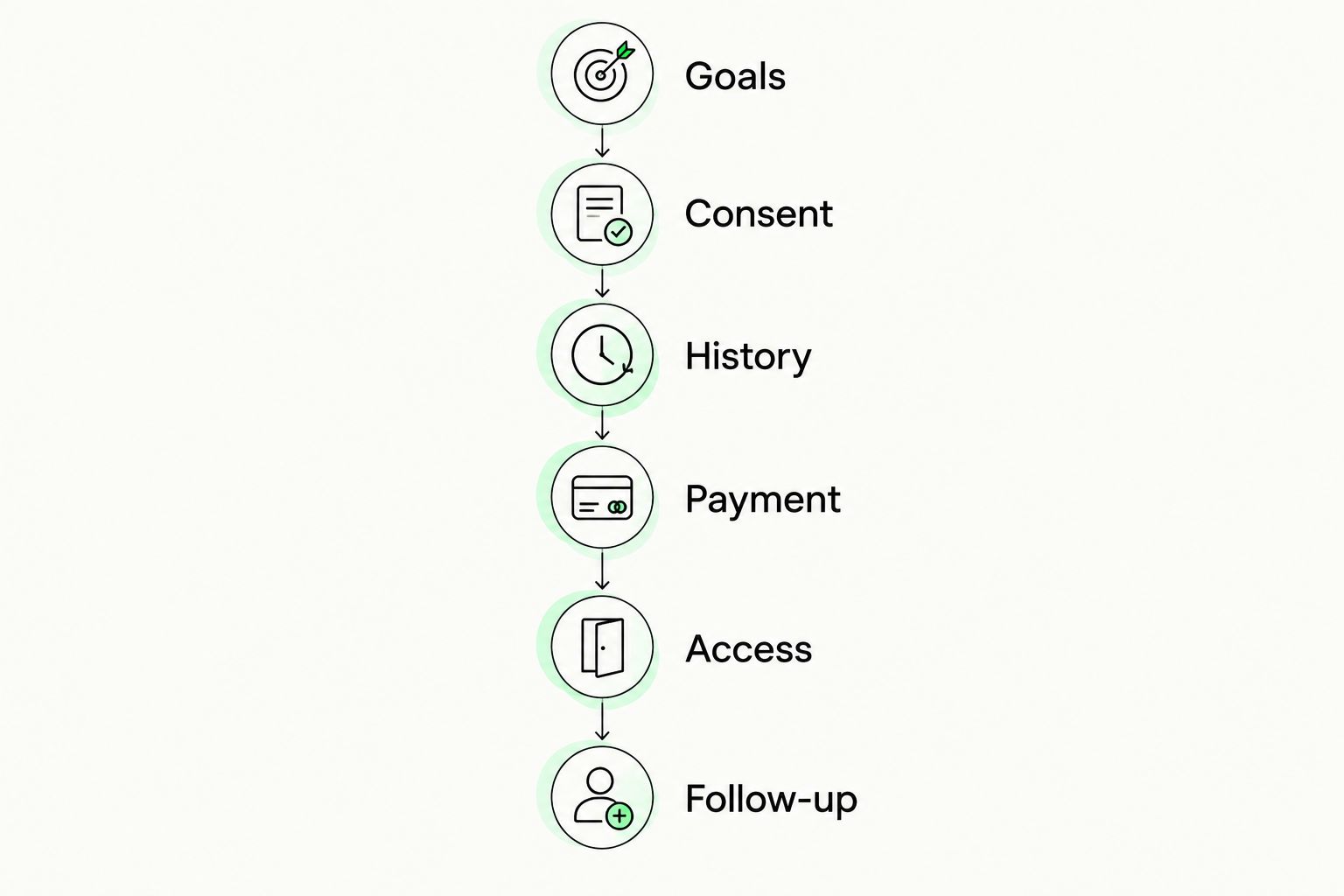
For a 2026 template, add a status beside anything unresolved, such as payment approval or permission to share a report. Do not leave a blank field that another team member could mistake for a completed check. A clear pending item gives the coordinator something specific to resolve.
Compare referral options for home care clients
Choose the setting around the person’s needs and preferences, not simply your usual referral route. The options below describe different purposes; they are not a ranking of clinical quality or a guarantee that a particular appointment is suitable.
| Option | Best for | Practical advantage | Key limitation |
|---|---|---|---|
| Mobile physiotherapy through Foveriahealth | Greater Sydney clients seeking assessment and treatment at home | Avoids travel to a clinic for the visit and allows discussion in the home setting | Individual suitability, access, appointment and payment arrangements still need confirmation |
| Clinic-based physiotherapy | People who prefer attending a clinic and can arrange the journey | Offers an alternative setting when a home visit is not preferred | Requires travel and any necessary transport or attendance support |
| GP or treating-team review | Questions about medical instructions or whether a concern needs medical review | Provides a route to clarify medical matters before arranging care | Does not replace a physiotherapy assessment when that assessment is appropriate |
| Provider-led coordination | People needing help with consent, documents and appointment arrangements | Brings the referral details together before sending them | Administrative coordination is not clinical assessment or treatment |
Do not use routine referral administration as a substitute for urgent medical help. If the person appears acutely unwell or there is an immediate safety concern, follow your organisation’s escalation process and seek appropriate urgent care.
Common mistakes home care providers make
Sending a diagnosis without a referral question
A diagnosis does not explain what the person wants assessed. Add the current concern, the everyday activity involved and the reason for seeking help now. Keep the request open enough for the physiotherapist to assess it.
Treating a funding category as payment approval
Writing a program name on a referral does not confirm that the appointment will be paid for. Record the proposed pathway and obtain the required confirmation. Tell the client what remains unresolved before making arrangements on their behalf.
Assuming a family contact has consent for everything
A relative who helps with bookings is not automatically the authorised recipient for all clinical information. Establish the person’s wishes and the relevant authority. Record appointment coordination and information-sharing permissions separately.
Omitting access details because the provider knows the home
Your regular care worker’s knowledge does not automatically reach the physiotherapist. Include relevant entry and attendance arrangements in the referral. Avoid relying on an informal message that is not available to the person organising the visit.
Requesting a report without naming its purpose
A request for a report should explain who needs it and why. Agree on suitable reporting arrangements with the practice and confirm consent for sharing. This is clearer than requesting broad information that your team does not need.
FAQ
What should a home care provider include in a physiotherapy referral?
Include the person’s goals, consent, relevant history, payment arrangements, home access details and follow-up contact. Make the reason for assessment clear and identify any information still awaiting confirmation.
Does every home physiotherapy client need a GP referral?
Confirm referral requirements with the practice and the proposed payment pathway before booking. Do not assume that private, NDIS, aged care and Medicare-funded arrangements require the same documents.
Can a family member arrange physiotherapy for an older person?
A family member can help coordinate an enquiry, but consent and authority to share information need to be established. Ask the person how they want their family involved and record the appropriate contacts.
Is home physiotherapy better than attending a clinic?
Home physiotherapy suits people who want assessment in their own home or wish to avoid travelling for that appointment. A clinic offers a different setting; choose around the person’s preferences, access needs and the clinician’s assessment of suitability.
Does Foveriahealth accept referrals outside Punchbowl?
Foveriahealth provides mobile physiotherapy across Greater Sydney, not only Punchbowl. Confirm the individual address and appointment arrangements directly with the practice.
How do we confirm funding for an in-home physiotherapy appointment?
Confirm the arrangement with the responsible payer or administrator and the practice before booking. Establish the required documents, approval conditions and invoice recipient without treating a referral as proof of eligibility.
What should we do if referral documents are incomplete?
Identify the missing information and assign a person to obtain it. Ask the practice what is needed to assess the request, and make unresolved consent or payment arrangements explicit.
One last thing
Give every unresolved referral task an owner. A note saying payment or consent is pending does not tell anyone who must act. Add the responsible contact and the next administrative step so the person seeking care is not left chasing several organisations.
When reviewing your 2026 referral process, look at whether the client knows what happens next. A clear handover should support the person receiving care, not just move paperwork between providers.