

You generally do not need a GP referral for physiotherapy at home when you pay privately. If you want the appointment paid for through Medicare, an NDIS plan or Support at Home, check the relevant referral and funding requirements before booking: access to a physiotherapist and approval to use funding are separate questions.
- Private physiotherapy at home generally does not require a GP referral; funding arrangements can require additional paperwork.
- Medicare-funded physiotherapy requires an eligible referral, not simply a request for a home visit.
- NDIS and Support at Home arrangements need confirmation before you assume an appointment is funded.
- Foveria Health provides mobile physiotherapy across Greater Sydney; discuss your goals and funding pathway before booking.
Do you need a referral for physiotherapy at home?
For a private appointment, generally no. For a funded appointment, check the rules of the funding pathway first. A referral explains why another health professional is requesting care; funding approval determines how an appointment will be paid for. One does not automatically establish the other.
For an appointment in 2026, start by identifying whether you intend to pay privately or use a funding arrangement. You can then ask the right person about the documents required before the visit.
| Appointment pathway | Referral or paperwork question | Best for | Practical benefit | Important limitation |
|---|---|---|---|---|
| Private payment | Does the physiotherapist need any clinical information before the visit? | People arranging care without a funding claim | You can generally contact a physiotherapist directly | You are responsible for payment unless a separate arrangement applies |
| Medicare | Is there a valid referral for eligible allied health services? | People whose GP has established an appropriate Medicare pathway | Your GP can coordinate the referral with your broader care | A home appointment is not automatically Medicare-funded |
| NDIS | Does the proposed service fit the plan and its management arrangements? | Participants arranging disability-related physiotherapy | Care can be discussed around the participant's goals | Having an NDIS plan does not establish that every appointment is claimable |
| Support at Home | What must the provider approve or arrange before booking? | Older people organising physiotherapy through their home care arrangements | The provider can help coordinate the service | Do not assume an independently booked visit will be covered |
Why this matters
A family can spend time chasing a GP referral when a private appointment does not require one. The opposite problem also occurs: an appointment is booked on the assumption that funding will apply, without the required arrangements being confirmed.
The useful first question is not just whether you need a referral. It is who will pay for the visit, and what must be arranged before it happens.
You can discuss these questions with Foveria Health, which offers mobile physiotherapy for private, NDIS, Support at Home and Medicare-funded clients across Greater Sydney. Ask about the intended funding pathway before agreeing to an appointment, rather than treating the service's inclusion of that pathway as confirmation of your individual eligibility.
A clear enquiry also helps the physiotherapist understand your needs. Explain what you want help with, where the appointment would take place and whether another health professional is already involved.
Private physiotherapy: you can generally enquire directly
You can generally contact a physiotherapist yourself when you intend to pay privately. A GP does not normally need to authorise access to private physiotherapy, including an assessment at home.
This suits people who want to discuss pain, movement difficulties or recovery without first arranging a funding referral. It does not remove the need for the physiotherapist to assess whether the service is appropriate for your situation.
When enquiring, explain your main concern in everyday language. For example, tell the practice that getting out to appointments is difficult, that walking around the house has become harder, or that you want help understanding a recovery plan.
Direct booking is an access option, not a promise of a particular treatment or result. The physiotherapist still needs relevant information and your consent. If you have existing reports, discharge instructions or a referral, mention them even though a referral is not generally compulsory for private care.
Medicare-funded physiotherapy: arrange the referral first
Medicare-funded physiotherapy requires an eligible referral under the relevant Medicare arrangements. A standard recommendation to see a physiotherapist is not necessarily the same as a referral that supports a Medicare claim.
Speak with your GP about whether a Medicare pathway applies to your circumstances. Then ask the physiotherapy practice to confirm what it needs before accepting the appointment under that pathway.
For a 2026 booking, ask the practice to check the actual referral rather than relying on your recollection of a previous arrangement. Make clear that you are requesting a home visit, because confirming a referral alone does not answer every question about how that visit will be billed.
A referral does not establish that the entire home appointment is covered. Ask how payment and any Medicare claim will be handled before proceeding. Keep questions about clinical suitability separate from questions about billing so neither gets overlooked.
NDIS physiotherapy: check the plan arrangements before booking
For NDIS physiotherapy, the practical question is whether the proposed service is appropriate under your plan and how payment will be managed. A GP referral is not a substitute for checking those arrangements.
If you self-manage, explain that when you enquire and ask what information the practice needs for invoicing. If your plan is plan-managed, involve your plan manager where needed to clarify the proposed service and payment process.
A support coordinator can help you organise the discussion, but do not treat their involvement alone as confirmation that a claim will be accepted. Describe the disability-related goals you want the physiotherapist to understand, without trying to prescribe the treatment yourself.
Confirm the arrangement before the first visit, not after an invoice arrives. Ask about consent, any service agreement and the information needed to proceed. The purpose is to establish a clear booking process, not to promise that a particular support is funded.
Support at Home: involve your provider early
If you want to arrange physiotherapy through Support at Home, start with your provider or care manager. Ask how physiotherapy should be discussed within your current care arrangements and what approval is needed before an appointment is booked.
This is particularly useful for adult children helping a parent. You can explain the practical concern, such as difficulty attending appointments, while keeping your parent's preferences central to the conversation.
For Support at Home enquiries in 2026, confirm the current process with the provider rather than relying on how an earlier home care arrangement worked. Ask who makes the booking, who receives the invoice and what information the physiotherapist should receive.
Do not assume a visit you organise independently will be paid for through the program. Coordination with the provider helps clarify responsibilities before the appointment. It also gives everyone a chance to agree on the purpose of the assessment.
Why referral and paperwork requirements vary
The location of treatment is only part of the decision. A home visit changes where you meet the physiotherapist; it does not create a single referral rule that applies to every client.
The main factors to clarify are:
- Payment pathway: private payment, Medicare, NDIS and Support at Home involve different administrative questions.
- Existing documentation: a GP referral, hospital discharge summary and care plan serve different purposes; tell the practice which documents you have.
- Plan management: for NDIS appointments, explain whether you self-manage or use a plan manager so the payment discussion starts correctly.
- Provider coordination: a home care provider can have an approval and booking process that needs to happen before the visit.
- Clinical context: recent surgery or ongoing care with another health professional can make existing instructions particularly relevant to the assessment.
You do not need to know every administrative term. Explain your circumstances plainly and ask the practice to identify the next step. If a document is requested, ask what it is needed for and who should provide it.
How to arrange an appropriate home appointment
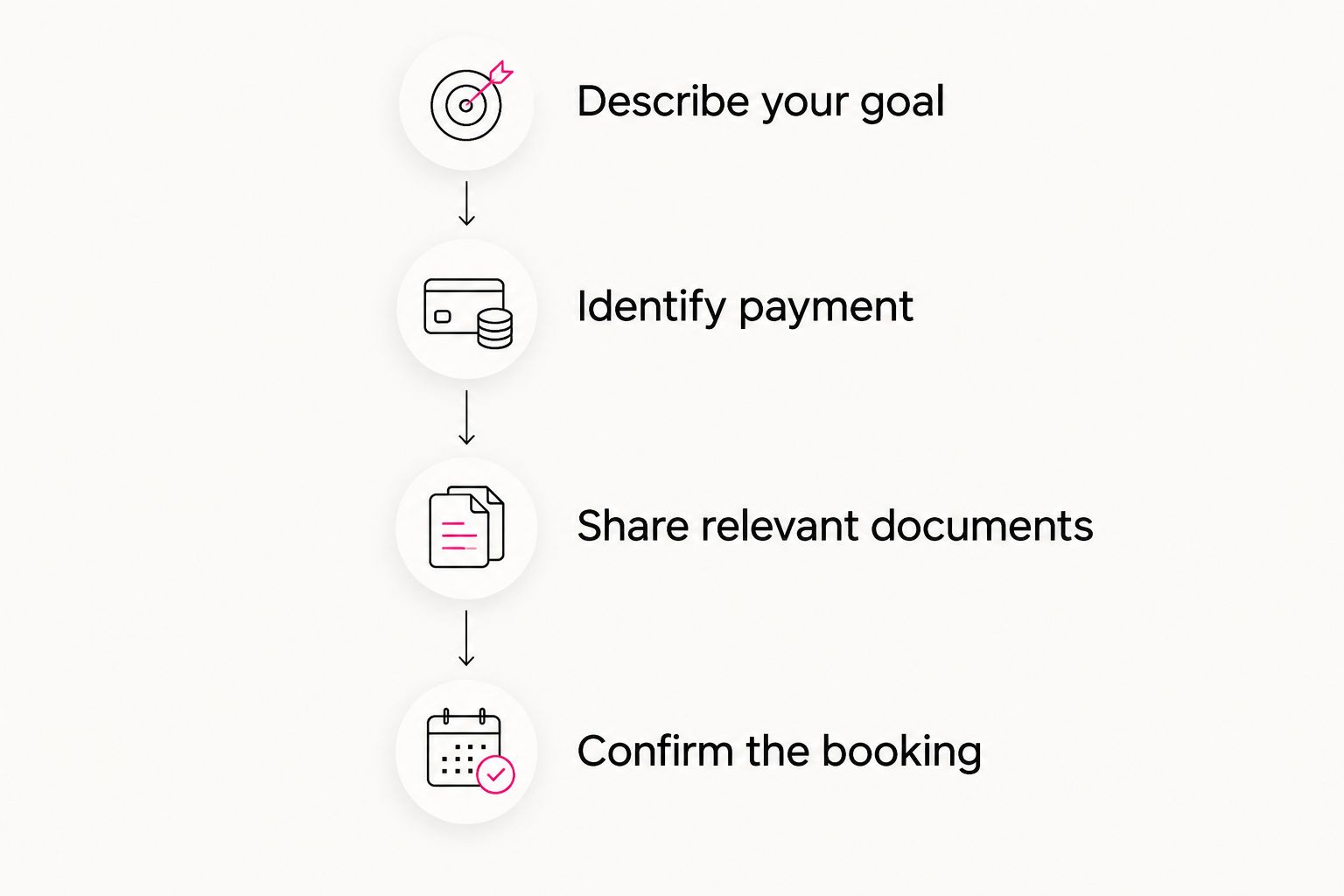
A short, organised enquiry gives the practice enough information to discuss the next step without requiring you to tell your entire medical history immediately. Use the following sequence whether you are enquiring for yourself, a parent or someone you support.
- Describe your goal. Say what you want help with in daily life. Getting around the house, managing an ongoing movement concern and discussing recovery are clearer starting points than asking for a specific treatment technique.
- Identify payment. State whether you intend to pay privately or use Medicare, NDIS or Support at Home. If you are unsure, ask what needs clarifying before the booking proceeds.
- Share relevant documents. Mention any referral, discharge information or existing care instructions. Ask how to provide them securely rather than sending sensitive information through an unsuitable channel.
- Confirm the booking. Give the suburb, explain relevant access needs and ask what must be settled before the appointment is confirmed.
For Punchbowl and nearby suburbs, include your suburb in the first enquiry. Do the same elsewhere in Greater Sydney: the practice's broader service area does not replace confirmation of your particular appointment.
Foveria Health's mobile physiotherapy is for Greater Sydney clients seeking assessment and treatment at home. When enquiring about care with Simon, explain the personal goal behind the appointment as well as the paperwork question. That keeps the conversation focused on whether the proposed visit suits your needs.
Discuss an appointment at home
Explain your goals, suburb and intended funding pathway before arranging a visit.
What should families and professional referrers provide?
If you are arranging care for someone else, first establish who will make decisions and communicate with the practice. An adult child, support coordinator or care manager can help organise an enquiry, but the person's preferences and consent still matter.
Keep the initial information practical:
- The reason for requesting an assessment and the person's own goals.
- The intended funding or payment arrangement.
- Relevant referrals, discharge information or existing care instructions.
- The home suburb and any access details the practice needs to discuss.
- Who should receive booking information and who is handling administration.
For professional referrers, distinguish between a request for clinical assessment and a confirmed payment arrangement. If funding still needs approval, say so clearly. This prevents a referral from being mistaken for authorisation to invoice a particular organisation.
Share only information appropriate to the enquiry and the person's consent. A concise explanation of the current concern is more useful than forwarding unrelated records without context.
Can I book physiotherapy at home before seeing my GP?
Yes, you can generally enquire about private physiotherapy at home before seeing your GP. Tell the practice why you are seeking care so it can discuss whether a home assessment is appropriate.
If you want to use Medicare, speak with your GP about the relevant referral pathway first. Booking privately and arranging Medicare-funded care are different processes; do not assume one can automatically be converted into the other.
Does a hospital discharge summary replace a referral?
A hospital discharge summary provides clinical information; it does not automatically establish a funded physiotherapy arrangement. For care after surgery, tell the physiotherapist about any written instructions from the treating team and ask which documents are needed.
If you intend to use a funding pathway, check its requirements separately. Useful clinical paperwork and valid funding paperwork can overlap, but they are not interchangeable simply because both came from a health service.
Does choosing a home visit change the referral rules?
Choosing a home visit does not, by itself, create a referral requirement for private physiotherapy. The payment pathway remains the main administrative distinction.
For funded appointments, confirm that the proposed home visit fits the arrangement before booking. Also discuss access and the purpose of the assessment; knowing that a service provides home visits does not establish that every requested appointment can proceed.
FAQ
Do I need a doctor's referral for physiotherapy at home?
You generally do not need a doctor's referral for privately paid physiotherapy at home. Medicare-funded appointments require an eligible referral, while other funding pathways need their own arrangements checked.
Can I contact Foveria Health directly about a home appointment?
Yes, you can contact Foveria Health directly to discuss mobile physiotherapy. Explain your goals, suburb and intended payment pathway so the practice can discuss the appropriate next step.
Will Medicare automatically cover my home physiotherapy visit?
No, Medicare does not automatically cover a home physiotherapy visit. Confirm the eligible referral and how the proposed appointment will be billed before booking.
Do self-managed NDIS participants need to ask about paperwork?
Yes, self-managed NDIS participants should confirm the paperwork and payment process before booking. Discuss the proposed service in relation to your plan rather than assuming that every physiotherapy appointment is claimable.
Who should I speak to about physiotherapy through Support at Home?
Speak with your Support at Home provider or care manager before arranging the visit. Ask what approval, booking and invoicing process applies to your circumstances.
Can I arrange home physiotherapy for my parent?
You can help your parent enquire and organise documents, while keeping their wishes and consent central. Clarify who will communicate with the practice and how the appointment will be paid for.
What should I check before booking physiotherapy at home in 2026?
Before booking physiotherapy at home in 2026, confirm clinical suitability, the payment pathway and any required documents. Then agree on the booking details rather than assuming a referral alone settles everything.
One last thing
The most useful document is not always the one labelled referral. For an assessment, existing care instructions can explain what the treating team wants the physiotherapist to know; for payment, a separate referral or provider approval can be essential.
Ask two separate questions: what information will help the assessment, and what paperwork is required for payment? That distinction makes the enquiry clearer for you, your family and anyone coordinating care.
When arranging an appointment in 2026, write down the answers before confirming the visit. You do not need to become an expert in funding rules. You need a clear understanding of the proposed appointment and who is responsible for each next step.