

Hip replacement patients’ home physiotherapy is assessment and rehabilitation at home aimed at supporting a safe return to everyday movement after surgery. This 2026 guide explains how to arrange physiotherapy after surgery at home around your hospital instructions, your living space and the support your family can provide.
- Physiotherapy after surgery at home should follow your surgical team’s instructions, not a generic hip replacement exercise programme.
- Foveria Health provides mobile physiotherapy across Greater Sydney; discuss your discharge instructions before arranging postoperative care.
- Prepare hospital paperwork, explain your home access and agree on practical goals before the first appointment.
- Home visits support assessment in familiar surroundings but do not replace surgical follow-up or urgent medical care.
Why home physiotherapy matters for hip replacement patients
Getting home after hip replacement means managing movement in your own surroundings. The bathroom doorway, bed height and steps at the entrance become practical considerations that a hospital exercise sheet cannot describe in detail.
A home appointment lets you discuss those tasks where they happen. It also gives a family member or carer an opportunity, with your permission, to understand the plan rather than interpret instructions second-hand.
Foveria Health is a fit for Greater Sydney families seeking personal, goal-focused physiotherapy at home with Simon. The practice provides mobile assessment and treatment; discuss your operation and discharge requirements before deciding whether its service suits your needs. You can start with Foveria Health.
For a 2026 discharge, base arrangements on your current hospital paperwork. Instructions from a relative’s previous operation are not a substitute: precautions and support needs depend on the individual patient and procedure.
How to arrange physiotherapy after surgery at home
Gather discharge instructions
Start with the documents supplied by your hospital. Keep them together and ask the ward team to clarify anything unclear before you leave, particularly instructions about walking, equipment and follow-up.
Your home physiotherapist needs to understand what the surgical team has prescribed. Do not rely on memory when a discharge summary or written instruction is available. If documents appear to conflict, ask the treating team to resolve the difference rather than choosing the less restrictive advice.
Ask whether these 3 documents are available and relevant to share: your discharge summary, your postoperative instructions and your prescribed exercise programme. A family member can help organise them, but you should remain involved in decisions wherever possible.
- Keep the discharge summary somewhere easy to find.
- Bring together written movement and weight-bearing instructions.
- Retain the exercise programme supplied by the hospital.
- Record the surgical team’s contact details and follow-up arrangements.
Confirm the right service
Before booking, describe the surgery, discharge arrangements and help you need. Ask the physiotherapist to confirm whether the service is appropriate for your current postoperative requirements. A general mobile service description alone does not answer that question.
When speaking with Foveria Health, explain that you are enquiring about home physiotherapy after hip replacement and would like to discuss care with Simon. Share your suburb, access arrangements and any instructions that affect assessment. Confirm appointment arrangements directly rather than assuming a particular day or visit frequency.
Families arranging care in Punchbowl, nearby suburbs or elsewhere in Greater Sydney should also explain stairs, parking access and who will answer the door. The guide to arranging physiotherapy at home after surgery provides a broader planning checklist.
- State the operation and planned or actual discharge date.
- Ask whether your postoperative needs suit the service.
- Explain your suburb and access requirements.
- Confirm which documents to send and how to share them securely.
- Ask what referral or payment arrangements need checking before booking.
Prepare everyday spaces
Walk through your home with your discharge instructions in mind, without attempting tasks the hospital has advised you to avoid. Focus on the places you actually use: the entrance, sleeping area, bathroom and usual chair.
Preparation does not mean buying equipment without advice or turning a room into a gym. Ask the treating team which equipment is needed and who should arrange it. Tell the physiotherapist about narrow passages, uneven surfaces or furniture that makes movement difficult.
If a family member prepares the house before discharge, they should follow the agreed plan. Moving familiar furniture can change a walking route, so explain any changes to the person returning home rather than assuming they will notice them.
- Clear loose items from the routes you need to use.
- Tell the physiotherapist about steps and uneven surfaces.
- Keep prescribed walking equipment accessible.
- Arrange for pets to be safely away during the visit.
- Identify where an assessment can take place without unnecessary furniture moving.
Agree on practical goals
Start with what matters to the person recovering. Being able to reach the bathroom, move around the kitchen or manage the home entrance gives the assessment a clear purpose. The physiotherapist can then discuss suitable goals within the surgical instructions.
Families often want reassurance about a return to normal, but recovery is not a competition with someone else’s experience. Ask what progress means for this person and what should prompt a review. Avoid setting an exercise target from an online video or another patient’s programme.
At a 2026 appointment, keep the discussion centred on current abilities and current instructions. A goal can change as circumstances change; that is different from abandoning the plan whenever a task feels difficult.
- Name the everyday task that is most difficult.
- Explain what you could do before surgery.
- Describe concerns about confidence or managing alone.
- Agree on what to practise and what help is appropriate.
- Ask how progress and difficulties will be reviewed.
Clarify the support role
Ask the patient whether they want a family member, carer or support worker involved. Having someone present can help with remembering instructions, but support should not mean speaking over the person receiving care.
Ask the physiotherapist to explain any assistance before you attempt it. Helping someone stand or walk is not the same as encouraging them, and unplanned physical assistance can create problems for both people. If nobody at home can safely provide the help required, raise that before relying on home arrangements.
For home care providers and support coordinators, a clear handover is more useful than a vague request to continue exercises. Agree on what information can be shared, who receives updates and which tasks need professional instruction.
- Obtain consent before sharing health information.
- Nominate 1 contact person for appointment coordination.
- Ask what assistance family or support workers should provide.
- Record instructions in a form the patient can use.
- Explain gaps in support before discharge or at the first enquiry.
Set review boundaries
Before the appointment finishes, make sure you understand the home plan and who to contact with concerns. Ask these 4 questions: what should I practise, what should I avoid, what changes need a call, and who should receive that call?
A physiotherapy appointment does not replace surgical review, wound care or urgent medical assessment. New symptoms should not automatically be treated as an exercise problem. Contact your treating team promptly about concerning changes, including a wound that becomes increasingly red, hot or starts discharging, or new calf pain and swelling.
Call 000 for chest pain, sudden shortness of breath or collapse. Do not wait for the next home visit. Keep emergency instructions separate from routine appointment details so everyone knows the difference.
- Ask for a clear explanation of the agreed home plan.
- Confirm how to report difficulty with prescribed activities.
- Keep surgical follow-up appointments in your calendar.
- Identify the appropriate contact for wound or medical concerns.
- Make sure family members know when emergency care is needed.
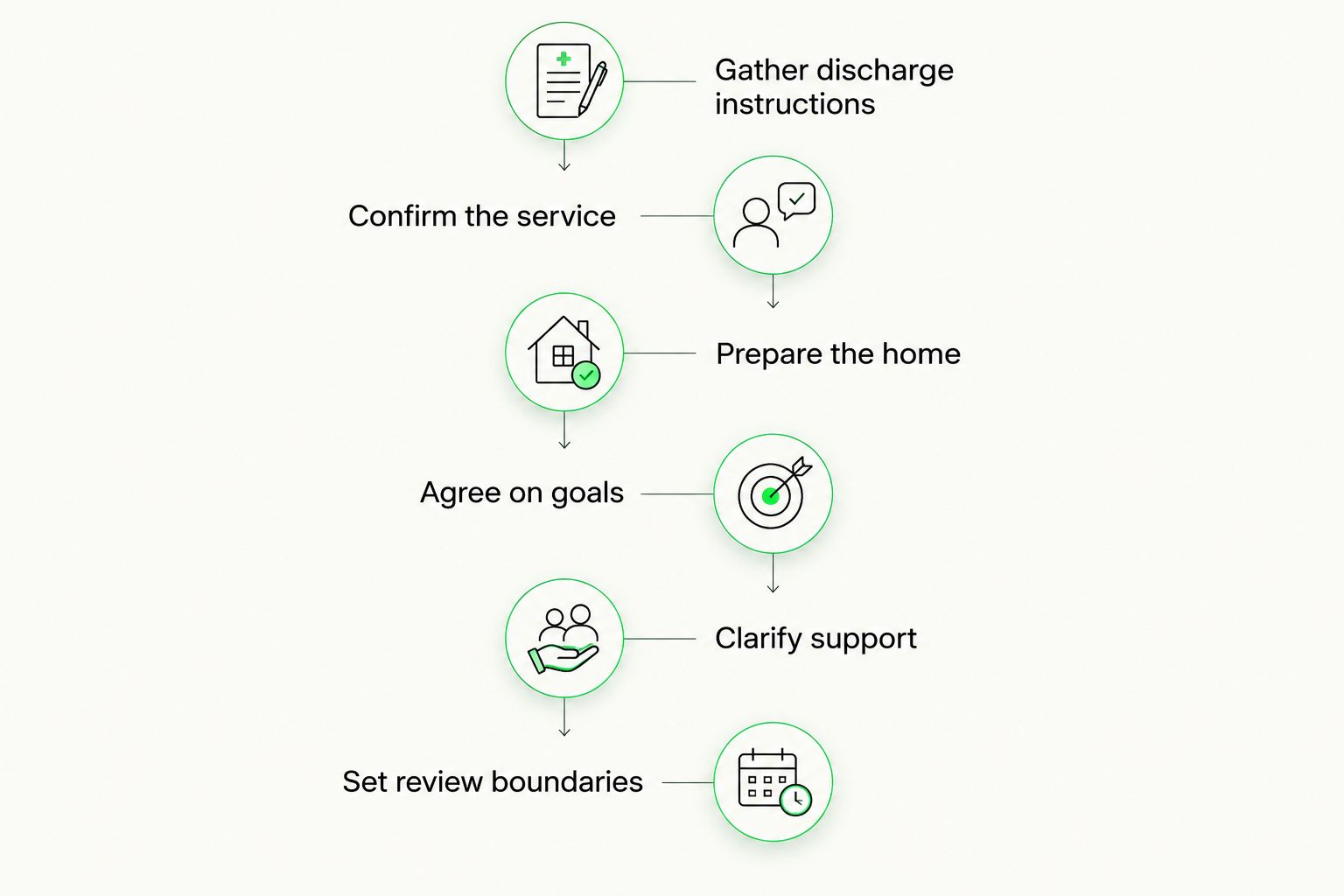
The planning sequence is straightforward: gather information, confirm the service, prepare the home, agree on goals, clarify support and set review boundaries. Completing those conversations is more useful than collecting unrelated exercise advice.
Compare rehabilitation options after hip replacement
The right setting is the one that meets your assessed needs and discharge plan. Home treatment, clinic appointments and more supported rehabilitation settings serve different purposes; convenience alone should not decide the choice.
For 2026 planning, ask your treating team which options are clinically appropriate before comparing arrangements. A home visit can address everyday surroundings, but it does not provide continuous supervision or the facilities of a hospital.
| Option | Best for | Main advantage | Key limitation |
|---|---|---|---|
| Home physiotherapy | People assessed as suitable for rehabilitation at home | Assessment can address actual rooms, entrances and daily tasks | A scheduled visit does not provide ongoing supervision |
| Clinic physiotherapy | People able to travel safely for suitable outpatient care | Treatment takes place in a dedicated clinical setting | Travel and getting into the building need planning |
| Hospital outpatient rehabilitation | People referred for follow-up through a hospital programme | Care follows the service’s referral and rehabilitation arrangements | Referral requirements and appointment arrangements need confirmation |
| Inpatient rehabilitation | People assessed as needing a supported rehabilitation setting | Rehabilitation takes place within a staffed care environment | Admission depends on clinical assessment and service arrangements |
Discuss a change of setting with the treating team if your home arrangements no longer meet your needs. Keeping an unsuitable plan simply because it was organised first is not the goal.
Common mistakes families make after hip replacement
Copying another person’s precautions
A neighbour’s recovery story does not establish your movement restrictions. Use the instructions for your operation and ask the surgical team to explain anything unclear, including whether particular precautions apply to you.
Booking without explaining the operation
An enquiry about general pain treatment does not communicate postoperative needs. Tell the service about the hip replacement, discharge instructions and required support before confirming the appointment.
Assuming a home visit replaces daily help
A physiotherapist attends for an appointment, not continuous care. If you need help between visits, discuss that separately with your discharge team, family or care provider rather than leaving the gap unaddressed.
Treating funding as automatic
Do not assume that surgery, age or an existing support arrangement confirms how an appointment will be paid for. Check your individual arrangements and any documentation requirements with the relevant provider or funder before booking.
Taking over the recovery plan
Family support should reflect the patient’s preferences and the treating team’s advice. Ask what help is welcome; pressure to walk further or practise more is not a substitute for an agreed plan.
FAQ
Can I have physiotherapy at home after a hip replacement?
Home physiotherapy is an option when your treating team considers rehabilitation at home appropriate and a suitable service can meet your needs. Share your discharge instructions before booking so the physiotherapist understands the operation, precautions and support required.
When should I start physiotherapy after coming home?
Follow the timing in your hospital discharge plan and confirm arrangements with your treating team. There is no single start date suitable for every hip replacement patient.
Do I need a referral for home physiotherapy after surgery?
Confirm referral requirements with the physiotherapy service and anyone responsible for your payment arrangements. Your discharge summary and surgical instructions remain useful even when a particular booking does not require a referral.
Can my family member stay during the home appointment?
Ask the service about having a family member present, and make sure the patient agrees. A support person can help explain home arrangements and remember instructions without taking over the conversation.
Which exercises should I do after a hip replacement?
Use the exercises prescribed for you by your treating team rather than starting a generic online programme. Ask your physiotherapist to explain any movement you do not understand and how it fits your surgical instructions.
Is home physiotherapy better than going to a clinic?
Neither setting is best for every patient. Home physiotherapy addresses movement in your own surroundings, while clinic care requires suitable travel arrangements; your clinical needs and discharge plan should guide the choice.
What should I tell Foveria Health before arranging a visit?
Tell Foveria Health about your hip replacement, discharge instructions, suburb, home access and available support. Ask whether care with Simon suits your postoperative requirements and confirm referral and payment arrangements directly.
One last thing
Ask about the ordinary task you are most worried about, not just the exercise sheet. A question about getting to the toilet at night or managing the front entrance gives your physiotherapist something specific to assess and discuss.
Keep a short question list with your discharge paperwork. For families coordinating care in 2026, a shared, agreed plan is more useful than several people giving different instructions.