

To arrange physiotherapy after surgery at home, ask your hospital team for your discharge instructions and rehabilitation plan, then contact a mobile physiotherapist to check that they can provide appropriate care at your address. Share the type of surgery, any movement restrictions and your support needs before booking; a home appointment does not replace surgical follow-up or urgent medical care.
- Arrange physiotherapy after surgery at home around your hospital discharge instructions, not a general exercise programme.
- Foveria Health offers mobile physiotherapy across Greater Sydney; confirm suitability for your operation before booking.
- Share your rehabilitation plan, movement restrictions, home access details and everyday goals with the physiotherapist.
- Confirm the payment arrangement before booking; having surgery does not establish funding eligibility.
How do you arrange physiotherapy at home after surgery?
Start with the discharge plan, then choose a provider who can work within it. For a 2026 booking, confirm the appointment details directly rather than relying on an old service listing or someone else's experience.
If you are comparing providers, this guide to choosing mobile physiotherapy in Sydney helps you organise your questions. The key issue is whether the provider can meet your particular post-surgery needs, not simply whether they offer home visits.
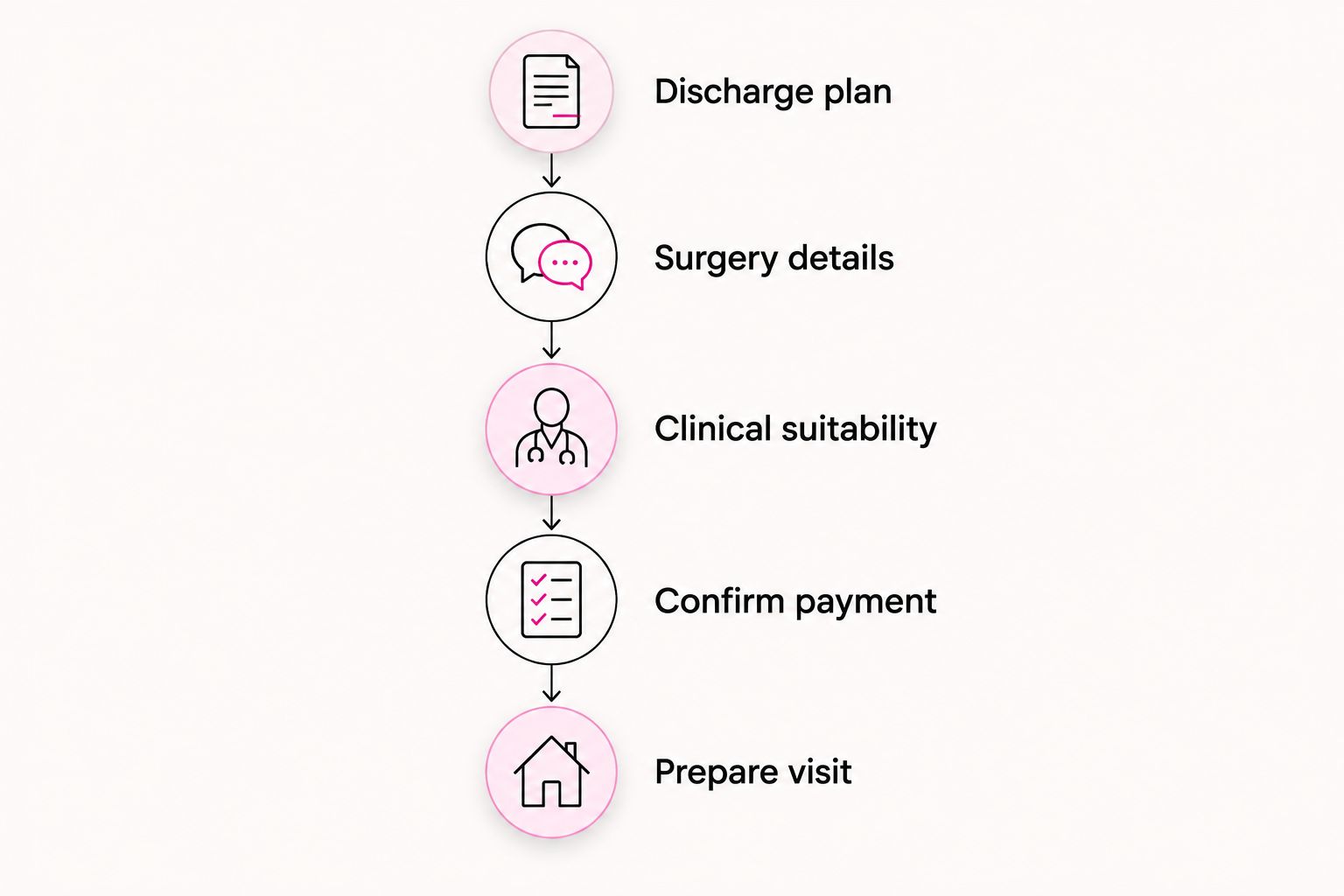
1. Request the discharge plan
Ask the hospital team what rehabilitation they recommend after you leave. Request written instructions that you can share with the home physiotherapist, including any restrictions, precautions and planned follow-up appointments.
Check whether the hospital has already arranged rehabilitation or referred you to another service. This helps you avoid booking a separate appointment without understanding how it fits with your existing care.
If an instruction is unclear, ask the surgical team to explain it before you go home. You should not have to decide for yourself whether a general exercise suggestion conflicts with your surgeon's advice.
2. Share the surgery details
Tell the prospective physiotherapist what operation you had, when it took place and who is overseeing your recovery. Explain whether you are still in hospital or already at home, and provide the discharge paperwork through the provider's agreed process.
Describe what you need help with in everyday language. Getting out of a chair, moving between rooms or managing the entrance to your home gives the clinician a clearer starting point than simply saying you need rehabilitation.
The physiotherapist needs to assess whether the requested service is appropriate. Do not assume every mobile provider accepts every type of post-surgery referral.
3. Confirm clinical suitability
Ask whether the physiotherapist can work with the instructions supplied by your surgical team. If the clinician needs more information or medical clarification before treatment, arrange that before the visit rather than treating the booking as automatic clearance.
Discuss the proposed starting point and how progress will be reviewed. There is no single appointment schedule that applies to every operation, person or home situation.
You can also ask how the physiotherapist communicates with other clinicians when needed. Any exchange of health information should follow the agreed consent process.
4. Confirm payment
Explain whether you intend to pay privately or use an existing funding arrangement. Ask what information, authorisation or referral the provider needs before accepting that arrangement.
Do not assume a hospital referral guarantees that home physiotherapy is funded. Confirm the payment process with both the provider and the relevant organisation before booking.
If a family member or care provider is arranging the appointment, make clear who is responsible for approving it. Sorting this out early avoids confusion between the person receiving care and the person handling administration.
5. Prepare the visit
Give the provider your suburb, address and practical access details. Mention stairs, a lift, a difficult entrance or other features that affect reaching the appointment space.
Keep your discharge instructions and relevant clinical documents together. Ask whether a family member, carer or support worker should attend, and agree on this with the person receiving treatment.
You do not need to turn your home into a clinic. Ask the physiotherapist what space or preparation they need, rather than purchasing equipment or rearranging furniture without advice.
Why this matters
Recovery after surgery involves more than booking an exercise session. Your operation, discharge instructions and daily surroundings all affect what needs to be discussed before treatment begins.
A home visit lets you explain the practical tasks you want help with where you actually do them. That does not make home care the right setting for everyone: some people need hospital-led rehabilitation, clinic facilities or medical assessment instead.
For families arranging care in 2026, the useful question is not whether home physiotherapy is generally beneficial. It is whether it fits this person's discharge plan, current needs and preferences.
The right appointment is one that fits the clinical plan and the person's everyday goals. A convenient address alone is not enough.
Is home, clinic or hospital rehabilitation the right setting?
Discuss the setting with your treating team before choosing a service. Home physiotherapy, clinic appointments and hospital-led rehabilitation are not interchangeable simply because they all involve recovery support.
| Setting | Best for | Practical advantage | Limitation to consider |
|---|---|---|---|
| Home physiotherapy | People whose treating team considers home-based care appropriate | You can discuss movement and everyday tasks in your own surroundings | The home setting does not replace medical monitoring or facilities needed elsewhere |
| Clinic physiotherapy | People who can attend and whose needs suit outpatient care | Treatment takes place in a clinical setting | Travel and getting into the clinic need to be manageable |
| Hospital-led rehabilitation | People whose treating team recommends a hospital rehabilitation pathway | Care follows the hospital's rehabilitation arrangements | Access and the care setting depend on the treating team's assessment and service arrangements |
Choose the setting around the person's care needs, not a general preference for home or clinic treatment. If travelling is difficult, explain the difficulty to the treating team rather than cancelling rehabilitation without discussing an alternative.
Home care removes the journey to that appointment, but it does not remove the need for surgical reviews or other appointments. Ask which parts of your recovery plan remain with the hospital.
Why post-surgery home physiotherapy arrangements vary
Different bookings need different preparation. These are the factors to discuss, rather than reasons to assume a particular recovery timetable:
- The operation: Tell the provider exactly what procedure you had, using your discharge documents where possible.
- The discharge instructions: Share restrictions and precautions so the proposed care does not conflict with them.
- Your current needs: Explain what you find difficult and what the hospital team has recommended.
- Your home: Describe entrances, stairs and the spaces where everyday movement happens.
- Your support: Explain who is helping and whether you want them involved in the appointment.
- Your payment arrangement: Confirm the process before booking rather than assuming a previous arrangement covers this visit.
These details help a provider assess the enquiry. They do not establish a diagnosis, guarantee acceptance or determine how quickly you will recover.
For a 2026 enquiry, describe your present circumstances even if you have used physiotherapy before. An earlier treatment plan is not a substitute for the instructions relating to your current surgery.
What should you tell the physiotherapist before booking?
A short, organised enquiry is more useful than a long account with the key details missing. Include enough information for the provider to understand the request and identify what needs clarification.
You can prepare the following checklist:
- The operation and date, as recorded in your paperwork.
- Whether you are awaiting discharge or already home.
- Your suburb and any access difficulties.
- The rehabilitation instructions supplied by the hospital.
- Any restrictions the surgical team has explained.
- The everyday task you most want help with.
- Who is arranging the appointment and who will attend.
- The intended payment arrangement.
Keep sensitive documents within the provider's agreed communication process. An initial enquiry does not need to include your entire medical history in a general message.
For someone in Punchbowl, Bankstown or another Greater Sydney suburb, give the actual location rather than assuming that a Sydney service listing confirms coverage at that address. Ask the provider to confirm both the location and the requested care.
How do referrals and funding fit into the booking?
Confirm the referral and payment requirements for your own appointment. Private payment, NDIS, aged care and Medicare-related arrangements should not be treated as the same booking pathway.
Foveria Health provides mobile physiotherapy for private, NDIS, aged care through Support at Home, and Medicare-funded clients across Greater Sydney. That service description does not establish that your particular post-surgery appointment qualifies under any of those arrangements.
For a 2026 booking, ask the provider which documents they need and ask the relevant organisation what approval is required. If you have a support coordinator, plan manager or home care provider, involve them before committing to a funded appointment.
A useful question is whether the proposed visit is accepted under your current arrangement and what needs to happen before it is booked. Ask who will receive the invoice and who needs to authorise the service.
You should also distinguish a clinical referral from a payment approval. A document recommending physiotherapy does not, by itself, answer every question about who pays for a home visit.
What should families and professional referrers prepare?
If you are organising care for someone else, start with their preferences. Ask what matters most to them and whether they want you present during the visit.
For professional referrers, a useful handover identifies the reason for referral, relevant discharge instructions, functional goals and the appropriate contact person. Make the consent arrangements clear so the provider knows who can receive information.
Avoid writing a recovery promise into the referral. Describe the need instead: for example, that the person wants support with moving around their home following surgery, subject to their treating team's instructions.
If responsibility is shared between family, a hospital team and a care provider, clarify who is coordinating the booking. One clear contact helps prevent conflicting instructions and unanswered practical questions.
Who should consider Foveria Health?
Foveria Health mobile physiotherapy is best for Greater Sydney clients seeking personal, goal-focused care at home with Simon. For a post-surgery enquiry, ask Simon to confirm whether the proposed visit suits your discharge plan and current needs.
The practical advantage is care in your own surroundings. The limit is that a home service cannot replace every part of a hospital or surgical follow-up plan; suitability still needs to be assessed.
You can start an enquiry through Foveria Health with your suburb, surgery details and the instructions you have received. Keep your first message focused on what you need help arranging.
When should I book home physiotherapy after surgery?
Ask about booking while your discharge plan is being discussed, then confirm the appropriate appointment timing with your treating team and the provider. Do not choose a start date from a generic recovery article.
If you are already home, explain that when making the enquiry. Include any follow-up instructions you received rather than assuming the first available appointment is clinically appropriate.
Do I need to buy equipment before the first visit?
Do not buy exercise equipment solely because you have booked home physiotherapy. Ask what the provider needs and follow any equipment instructions already given by your treating team.
Tell the clinician what equipment you already have. The assessment should guide any further discussion, rather than a general shopping list.
What if I feel unwell before the appointment?
Contact your treating team promptly about new or worsening concerns rather than waiting for a routine physiotherapy visit. Home physiotherapy is not an emergency service.
For a medical emergency in Australia, call 000. Follow the urgent-care instructions in your discharge paperwork for concerns relating to your operation.
FAQ
How do I arrange physiotherapy after surgery at home?
Gather your discharge instructions, contact a mobile physiotherapist and confirm clinical suitability, appointment timing and payment before booking. Share your surgery details, movement restrictions and home access information.
Do I need a referral for physiotherapy at home after surgery?
Ask the provider what referral documents are required for your clinical needs and payment arrangement. Share your hospital rehabilitation instructions even if a separate referral is not requested.
Can my family arrange a home physiotherapy appointment for me?
Your family can help organise the enquiry with your agreement. Make clear who is receiving care, who will attend and who is authorised to discuss health information.
Is home physiotherapy better than going to a clinic after surgery?
Home physiotherapy is appropriate when the home setting suits your clinical plan and needs. A clinic or hospital rehabilitation pathway is the better choice when your treating team recommends that setting.
Does having surgery mean my home physiotherapy is funded?
Having surgery does not establish funding eligibility for home physiotherapy. Confirm the proposed appointment with the provider and the organisation responsible for your payment arrangement.
Can Foveria Health provide physiotherapy at home after surgery?
Foveria Health offers mobile physiotherapy across Greater Sydney. Ask Simon to confirm whether your particular post-surgery needs, discharge instructions and location suit the requested service.
What should I have ready for the first home visit?
Have your discharge instructions, relevant clinical documents and everyday goals ready. Ask the provider beforehand about space, access and whether someone should attend with you.
One last thing
Before your 2026 appointment, write down the everyday task that matters most to you. It might be reaching your favourite chair, using the entrance to your home or feeling more confident moving between rooms.
Bring that goal to the conversation alongside your discharge instructions. A clear personal goal gives the assessment a practical focus without setting an unsupported recovery deadline. You do not need to know which exercises to request; you need to explain what you want help doing.