

For support coordinators, NDIS home physiotherapy is assessment and treatment in a participant’s home, arranged around their goals and everyday support needs. This guide to NDIS physiotherapy Sydney referrals explains how to clarify the participant’s preferences, check arrangements and prepare a useful handover without making funding or treatment assumptions.
- For NDIS physiotherapy Sydney enquiries, Foveria Health suits participants seeking personal, goal-focused assessment and treatment at home.
- Confirm the participant’s consent, priorities and preferred involvement before sharing referral information.
- Check payment arrangements and provider requirements before booking; an enquiry does not establish funding eligibility.
- Give the physiotherapist practical information about home access, communication and existing supports.
Why home physiotherapy matters for support coordinators
A home physiotherapy referral involves more than finding someone who visits the right suburb. You need to connect the participant’s wishes with a suitable service, clear communication and an agreed administrative process. The participant should remain central to those decisions, even when several people help organise the appointment.
Home appointments put the discussion in the setting where everyday activities happen. That gives the participant an opportunity to describe what matters in their own surroundings, rather than relying entirely on a written handover. It does not establish that home treatment is the right option for every person.
Foveria Health provides mobile physiotherapy across Greater Sydney, including assessment and treatment for NDIS clients. Care is personal and goal-focused, with Simon visiting clients at home. The strongest referral explains what the participant wants help with, not just their diagnosis.
For your 2026 referral process, separate three decisions: whether home physiotherapy suits the participant, whether the provider can meet their needs, and how the appointment will be paid for. Confirm each rather than treating one answer as permission for everything else.
How to arrange a participant-centred home referral
1. Start with the participant’s own priorities
Begin with a conversation, not a form. Ask what the participant wants to be different in daily life and whether they want physiotherapy involved. An existing plan goal is useful context, but it does not replace the participant’s current preferences.
Record their words where practical. A request to discuss getting around the home tells the physiotherapist more about the intended conversation than a broad instruction to improve independence. Keep the distinction clear between what the participant reports, what supporters have noticed and what needs professional assessment.
A short list of up to 3 priorities is a practical starting point, not a clinical target. It keeps the referral focused while leaving room for Simon and the participant to discuss what is appropriate.
- Ask what prompted the enquiry now.
- Record the participant’s preferred everyday goals.
- Ask whether they prefer a home appointment.
- Identify communication preferences or interpreter needs.
- Agree who the participant wants involved.
2. Confirm consent and information-sharing boundaries
Before sending records, ask what the participant agrees to share and who should receive appointment information. Do not assume a family member, support worker and plan manager all need the same information. Their roles in the referral can differ.
Keep the handover relevant to the appointment. A large attachment bundle is not a substitute for a clear summary, and administrative contacts do not automatically need detailed health information. Use your organisation’s consent and privacy processes when recording and sending information.
Ask the receiving practice how it accepts sensitive documents before sending them. If several people are coordinating the referral, nominate a main contact so the participant is not repeatedly asked the same questions. Make clear that this contact supports communication rather than replaces the participant’s choices.
- Record consent using your usual process.
- Confirm which documents the participant agrees to share.
- Identify the main appointment contact.
- List other contacts only where relevant and agreed.
- Ask how the practice accepts referral information.
3. Check provider fit and payment arrangements separately
Start with a simple enquiry by phone or written message. Describe the participant’s suburb, reason for referral, communication needs and preferred appointment setting. Ask whether the practice can assess the enquiry before sending a full set of records.
For Foveria Health NDIS physiotherapy enquiries, explain that you are seeking goal-focused care at home with Simon. The practice serves Greater Sydney; confirm the specific address and appointment arrangements directly. A location within Greater Sydney does not establish a particular appointment time or service arrangement.
For a referral made in 2026, check payment requirements against the participant’s current arrangements. Do not promise that an appointment will be funded. Ask the relevant parties to confirm the proposed service, invoicing process and any documents needed before a booking is finalised.
- Confirm the exact suburb and home-visit address.
- Explain whether the participant is self-managed or plan-managed.
- Ask what information is needed to assess provider fit.
- Confirm invoicing details with the appropriate contact.
- Request written appointment and service terms.
- Resolve unanswered payment questions before booking.
4. Prepare a concise, useful handover
Write a 1-page referral summary as an organising tool, with supporting documents attached only where relevant and agreed. The aim is to make the reason for referral easy to understand, not to compress the participant’s whole history into a page.
Describe practical concerns without diagnosing them. Explain which activities the participant wants to discuss, what support is already present and whether there are relevant instructions from existing treating clinicians. Keep reported information clearly labelled so observations do not become assumed clinical findings.
Support coordinators do not need to choose a treatment technique. The initial enquiry should help Simon understand the request and identify what needs further discussion. If another clinician has provided specific precautions or instructions, pass those on accurately rather than paraphrasing them into a new treatment plan.
- Summarise the participant’s reason for seeking physiotherapy.
- Include their agreed everyday priorities.
- Describe current supports and relevant equipment.
- Identify relevant treating clinicians and documents.
- Separate participant reports from others’ observations.
- State what you need from the initial appointment.
5. Prepare the home visit with the participant
Ask what would make the visit comfortable and manageable. Practical arrangements matter: entry instructions, who will answer the door and whether the participant wants a supporter present. These details belong in the booking conversation, not in a last-minute message after the physiotherapist arrives.
Do not rearrange the home or purchase equipment on assumption. Ask the practice what preparation is appropriate for the planned appointment. The participant’s usual surroundings are part of the reason for choosing home care, and changes should respect their preferences.
Write down the agreed details so the participant and any attending supporter have the same information. If an appointment changes, update the people who genuinely need to know. Avoid making the participant the messenger between several services unless that is their preference.
- Confirm entry instructions and any access restrictions.
- Agree who will attend with the participant.
- Share relevant communication or sensory preferences.
- Ask what documents or existing equipment to have nearby.
- Confirm how appointment changes will be communicated.
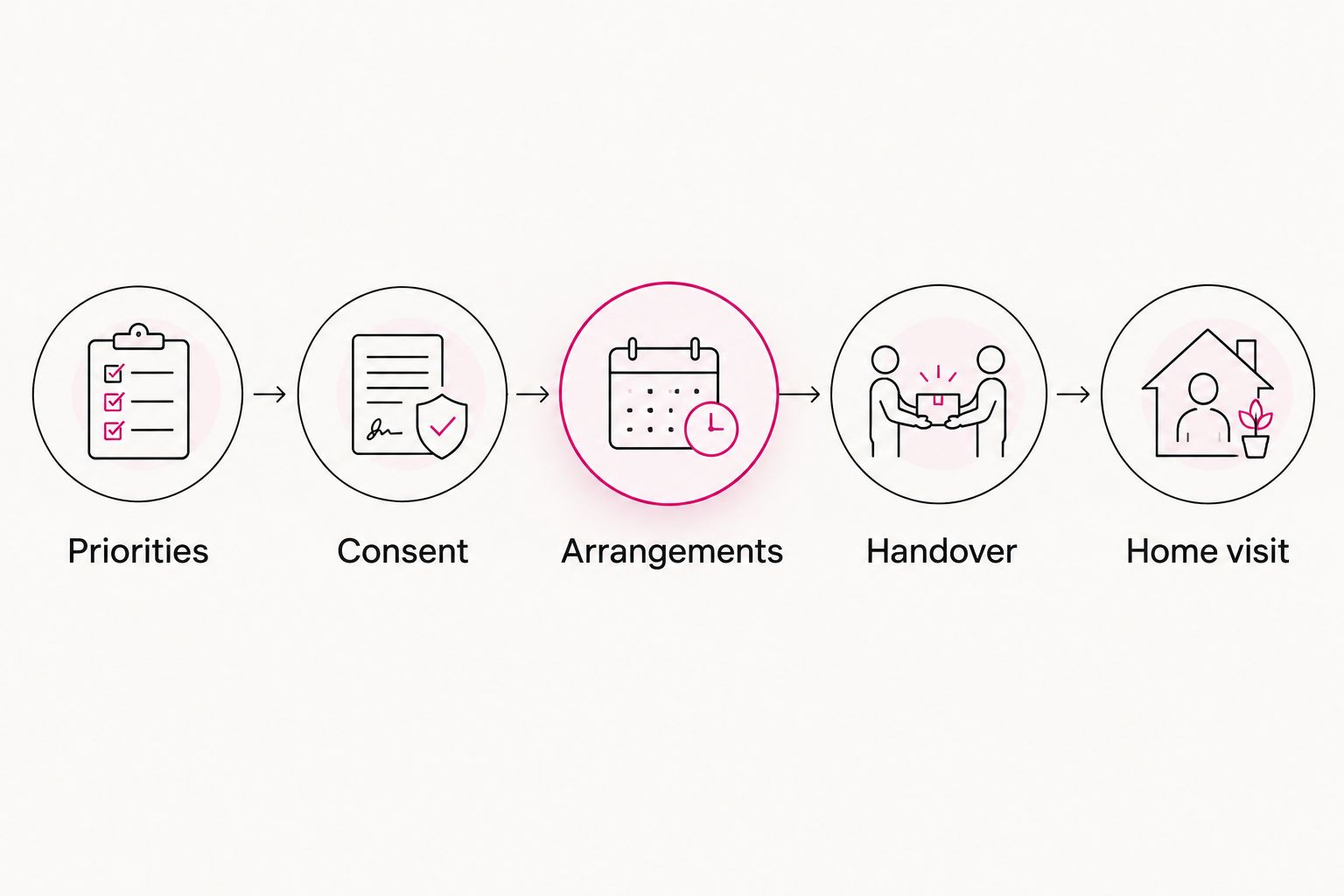
The referral sequence is straightforward: establish priorities, confirm consent, check arrangements, provide a handover and prepare the visit. Keep those decisions visible in your referral record so another coordinator can understand what has already been agreed.
6. Agree on follow-up before closing the referral
Ask how the participant wants recommendations communicated after the assessment. A support coordinator might need an agreed summary to help organise supports, while the participant needs information they can understand and use. Those needs are related, but they are not identical.
Distinguish an appointment summary, ongoing correspondence and a formal report. Ask what is being requested and confirm the arrangements rather than treating every document as included. Do not promise a report’s content, timing or purpose on the provider’s behalf.
For a 2026 handover between services, record who is responsible for the next administrative action. That might be confirming another appointment, supplying an agreed document or asking a payment question. Clear ownership prevents an otherwise complete referral from sitting unresolved.
- Confirm who receives agreed follow-up information.
- Ask how recommendations will be explained to the participant.
- Clarify any report request separately.
- Record the next action and its owner.
- Check whether the participant has unanswered questions.
Compare appointment settings before choosing
Choose the setting around the participant’s needs, not the coordinator’s easiest booking route. A home visit and a clinic appointment offer different practical advantages. Neither setting, by itself, establishes clinical suitability or funding eligibility.
The comparison below is a discussion aid for 2026 referrals. Confirm the actual arrangements with each provider rather than assuming every service works the same way.
| Option | Best for | Practical advantage | Key limitation |
|---|---|---|---|
| Foveria Health home physiotherapy with Simon | Participants seeking personal, goal-focused care at home in Greater Sydney | Assessment and treatment take place in the participant’s home | Suitability, appointment arrangements and payment requirements need direct confirmation |
| Clinic-based physiotherapy | Participants who prefer attending a clinic | Keeps appointments outside the home | Requires travel and does not place the appointment in the participant’s home environment |
| Telehealth physiotherapy | Participants seeking a remote discussion or review, where the clinician considers it suitable | Does not require travel or a home visitor | Does not allow hands-on assessment or treatment; confirm suitability and provider arrangements |
A participant’s preference can also change. Someone who previously attended a clinic might now want to discuss home appointments, while another person might value leaving home for care. Ask again rather than carrying an old preference into a new referral.
Common mistakes support coordinators make
Sending a diagnosis without a referral question
A diagnosis provides context but does not explain what the participant wants from the appointment. Add a plain-language reason for referral and their current priorities. Leave treatment selection to the physiotherapist’s assessment and discussion with the participant.
Treating plan management as booking approval
Knowing who manages a plan does not settle every payment question. Confirm the proposed service and administrative requirements with the relevant parties before making commitments. Keep unresolved questions visible rather than describing the appointment as approved.
Making family the default decision-maker
A family member can be a valuable source of support without being the participant’s preferred contact for every issue. Ask the participant how they want family involved and record that choice. Revisit the arrangement when circumstances change.
Requesting a report without defining its purpose
A vague request for an NDIS report leaves the provider and participant unclear about what is needed. Explain the intended purpose, recipient and requested timing, then confirm the documentation arrangements. Do not assume a routine appointment summary serves every reporting purpose.
Booking before checking home access
An address alone does not explain entry arrangements, stairs, building access or who will be present. Ask about these details early and share relevant information with consent. Confirm what the practice needs rather than assuming every home visit has the same setup requirements.
Keep the participant visible in professional referrals
A useful professional referral should make sense to the participant as well as the receiving practice. Before sending it, read the summary back or offer it in the participant’s preferred format. Check that it reflects their priorities rather than only the service system’s language.
Keep 2 contact roles distinct where they exist: the person arranging the appointment and the person handling payment administration. They can be the same person, but do not assume that. Clear role labels reduce unnecessary sharing of personal information and help direct questions appropriately.
For your 2026 referral template, include a space for unresolved questions. An honest question about suitability or paperwork is more useful than an unsupported assurance. Record the answer when it is confirmed, with enough context for the next person handling the referral.
FAQ
What should I include in an NDIS home physiotherapy referral?
Include the participant’s agreed priorities, reason for referral, suburb, communication preferences and relevant support information. Confirm consent before sharing records, and distinguish the appointment contact from the payment contact where they differ.
Is home physiotherapy better than clinic physiotherapy?
Neither setting is automatically better for every participant. Home appointments take place in the person’s everyday surroundings, while clinic appointments require travel; discuss preferences and clinical suitability with the physiotherapist.
Can I arrange physiotherapy before payment details are confirmed?
Make an initial enquiry, but resolve payment arrangements before committing to a booking. Confirm the proposed service, invoicing process and required documents with the relevant parties rather than assuming funding eligibility.
Does Foveria Health provide NDIS physiotherapy in Sydney?
Foveria Health provides mobile physiotherapy to NDIS clients across Greater Sydney. Discuss the participant’s specific needs, address and appointment arrangements directly with the practice before booking.
Can a support worker or family member attend the home visit?
Discuss attendance with the participant and the practice before the appointment. Record who the participant wants present and what role that person will have, rather than assuming a supporter should attend.
Should I request a particular treatment in the referral?
Describe the participant’s concerns and goals rather than prescribing a treatment technique. Share relevant instructions from existing treating clinicians accurately, and let the physiotherapist assess what is appropriate.
What should I ask about an NDIS physiotherapy report?
Explain the report’s intended purpose, recipient and requested timing, then confirm the documentation arrangements with the provider. Do not assume a formal report is included in an appointment or that its content can be promised in advance.
One last thing
Before sending a referral, ask the participant: what would you like Simon to understand before he arrives? This invitation can bring out a preference that a standard form misses, such as wanting more time to explain concerns or having a trusted supporter nearby.
Keep that answer near the top of the handover. A well-organised referral should help the participant feel heard, not simply move their paperwork to the next service.