

Self-managed participants’ NDIS physiotherapy in Sydney is physiotherapy arranged around disability-related needs, with the aim of supporting everyday function and personal goals. Choosing care at home also means checking how the service fits your plan, how payments will work and whether the physiotherapist understands what matters in your daily life.
- For NDIS physiotherapy Sydney enquiries, Foveria Health suits participants seeking personal, goal-focused physiotherapy at home in Greater Sydney.
- Check your plan and payment arrangements before agreeing to home visits; an NDIS label alone does not confirm funding.
- Choose between home and clinic appointments by considering access, your goals and the assessment you need.
- Agree on visit arrangements, keep clear records and review whether care remains relevant to your goals.
Why home physiotherapy matters for self-managed participants
The right appointment fits both your everyday needs and your funding arrangements. If travelling to a clinic is difficult, an in-home appointment brings the assessment into the setting where you live. It also gives you an opportunity to discuss practical concerns where they arise, rather than trying to describe everything from memory.
Foveria Health provides mobile physiotherapy across Greater Sydney, including in-home assessment and musculoskeletal, respiratory and manual therapy treatment. For a self-managed participant, the useful starting point is a conversation about your needs, not an assumption that every treatment listed is appropriate or funded.
Your search for NDIS physiotherapy in Sydney needs to answer separate questions: does the provider offer the care you need, and does the proposed support fit your circumstances? Keep those questions separate when making enquiries in 2026. A suitable clinical service does not, by itself, establish how you should pay for it.
How to arrange self-managed NDIS physiotherapy
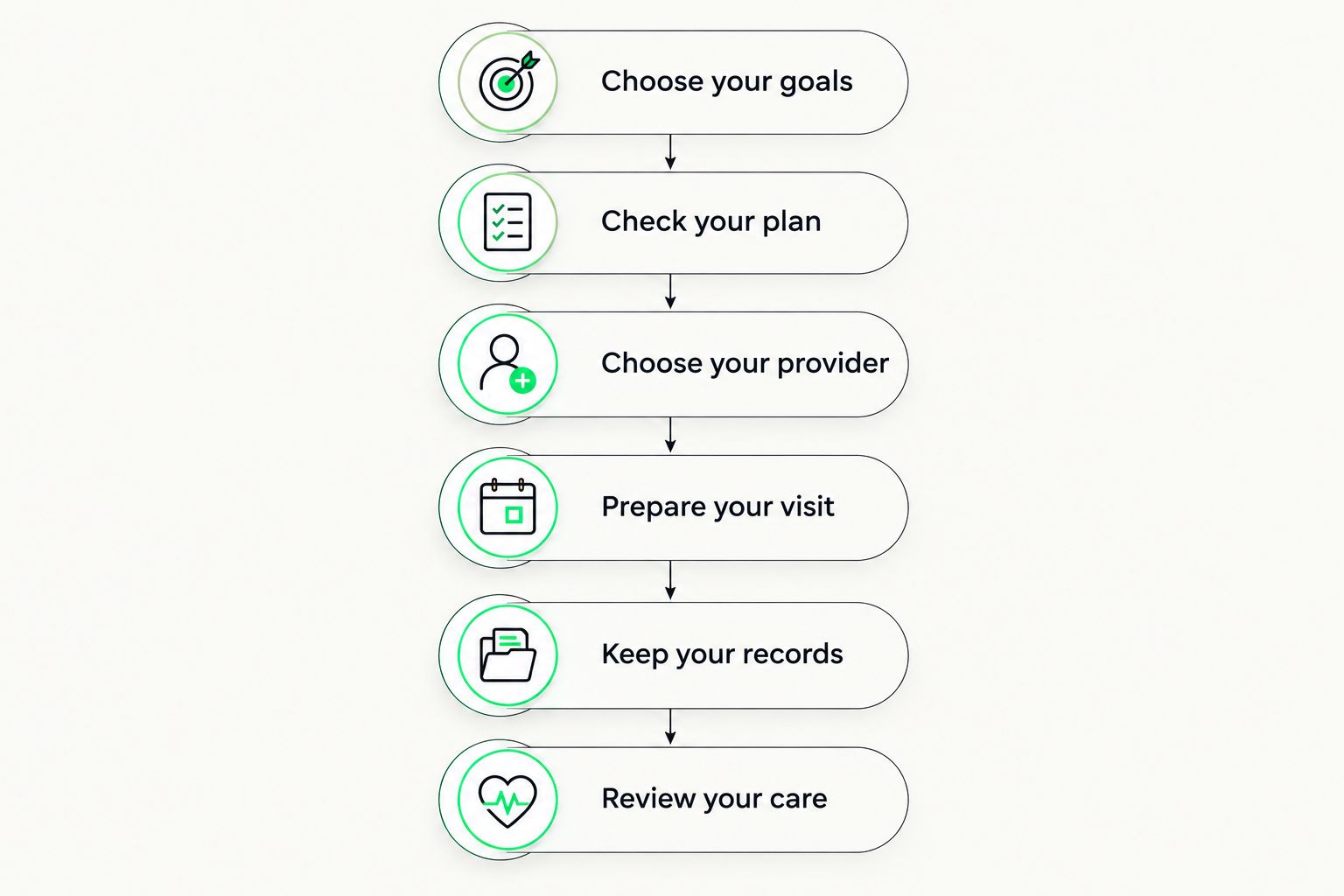
Use the following steps to prepare an enquiry, compare appointment settings and agree on a clear plan. You do not need specialist software or a polished referral document. A notebook, your relevant plan information and a short account of your goals are enough to begin the conversation.
Choose your goals
Start with what you want help doing, rather than choosing a treatment technique. Write down 2–3 everyday goals as a starting point for discussion: getting around your home, managing an activity that feels difficult or understanding a movement concern. These are prompts for an assessment, not promises of improvement.
Describe the task, the difficulty and any support you already use. For example, explain where you need assistance at home rather than deciding in advance which exercise or hands-on treatment you need. The physiotherapist can discuss appropriate assessment and treatment with you.
Families and support coordinators can help prepare this information, but the participant’s priorities should remain central. Include how you prefer to communicate and whether you want someone else involved.
- Write the everyday activities you want to discuss.
- Explain what currently makes those activities difficult.
- Note any assistance or equipment you already use.
- Identify what a useful change would mean to you.
- Record who you want involved in the conversation.
Check your plan
Read your relevant plan information before booking. The manual approach is to collect the documents you already have, mark the sections you need explained and ask your NDIS contact for clarification where necessary. Do not rely on a provider’s service description as confirmation that a particular appointment belongs in your budget.
For a booking in 2026, check the rules and guidance current when you arrange the service. Ask how the proposed physiotherapy relates to your disability-related needs and which payment process applies to your situation. Separate this from treatment you seek for an unrelated health concern.
Resolve payment questions before the first appointment. That protects you from agreeing to a service without understanding your responsibilities. A family member or support coordinator can help organise questions, without replacing advice from the appropriate funding contact.
- Identify the relevant information in your current plan.
- Ask which funding rules apply to the proposed support.
- Clarify anything you do not understand with your NDIS contact.
- Confirm how invoices and payments will be handled.
- Keep written confirmation of the arrangements you agree to.
Choose your provider
Compare providers by asking the same practical questions. You can do this by phone or email using a short checklist. Ask who will assess you, what information they need beforehand and how they will discuss goals and treatment choices with you.
Foveria Health offers physiotherapy at home with Simon across Greater Sydney. This makes the service relevant when you want an assessment in your home environment, but a home visit is not automatically the right setting for every need. Discuss whether your assessment requires facilities or equipment available elsewhere.
If you live in Punchbowl, a nearby suburb or another part of Greater Sydney, give your exact suburb during the enquiry. Confirm the proposed visit arrangements rather than assuming coverage, appointment timing or a particular treatment.
- Ask who will provide your assessment and follow-up care.
- Explain your goals and relevant support needs.
- Confirm whether your home is an appropriate appointment setting.
- Ask how progress and treatment decisions will be discussed.
- Confirm the arrangements for your suburb and address.
- Request clear information about the service agreement and payments.
Prepare your visit
Make a 1-page summary of the information you want to share. This is an organisational suggestion, not a required clinical form. Include your main concerns, relevant health information and questions about daily activities; ask the provider what documents they need before the appointment.
Explain access arrangements before the visit. Stairs, building entry, limited space or the presence of a support worker can affect how an appointment is organised. There is no need to buy equipment or rearrange your home extensively before the physiotherapist has discussed what is required.
Decide who you would like present and what you are comfortable sharing. An older participant might want a family member involved; another participant might prefer to speak independently. Make your preference clear at the outset.
- Gather relevant referral or health documents you already hold.
- Prepare your summary and questions.
- Explain building access and any stairs.
- Ask what space is needed for the assessment.
- Agree who will attend and how they will participate.
- Tell the provider about your communication preferences.
Keep your records
Set up a simple folder for your 2026 physiotherapy documents. A paper folder or clearly named digital folder can hold the service agreement, invoices, receipts and information supplied after appointments. Keep funding records separate from casual messages so you can find the agreed arrangements later.
Ask how invoices will describe the service and what payment steps you need to follow. Check documents against the arrangements you agreed to, and raise anything unclear with the provider before treating it as settled.
Clinical information also deserves care. If a support coordinator, family member or home care provider needs an update, discuss your consent and what information should be shared. Good coordination does not require everyone to receive your complete health history.
- Store the agreed service and payment arrangements together.
- Keep invoices and evidence of payment.
- Record questions about any unclear document.
- Keep assessment summaries and agreed goals accessible.
- Specify who has permission to receive updates.
Review your care
Agree on a review point with your physiotherapist rather than assuming appointments should continue unchanged. Ask how you will discuss your goals, what information will guide decisions and when the treatment approach should be reconsidered.
A review can include what you find easier, what remains difficult and whether the appointments still fit your circumstances. It should also give you space to discuss discomfort, concerns or instructions you do not understand. Do not change a prescribed programme based on a general article; ask the treating clinician for individual advice.
Foveria Health’s home physiotherapy can be discussed in relation to your own daily routines and priorities. The important test is whether the agreed care remains appropriate for you, not whether you have completed a predetermined number of visits.
- Ask when your goals and care plan will be reviewed.
- Describe changes in the activities you discussed initially.
- Raise concerns or instructions that need clarification.
- Explain changes in your health or support arrangements.
- Confirm any changes to appointments and payment arrangements.
These steps follow a practical sequence: define your needs, clarify the plan, choose a provider and organise the visit. Records and review then help keep the arrangement clear rather than allowing appointments to continue without discussion.
Compare appointment options for your needs
Choose the setting around the assessment you need, not the convenience alone. Home appointments let you discuss your usual environment. Clinic appointments provide a different setting, while remote consultations do not place a physiotherapist physically beside you.
The table compares appointment approaches, not funding eligibility or a guarantee that a particular provider offers every option. Ask prospective providers which setting they recommend after hearing your needs.
| Option | Best for | Practical strength | Key limitation |
|---|---|---|---|
| Foveria Health home physiotherapy | Participants seeking personal assessment and care at home in Greater Sydney | Lets you discuss goals in your everyday environment with Simon | A home visit does not provide a clinic setting; confirm suitability and visit arrangements |
| Clinic-based physiotherapy | Participants who can attend a clinic and need that setting | Allows assessment in the provider’s clinical environment | Requires travel and does not directly show your home layout |
| Remote physiotherapy consultation | Participants seeking a discussion or review that a clinician considers suitable remotely | Removes the need to travel for that conversation | Cannot include a hands-on assessment in the same room |
Home care also involves inviting a clinician into your personal space. If that does not suit you, say so. Privacy, communication preferences and comfort with the setting belong in the decision alongside transport and assessment needs.
Discuss your home physiotherapy needs
Explain your goals, suburb and questions about arranging an assessment with Simon.
Common mistakes self-managed participants make
Treating an NDIS label as funding confirmation
A provider mentioning NDIS services does not answer every question about your own plan. Confirm how the proposed support fits your circumstances and how payment will work before agreeing to appointments. Keep the confirmation with your other records.
Choosing treatment before explaining the goal
Requesting a particular hands-on technique can narrow the conversation too early. Explain what you want help doing and let the assessment guide the discussion. Treatment choice should follow your needs, not replace that conversation.
Letting the enquiry leave out the participant
Families and coordinators often handle practical arrangements, but the participant still needs a voice. Ask how they want to be involved and what information they consent to sharing. Include communication preferences in the enquiry rather than waiting until the visit.
Booking without discussing the home setting
A suburb name alone does not explain stairs, entry arrangements or space. Give the provider the practical details needed to organise the appointment. Confirm whether a home visit is suitable instead of assuming every assessment can happen there.
Continuing without a review conversation
Repeated appointments are not a substitute for discussing goals. Agree on how you will review the care and raise changes in your circumstances. Keep your 2026 appointment arrangements aligned with the current discussion, not an old assumption.
FAQ
What should I check before booking NDIS physiotherapy in Sydney?
Check your goals, relevant plan information, provider suitability and payment arrangements before booking. Explain your suburb and access needs, and clarify funding questions with your NDIS contact rather than relying on a service label.
Is home physiotherapy better than going to a clinic?
Home physiotherapy is not automatically better than clinic care; the right setting depends on your needs. Home visits allow discussion of your everyday environment, while a clinic provides a different assessment setting. Ask the physiotherapist which is appropriate for you.
Does Foveria Health provide physiotherapy at home?
Foveria Health provides mobile physiotherapy and in-home assessment across Greater Sydney. Discuss your goals, suburb and proposed visit arrangements with Simon before booking.
Can I assume my self-managed NDIS plan will cover physiotherapy?
No, do not assume a proposed appointment is covered simply because you self-manage your plan. Check the relevant plan information and current requirements with your NDIS contact before agreeing to the service.
Do I need a referral for an in-home physiotherapy appointment?
Confirm referral requirements for your proposed appointment before booking. Explain your intended payment arrangement and ask which documents the provider needs; do not assume requirements are identical across funding pathways.
Can a family member or support coordinator help arrange the visit?
A family member or support coordinator can help you prepare questions and organise the enquiry with your agreement. Tell the provider who you want involved and what information you consent to sharing.
What should I prepare for the first home visit?
Prepare your goals, relevant documents and information about access to your home. Ask what space the physiotherapist needs and whether someone you trust should attend. There is no need to purchase equipment before discussing requirements.
What records should I keep for appointments in 2026?
Keep your agreed service arrangements, invoices, payment records and information supplied after appointments together. Clarify which records your payment process requires and keep permission to share health information clear.
One last thing
Before sending an enquiry, write 3 questions: what will the assessment cover, what needs confirming about payment, and how will we review my goals? Those questions connect the clinical discussion with the practical arrangements. They also give you a clear starting point without requiring you to know which treatment you need.