

Stroke survivors’ home physiotherapy is assessment and movement rehabilitation in your own surroundings, aimed at supporting everyday activities after a stroke. Physiotherapy for stroke recovery at home needs to account for changes in movement, fatigue, communication and the support you have available—not just provide an exercise sheet.
- Physiotherapy for stroke recovery at home should follow an individual assessment, not a generic exercise routine.
- Foveria Health provides mobile physiotherapy across Greater Sydney; discuss your stroke rehabilitation needs before booking.
- Choose home rehabilitation, outpatient care or a combination according to your clinical needs and rehabilitation team's advice.
- New stroke symptoms are an emergency: call 000 rather than waiting for a physiotherapy appointment.
Why home physiotherapy matters for stroke survivors
Home physiotherapy connects rehabilitation with the places where you need to move: your bed, favourite chair, hallway and front entrance. A clinic assessment and a home assessment offer different information; the home visit shows the demands of your actual surroundings.
Getting to appointments also involves more than travel. Families often need to coordinate transport, personal care, communication support and rest around the visit.
Foveria Health mobile physiotherapy suits Greater Sydney clients seeking assessment and treatment in their own homes. For stroke recovery specifically, ask whether Simon can meet your rehabilitation needs and coordinate with your existing team. An in-home service is not automatically a specialist stroke rehabilitation service.
You can learn about Foveria Health before making an enquiry. Use this 2026 guide to prepare your questions, rather than to choose exercises without an assessment.
How to arrange physiotherapy for stroke recovery at home
1. Start with your discharge and rehabilitation advice
Begin with the information you already have. Your hospital discharge summary, rehabilitation recommendations and current care plan help explain what has happened and what support is needed next.
If you are already home, write down what has changed since discharge. Describe the activity rather than trying to name the problem: getting out of bed, standing at the sink or reaching the front door.
Home physiotherapy should fit into your rehabilitation plan, not quietly replace follow-up with your medical or rehabilitation team. Ask that team which setting and level of support suit your current needs, particularly when you require hands-on assistance.
For your 2026 appointment summary, keep the essential information on 1 page, with supporting documents attached. This is an organising suggestion, not a clinical requirement.
- Gather your discharge summary and rehabilitation recommendations.
- List current medicines and relevant medical conditions.
- Record equipment and assistance already recommended.
- Note recent falls, near falls or changes in function.
- Identify who can clarify the existing rehabilitation plan.
2. Choose goals that matter in your daily life
Start by describing what you want to do more easily. A goal such as getting from your bedroom to the dining table gives a physiotherapist more practical information than simply wanting stronger legs.
Stroke affects people differently. Assessment needs to consider your movement alongside fatigue, understanding, vision, sensation and confidence where relevant. Some concerns also need input from other health professionals.
You can prepare your goals yourself or with someone you trust. If writing is difficult, use spoken notes, pictures or a familiar support person. You should still have the opportunity to express your preferences.
Bring 2 priority activities to the first discussion so your main concerns are clear. Simon can then discuss whether Foveria Health’s home physiotherapy service is an appropriate fit; suitability comes before booking a course of treatment.
- Name an activity you want to work towards.
- Explain what currently makes that activity difficult.
- Describe the help you receive during it.
- Tell the physiotherapist what matters most to you.
- Ask how progress towards the activity will be reviewed.
3. Check the service matches your rehabilitation needs
Use a short phone or written enquiry before arranging a visit. Explain that the appointment concerns stroke recovery, your suburb, and the help you currently need with moving around.
Ask about experience with people whose needs resemble yours. The important question is not simply whether a provider offers home visits, but whether the provider can assess and support your particular situation.
Foveria Health offers assessment and treatment at home across Greater Sydney. If you live in Punchbowl or a nearby suburb, include that in your enquiry; clients elsewhere in Greater Sydney should also confirm arrangements for their address. Do not assume appointment availability or stroke-specific expertise from general service coverage.
The guide to preparing for your first physiotherapy visit at home can help organise the practical details.
- Describe your stroke-related movement concerns.
- Explain whether you need another person to assist.
- Ask whether your needs fit the clinician’s experience.
- Confirm address, access and appointment arrangements.
- Explain any communication or interpreter requirements.
- Ask what records to provide before the visit.
4. Prepare the people, space and information
You do not need to turn your home into a treatment room. Ask what space is needed and explain any access difficulties before the appointment.
Keep your usual walking aid and relevant equipment accessible. Do not rearrange everything to make the home look easier to manage: the physiotherapist needs to understand the environment you actually use. Tell the clinician about hazards rather than attempting a risky task to demonstrate them.
With your consent, a family member or support worker can help explain daily routines and hear recommendations. Their role is to support your participation, not answer every question on your behalf.
For a clear handover in 2026, nominate 1 main contact if several relatives or services are involved. Confirm what information you consent to sharing and with whom.
- Provide entry instructions and any access concerns.
- Have existing equipment and relevant records nearby.
- Arrange your preferred communication support.
- Identify who you want present during the assessment.
- Tell the clinician about fatigue and usual rest times.
5. Agree on a plan you can understand
An assessment should lead to an explanation of the main findings and the proposed next steps. Ask what each activity is intended to help, what assistance is needed and how the plan will be reviewed.
Home-based rehabilitation can involve practising meaningful tasks, but the choice and difficulty of those tasks must match your assessment. There is no single exercise routine suitable for every stroke survivor. A plan that suits someone else is not a safe substitute for your own instructions.
Family members should receive clear guidance before helping with physical practice. If you do not understand how to assist, ask for a demonstration rather than improvising. Do not pull on an affected arm to help someone move.
Ask for instructions in a format you can use between visits, including clear advice about when to stop and whom to contact.
- Ask what each prescribed activity is working towards.
- Confirm the assistance or supervision required.
- Request written or accessible instructions.
- Clarify what to do if an activity causes difficulty.
- Agree how changes will be communicated.
6. Review progress and coordinate the wider team
Keep a simple record of what happens during everyday activities. Useful observations include the assistance you needed, a task that became harder or fatigue that interrupted practice. You do not need to create your own clinical scoring system.
Bring those observations to review appointments. A change in the plan should follow reassessment, not pressure to keep increasing the difficulty. Recovery does not follow a guaranteed timetable.
Physiotherapy is only part of stroke rehabilitation. Occupational therapy, speech pathology, nursing, medical care and other services can have separate roles. Ask who is responsible for concerns outside the physiotherapy plan, including swallowing, communication or medication questions.
For a 2026 care review, check that everyone is working from current instructions rather than an old discharge sheet.
- Record changes in everyday tasks and assistance needs.
- Report falls, pain or unexpected deterioration promptly.
- Ask when the physiotherapy plan needs reassessment.
- Share agreed updates with consent.
- Clarify who manages concerns outside physiotherapy.
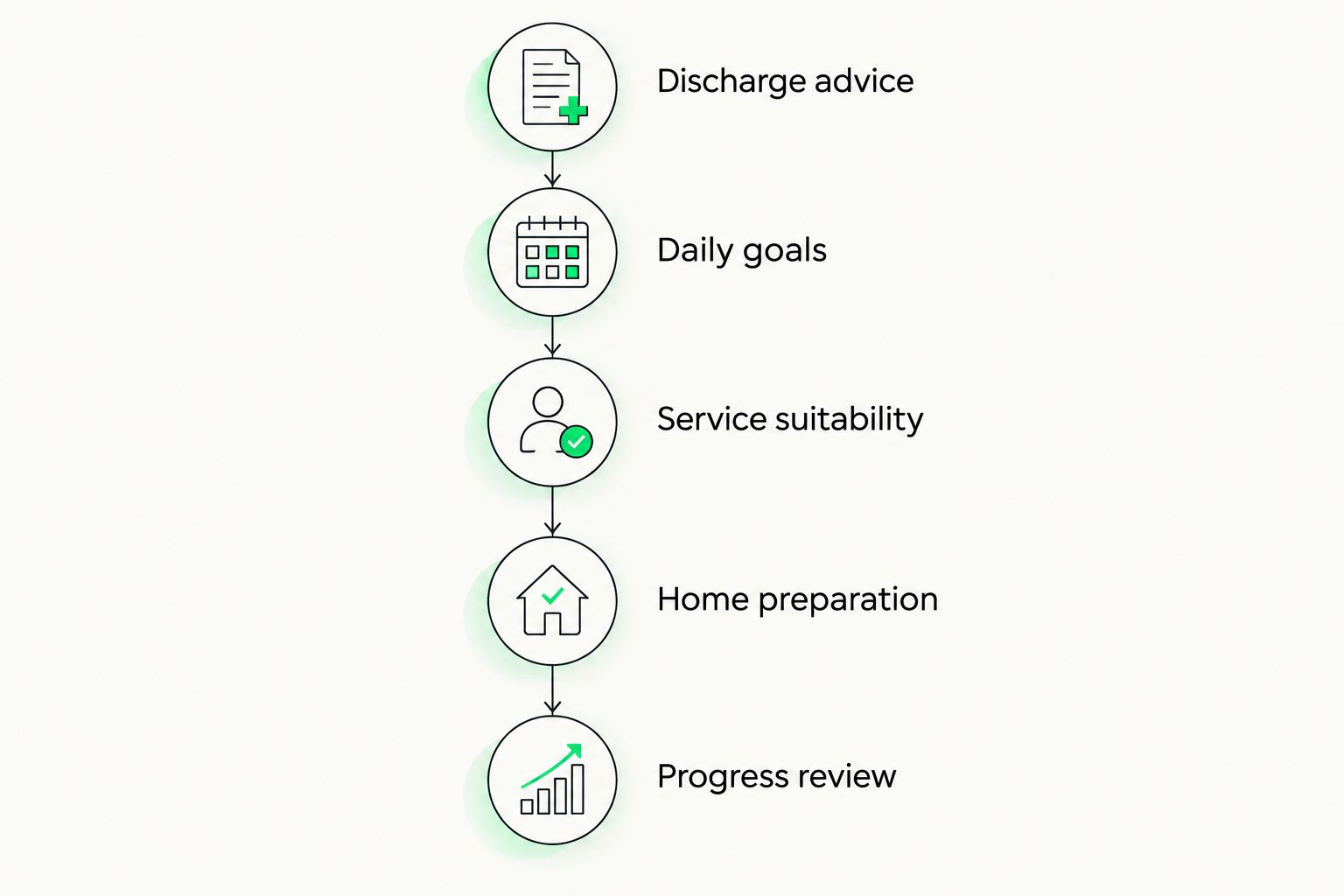
The process is easier to follow when each decision has a clear purpose: understand the existing plan, identify meaningful goals, check suitability, then review what happens at home.
Compare rehabilitation options after a stroke
Choose the setting around your needs, not convenience alone. Home visits show everyday surroundings, while a rehabilitation service can offer facilities or coordinated care that are not available in a home appointment. Your treating team can help judge the appropriate balance.
| Option | Best for | Main advantage | Key limitation |
|---|---|---|---|
| Mobile physiotherapy at home | People needing assessment in their own surroundings | Connects movement assessment with actual household tasks | Facilities and equipment differ from a rehabilitation centre; check stroke experience |
| Outpatient rehabilitation | People whose plan calls for clinic-based rehabilitation | Provides access to the service’s clinical setting and resources | Requires travel and coordination around appointments |
| A coordinated combination | People whose team recommends both home and clinic input | Allows different settings to address different needs | Requires clear communication to avoid conflicting instructions |
| Clinician-prescribed practice between visits | People assessed as suitable for practice with the specified support | Gives a clear role to activity between appointments | Does not replace assessment, supervision or clinical review |
Ask who will coordinate the plan if you use more than one service. Several providers are not automatically better than a smaller, well-coordinated team.
Check referrals and funding before committing
Do not assume a stroke diagnosis makes a particular appointment eligible for funding. The relevant pathway, documentation and payment arrangements need to be checked for your circumstances.
For a 2026 enquiry, explain whether you are arranging private care or asking about Medicare, NDIS or aged care arrangements. Foveria Health’s stated client groups include these groups, but that does not establish eligibility for your proposed treatment.
Self-managed and plan-managed NDIS participants should confirm arrangements with the provider and relevant plan contact before proceeding. Home care providers and support coordinators should obtain consent before sending personal information.
- Ask whether a referral is needed for your proposed arrangement.
- Confirm who must approve the service before it begins.
- Request the service agreement and cancellation terms.
- Clarify who receives invoices and clinical updates.
- Ask what happens if the funding arrangement changes.
Common mistakes families make after stroke
Choosing exercises before checking suitability
A video cannot assess your balance, assistance needs or understanding of instructions. Ask for an individual plan before trying unfamiliar exercises, particularly standing or walking activities.
Treating every movement difficulty as a strength problem
Fatigue, altered sensation, vision and attention can affect how someone moves after stroke. Describe what you observe and let the assessment guide the response rather than simply adding more exercise.
Giving support workers unclear instructions
A note saying to practise walking does not explain the required assistance or stopping points. Ask for practical instructions that match each support person’s role and training.
Booking without checking stroke-related experience
Mobile physiotherapy describes where care happens, not a clinician’s specialist credentials. Ask about suitability directly and accept referral to a more appropriate service when necessary.
Overlooking the person’s preferences
A family’s priorities and a stroke survivor’s priorities are not always identical. Include the person in decisions using the communication support they need, and confirm consent before involving others.
FAQ
Is physiotherapy for stroke recovery at home suitable for everyone?
Home physiotherapy is not suitable for every rehabilitation need. Your treating team and prospective physiotherapist should assess whether home care, clinic care or a combination fits your situation.
What exercises should I do at home after a stroke?
Use exercises prescribed for you after an individual assessment. Stroke can affect movement, sensation, vision and attention differently, so a generic routine cannot establish what assistance or supervision you need.
Can a family member attend a home stroke physiotherapy appointment?
You can ask for a family member or support person to attend with your consent. Explain the role you want them to have and request clear guidance before they help with physical practice.
Does Foveria Health provide specialist stroke rehabilitation?
Foveria Health’s supplied service information confirms mobile physiotherapy, not specialist stroke rehabilitation credentials. Ask Simon whether your stroke-related needs fit his experience and whether coordination with another rehabilitation service is needed.
Can Medicare, NDIS or aged care funding cover home stroke physiotherapy?
Funding must be confirmed for your individual circumstances before treatment is arranged. Ask the provider and relevant funding contact about documentation, approval and payment arrangements rather than assuming coverage.
How long does stroke recovery take with home physiotherapy?
There is no guaranteed recovery timetable. Agree on meaningful goals with your rehabilitation team and review changes in everyday function rather than relying on a promised number of visits.
What should I do if new stroke symptoms appear at home?
Call 000 immediately for suspected stroke, including sudden facial drooping, arm weakness or speech difficulty. Do not wait for a physiotherapy visit, even if the symptoms improve.
One last thing
The most useful appointment question is often: what should happen between visits? Before the physiotherapist leaves, make sure you understand what you can practise, what help you need and what changes require advice. A clear plan should support you and the people helping you—not leave anyone guessing.