

NDIS plan managers’ physiotherapy coordination is the practical work of arranging assessment and treatment with the aim of supporting a participant’s goals while keeping consent, service details and payment arrangements clear. This guide to NDIS physiotherapy for plan managers focuses on home visits in Greater Sydney, where you need to consider both the participant’s preferences and the practical arrangements at their address.
- Foveria Health suits NDIS participants seeking mobile physiotherapy at home in Greater Sydney.
- NDIS physiotherapy for plan managers starts with participant choice, clear consent and an agreed referral pathway.
- Confirm service terms and payment arrangements before booking; a referral does not confirm funding.
- Keep clinical decisions with the physiotherapist and financial administration with the agreed contacts.
Why home physiotherapy matters for plan managers
A home visit removes the need to travel to a clinic for that appointment. It also places the assessment in the setting where a participant carries out everyday activities, rather than asking everyone to describe that setting from memory.
For a plan manager, however, arranging a visit involves more than finding a physiotherapist. You need a clear handover between the participant, their chosen supports, the provider and the person handling invoices. Unclear responsibilities leave families repeating information and providers chasing answers.
Foveria Health provides mobile physiotherapy assessment and treatment across Greater Sydney, including care for NDIS participants. The service suits participants seeking physiotherapy at home; suitability for an individual referral still needs discussion with Simon.
For your 2026 referral process, keep the participant’s preferences separate from assumptions about funding. Someone wanting home physiotherapy does not, by itself, establish how the service will be paid for.
Arrange a clear referral in 6 steps
Start with a simple written checklist or secure referral template. A separate platform is not a prerequisite: the useful information is the same whether your team uses a document, an approved form or its existing client system.
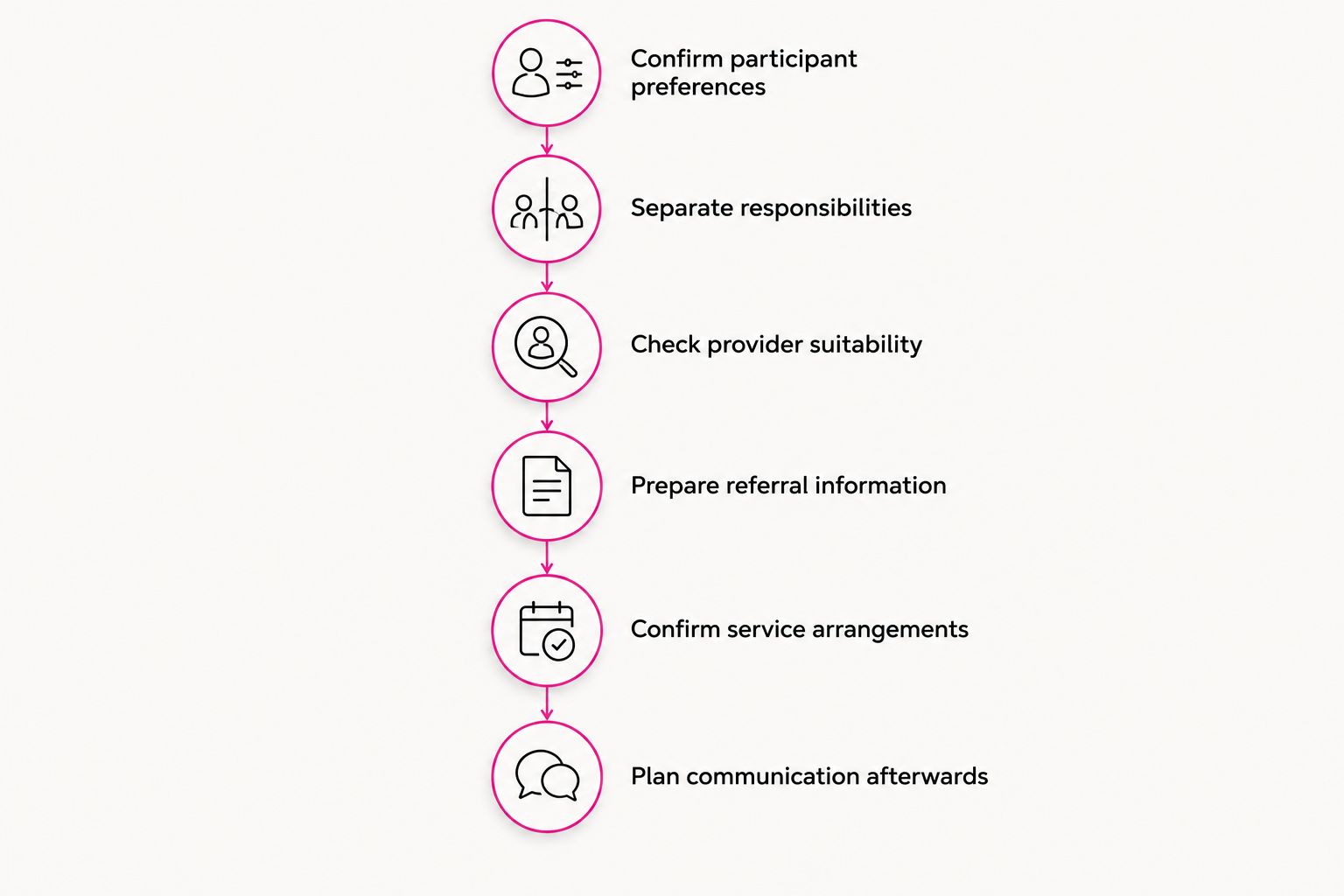
The following 6 steps keep participant choice, clinical information and financial administration distinct. Work through them before treating a booking as settled.
Confirm participant preferences
Begin with the participant, not the invoice process. Ask what they want help with, whether they want a home visit and who they want involved in arranging it. A family member’s enthusiasm does not replace the participant’s own preferences or the appropriate consent arrangements.
Write the goal in everyday language. For example, a participant might want help understanding difficulty getting out of a chair or moving around their home. Record that as their concern, not as a diagnosis or a promised treatment outcome.
If another person communicates on the participant’s behalf, clarify that person’s role and how the participant’s choices will be represented. Do not assume the person copied into an email can make every decision.
- Record the participant’s preferred name and contact method.
- Ask whether home assessment is their preferred setting.
- Note what they want the appointment to address.
- Identify any communication or accessibility preferences.
- Confirm who they want involved in booking discussions.
Separate responsibilities
Use a short responsibility list before sending the referral. The plan manager’s administrative involvement is different from the physiotherapist’s clinical role, and a support coordinator or family member might have a separate part in organising the appointment.
For your 2026 workflow, distinguish booking contact, clinical contact and invoice contact. These are 3 contact roles, not necessarily 3 different people. Naming them prevents an invoice question from landing with someone who cannot answer it.
Keep clinical decisions with the treating professional and the participant. Your referral can describe concerns and goals without selecting treatment techniques or prescribing a schedule. If someone asks you whether a particular treatment is appropriate, direct that question to the physiotherapist.
- Name the person authorised to arrange the appointment.
- Identify the contact for questions about relevant health information.
- Confirm the correct recipient for invoices.
- Clarify the support coordinator’s role, if involved.
- Record who will respond when arrangements change.
Check provider suitability
Create a shortlist manually using the participant’s preferences, location and stated needs. Ask providers direct questions rather than relying on a broad description such as mobile physiotherapy. A service’s general scope does not establish that it fits every referral.
Foveria Health offers in-home assessment and treatment, with personal, goal-focused care at home with Simon. Share the participant’s suburb and main concerns, then ask whether the proposed referral fits the service. This is the point to discuss a specific provider—not before you understand what the participant wants.
Use the guide to choosing mobile physiotherapy in Sydney to structure your questions. For Punchbowl, nearby suburbs and other Greater Sydney addresses, confirm the particular visit arrangements directly rather than assuming they are identical across locations.
- Give the suburb and relevant property access details.
- Describe the participant’s main goals in plain language.
- Ask about experience relevant to those needs.
- Explain communication and support requirements.
- Ask what information is needed before accepting the referral.
Prepare referral information
Use a concise referral summary rather than forwarding an entire email history. Start with information the participant has agreed can be shared, and use an appropriate secure channel. Keep financial details separate from clinical documents where your process allows.
Relevant background helps the physiotherapist prepare, but more information is not automatically more useful. Describe the reason for referral, current concerns and any existing professional instructions that relate to the appointment. Let the physiotherapist identify what further clinical information is needed.
For a 2026 referral, check that contact details and attached documents are current. Label older information clearly rather than presenting it as the participant’s present situation. Avoid copying sensitive information into a large email group simply because everyone has been involved previously.
- Include the reason for referral and the participant’s stated goals.
- Document the agreed information-sharing arrangements.
- Provide current booking and support contacts.
- Include relevant existing reports when appropriately authorised.
- Note access needs, pets or other practical visit considerations.
Confirm service arrangements
Ask for the proposed service arrangements in writing before confirming a booking. Read them alongside the participant’s preferences and your payment administration requirements. A clear agreement is more useful than an informal assurance that everything will be sorted out later.
Keep 3 checks separate: what is proposed, what the participant agrees to, and how payment will be handled. Do not treat a referral, a diagnosis or a provider’s willingness to visit as confirmation that a particular expense can be paid from a participant’s plan.
Discuss fees and any additional charges directly with the provider, without relying on figures copied from another participant’s arrangements. Confirm questions about the particular plan through the appropriate channels. This guide does not establish funding eligibility or payment approval.
- Request written service terms before proceeding.
- Clarify how travel, cancellations and reports are addressed.
- Confirm the intended invoice recipient and required details.
- Resolve payment questions before representing them as settled.
- Make sure the participant understands the proposed arrangements.
Plan communication afterwards
Agree on communication before the first visit, rather than waiting until someone needs an update. Ask the participant who should receive information and distinguish appointment administration from clinical reporting. A booking confirmation and a clinical report serve different purposes.
For your 2026 records, maintain 1 current contact list rather than several conflicting versions. Record changes when the participant nominates a new contact or their support arrangements change. That small administrative habit reduces avoidable confusion without adding another clinical form.
Ask how follow-up recommendations will be discussed with the participant and what reporting, if any, is proposed. Do not promise a report, its contents or a delivery date on the provider’s behalf. Confirm those details directly, including any associated arrangements.
- Agree who receives appointment confirmations.
- Record who can receive clinical updates.
- Clarify whether a report is being requested.
- Ask how changes to appointments should be communicated.
- Update contacts when the participant’s arrangements change.
The referral sequence is simple: establish preferences, assign responsibilities, check the provider, prepare information, confirm arrangements and agree on communication. Keep the sequence visible so a missing payment detail does not obscure an unresolved consent question.
Compare appointment settings
Choose the setting around the participant’s needs, not administrative convenience alone. Home visits, clinic appointments and video consultations offer different ways to access physiotherapy. The treating provider needs to discuss whether a particular format is appropriate.
The comparison below describes appointment formats, not services all offered by the same practice. Foveria Health’s stated service is mobile physiotherapy; clinic and video options are included to help you discuss alternatives without assuming they are interchangeable.
| Option | Best for | Practical advantage | Key limitation |
|---|---|---|---|
| Mobile physiotherapy at home | Participants who prefer assessment in their home setting | Avoids travel to a clinic and allows discussion of the home environment | Requires agreement on property access, visit arrangements and provider suitability |
| Clinic physiotherapy | Participants who prefer a dedicated clinical setting and can arrange attendance | Separates the appointment from household activity | Requires travel and confirmation that the clinic meets relevant access needs |
| Video physiotherapy | Participants seeking remote consultation where the clinician considers it appropriate | Allows a discussion without an in-person visit | Does not provide hands-on assessment and depends on suitable technology and communication |
A convenient format is not automatically the right clinical format. Ask the provider to explain the proposed approach in language the participant understands, including its limitations.
Common mistakes plan managers make
Treating plan management as clinical approval
Handling payment administration does not establish which assessment or treatment a participant needs. Keep the referral focused on the person’s concerns and preferences, and leave clinical recommendations to the treating professional.
Better approach: ask the provider to explain the proposed service and resolve payment questions separately.
Sending a referral without clear permission
A well-intended introduction can still share more personal information than the participant expected. Existing involvement by a family member or coordinator does not answer every question about who should receive health information.
Better approach: establish the appropriate consent arrangements and share only information relevant to the referral.
Assuming every home visit has identical arrangements
Different addresses involve different access considerations. Stairs, building entry, parking instructions and the presence of a support person all deserve discussion before the visit.
Better approach: confirm the actual address and access needs, rather than copying arrangements from another referral.
Promising appointments or reports for the provider
A family might ask you to confirm a visit or obtain a report quickly. Avoid giving a commitment that the provider has not agreed to, even when the request sounds straightforward.
Better approach: distinguish a requested arrangement from a confirmed arrangement in every handover.
Sharing clinical updates as routine invoice attachments
The people processing an invoice do not automatically need the full clinical discussion. Combining everything into one email makes it harder to control who receives sensitive information.
Better approach: separate invoice handling from clinical information-sharing and follow the agreed permissions.
FAQ
What should a plan manager check before arranging home physiotherapy?
Check the participant’s preferences, consent arrangements, provider suitability and proposed payment process before confirming a booking. Also identify the booking contact, clinical contact and invoice recipient so questions reach the right person.
Does a physiotherapy referral confirm NDIS funding?
No, a referral does not confirm that a particular service can be paid from a participant’s plan. Resolve the proposed service and payment arrangements through the appropriate channels before treating payment as agreed.
Is mobile physiotherapy better than attending a clinic?
Mobile physiotherapy is not automatically better than a clinic appointment; the appropriate setting depends on the participant’s needs and preferences. Home visits avoid clinic travel, while clinic attendance requires suitable transport and access arrangements.
Can a support coordinator help organise the home visit?
A support coordinator can be involved where that matches the participant’s agreed arrangements. Clarify whether they are helping with referrals, bookings or communication rather than assuming they are responsible for every part of the process.
What should I send with a home physiotherapy referral?
Send a concise summary of the participant’s goals, reason for referral, relevant background and agreed contact details. Share reports only through appropriate channels and with the necessary permission.
Can a family member attend the physiotherapy appointment?
Discuss family attendance with the participant and provider before the appointment. Clarify whom the participant wants present and how that person will support communication without taking over the participant’s choices.
How do I enquire about home physiotherapy in Greater Sydney?
Contact Foveria Health with the participant’s suburb, main concerns and preferred contact arrangements. Ask Simon to confirm whether the referral fits the service and what information is needed before a booking is agreed.
One last thing
Ask the participant what a useful appointment would help them understand. That question is different from asking which treatment they want: it leaves room for assessment without asking the person to select a clinical technique.
Add their answer to your 2026 referral checklist in their own words, with permission. A clear personal goal gives everyone a shared starting point while leaving clinical decisions and funding questions in their proper places.