

Home care teams should share the person’s own priorities, current support needs and relevant observations in a concise written referral, with consent to share information. Ask the physiotherapist to translate those priorities into agreed goals after assessment, then confirm who will receive updates and how changes will be communicated.
- Physiotherapy referrals for home care providers should connect the person’s priorities with clear observations and an agreed communication plan.
- Foveria Health provides mobile physiotherapy assessment and treatment at home across Greater Sydney.
- Describe what happens during everyday activities; leave clinical assessment and treatment decisions to the physiotherapist.
- Agree who receives updates, who coordinates support and when the team should review goals.
Why this matters
A referral that says only that someone needs better mobility leaves the physiotherapist without the person’s reason for wanting help. Being able to get to the dining table, use the garden or participate in a family routine gives the discussion a clearer purpose.
Good communication also separates what staff have observed from what still needs assessment. Your team brings knowledge of everyday routines; the physiotherapist brings the clinical assessment needed to discuss appropriate treatment and support.
Use the physiotherapy referrals checklist for home care providers alongside the goal-sharing approach below. For your 2026 referral template, make the person’s priority visible near the beginning rather than burying it in background notes.
How should home care teams share goals with a physiotherapist?
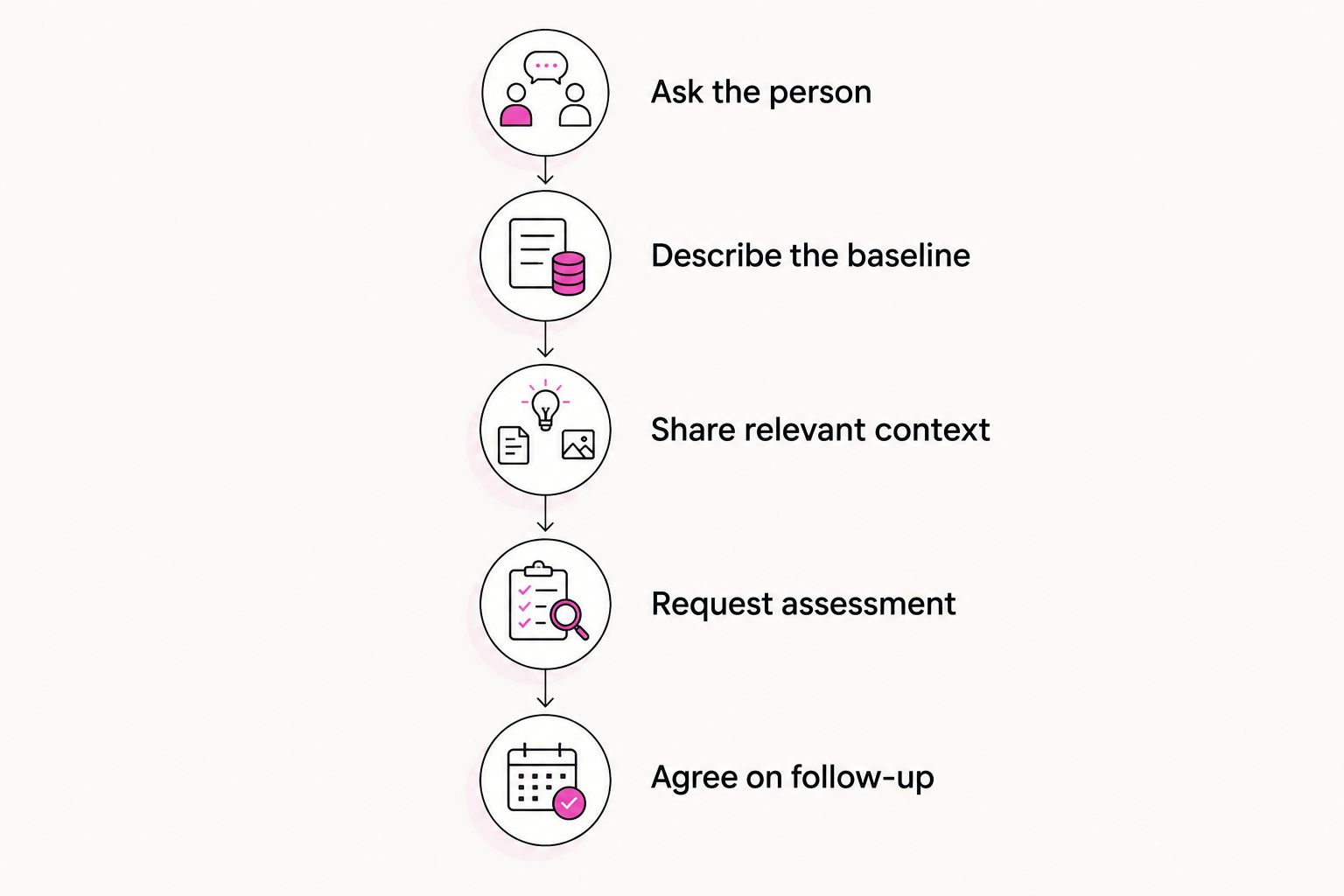
Start with what matters to the person, describe the current situation and request assessment before agreeing on the treatment plan. A useful handover follows this sequence.
- Ask the person. Find out which everyday activity they most want help with. Include their wording where practical, without replacing it with a staff-selected target.
- Describe the baseline. Explain what happens now, including the setting, existing assistance and any changes staff have noticed. Distinguish direct observations from information reported by others.
- Share relevant context. Include the referral reason, relevant care information, communication preferences and practical home-access details. Share information through your organisation’s agreed process and with appropriate consent.
- Request assessment. Explain the desired activity without prescribing an exercise programme or assuming a particular treatment is suitable.
- Agree on follow-up. Nominate a contact person, confirm who can receive information and ask how agreed goals and recommendations will be communicated.
These are communication steps, not a clinical assessment. Your team does not need to decide what causes a movement difficulty before requesting physiotherapy input.
Turn a broad aim into an everyday goal
Broad aims such as improving confidence or independence can start a conversation, but they need context. Ask what confidence or independence would look like during the person’s usual day.
You might identify getting to the front door, joining a household activity or moving between familiar rooms as the priority. These are examples for discussion, not recommendations for a particular person.
Keep the desired activity separate from the support required today. Wanting to do something independently does not establish that doing it without assistance is currently appropriate.
Describe the activity
Name the task and setting. Explain whether the concern occurs around a chair, along a hallway, at an entrance or during another routine, rather than using a broad label such as poor function.
The physiotherapist can then ask more focused questions during assessment. Your referral should describe the situation without deciding what the assessment will find.
Describe current support
State what assistance the person currently receives and who provides it. Identify whether this information comes from a current care document, a staff observation or the person’s own account.
If accounts differ, record that difference rather than choosing the most optimistic description. Uncertainty belongs in the handover so the physiotherapist knows what needs clarification.
Describe what matters
Explain why the activity matters to the person. A goal chosen because it supports a valued routine is different from a task selected solely because it fits the service schedule.
For a 2026 care-plan update, check that an older goal still reflects the person’s wishes. Copying it into a new document does not confirm that it remains their priority.
What should the written handover include?
Keep the main referral readable without requiring the physiotherapist to search through unrelated records. Attach relevant supporting information through an agreed channel, and clearly identify the question you want the assessment to address.
A practical handover includes:
- Person’s priority: the everyday activity they want help with and why it matters.
- Current situation: relevant observations, existing assistance and changes from the usual routine.
- Relevant records: care information that relates to the assessment, with its source and date clear.
- Communication needs: preferred communication approach, interpreter needs or a requested support person.
- Consent and contacts: what information can be shared, with whom, and the nominated coordinating contact.
- Requested response: the assessment question and the information your team needs afterwards.
Avoid sending an entire file simply because it is available. Select relevant information and follow your organisation’s privacy and record-sharing procedures.
A reusable referral outline
Use the following prompts in your own system. Complete them with verified details rather than treating the wording as a finished referral.
Person’s priority: Describe the activity the person wants support with and its importance to them.
Current situation: Record what the person does now, the assistance provided and relevant observations.
Assessment request: Ask the physiotherapist to assess the concern and discuss appropriate goals with the person.
Communication agreement: Identify the coordinating contact, authorised recipients and the preferred way to exchange updates.
Review arrangements: Record how the team will confirm agreed actions and communicate a change in circumstances.
If you use this outline in 2026, retain the date of the actual observations. A recently submitted referral can still contain outdated information.
Choose a communication method that suits the handover
Use a written referral for the core information and a conversation when details need clarification. Neither method replaces an assessment or the need to confirm what the person wants.
| Communication method | Best for | Useful feature | Limitation |
|---|---|---|---|
| Written referral | Sharing the initial priorities and background | Gives the receiving clinician a record to refer to | Vague wording or older attachments can leave questions unanswered |
| Agreed phone discussion | Clarifying context or differing accounts | Allows questions and explanations | Important decisions still need recording through the agreed process |
| Shared review discussion | Checking whether goals and responsibilities remain clear | Brings the person and relevant team members into the discussion | Attendance alone does not establish consent or agreement |
Choose the method according to the information being shared. Do not assume a message has been understood because it was sent; ask for clarification when responsibilities remain unclear.
A conversation can explain context that is difficult to capture briefly. Follow it with an accurate record of agreed actions so colleagues are not relying on second-hand recollections.
Why goal-sharing needs vary
The essentials stay the same, but the detail required depends on the person’s circumstances. These factors help determine what your referral and follow-up need to cover:
- The person’s priorities: family, staff and the person receiving care do not always identify the same first goal.
- Communication preferences: the person might want extra time, an interpreter or someone they trust involved.
- Current assistance: the physiotherapist needs to understand the support already built into everyday routines.
- Changes in circumstances: a change in usual function or a recent transition in care needs clear context and dates.
- Team involvement: several workers or services need an agreed contact and clear responsibilities.
- Information-sharing consent: the people involved in providing support are not automatically authorised to receive every detail.
Do not make the referral longer simply because more people are involved. Make ownership clearer: who coordinates the information, who confirms decisions and who receives the agreed update.
How do you agree on goals after the assessment?
Ask the physiotherapist to explain the proposed goals in everyday language and confirm that they reflect the person’s priorities. Separate the desired outcome from the actions proposed to support it.
The person should understand what the goal means in their own routine. Home care staff also need clarity about which actions fall within their role and what requires further instruction or assessment.
Before closing the discussion, confirm:
- What goal has been agreed with the person?
- What recommendations have been made?
- What information do workers need before supporting any agreed activity?
- Who will clarify questions or conflicting instructions?
- How will the team report changes and review progress?
Do not interpret a broad goal as permission to change existing assistance arrangements. Ask the appropriate clinician or care lead to clarify instructions through your usual process.
How should home care teams report progress?
Report what happened during the relevant activity, the assistance provided and what the person said about the experience. Specific observations give the physiotherapist more context than a general statement that someone is doing well.
Keep observations distinct from conclusions. Record whether information was observed directly or reported, and avoid attributing a change to treatment unless that conclusion has been established.
Use your usual escalation process for a new concern rather than waiting for a routine goal review. A referral or progress email is not an emergency response pathway.
What if the person and their family want different goals?
Start by identifying the person’s own preference and the concern behind each suggested goal. Share those differences respectfully with the physiotherapist rather than presenting a family preference as an agreed decision.
If communication or decision-making support is needed, follow the person’s established arrangements and your organisation’s procedures. Do not assume that being a relative or coordinating care automatically gives someone authority to decide or receive information.
Arranging a goal-focused home assessment in Greater Sydney
Foveria Health’s mobile physiotherapy suits people seeking assessment and treatment at home in Greater Sydney. For a home care referral, describe the person’s priorities and ask Simon what information is needed to discuss an appropriate appointment.
An in-home assessment allows the conversation to relate to the person’s own surroundings. It does not mean every requested goal or treatment will be appropriate; that needs individual assessment and discussion.
Before arranging care with Foveria Health, confirm the location, practical access needs, communication arrangements and the administrative details relevant to the referral. For enquiries in Punchbowl, nearby suburbs or elsewhere in Greater Sydney, include the suburb rather than assuming a particular appointment arrangement.
Discuss a home physiotherapy referral
Share the person’s priorities and ask about arranging an assessment with Simon.
FAQ
What should physiotherapy referrals for home care providers include?
Physiotherapy referrals for home care providers should include the person’s priorities, relevant observations, current support and an assessment request. Add consent arrangements, a coordinating contact and relevant supporting information.
Should home care workers choose the physiotherapy exercises?
Home care workers should not use a referral goal to choose or change physiotherapy exercises. Ask the physiotherapist for individual instructions and clarify how any agreed support fits the worker’s role.
Can a family member help explain the person’s goals?
A family member can contribute when the person wants them involved and appropriate information-sharing arrangements are in place. Keep the person’s own priorities clear rather than replacing them with a family preference.
Is a phone call better than a written referral?
A phone call helps clarify details, while a written referral provides a record of the main information. Use the agreed communication process and document important decisions after a discussion.
How often should the home care team review physiotherapy goals?
Agree on review arrangements with the person and physiotherapist rather than applying a fixed interval to everyone. Clarify how changes or concerns should be communicated between reviews.
What should we do when different workers report different abilities?
Record the differing observations and their context, including the activity and assistance provided. Ask the physiotherapist to clarify what needs assessment rather than presenting either account as the final conclusion.
Does sending a referral confirm funding or an appointment?
Sending a referral does not confirm funding or an appointment. Confirm the relevant arrangements separately before care proceeds.
One last thing
A goal can remain worded exactly the same while the person’s priorities change. Before reusing a referral in 2026, ask whether the activity still matters to them and whether the description of current support is accurate.
For Foveria Health referrals, that short conversation gives Simon a clearer starting point: what the person wants help with, what happens now and who should be involved next.