

Aged care staff physiotherapy coordination is arranging assessment and treatment to support an older person’s everyday movement goals; this 2026 guide explains how to organise that care at home. It covers physiotherapy for aged care staff arranging client care, rather than treatment for staff members’ own workplace injuries.
- Physiotherapy for aged care staff starts with the older person’s goals, consent and current support needs.
- Foveria Health provides mobile physiotherapy for older people seeking assessment and treatment at home in Greater Sydney.
- Home physiotherapy brings assessment into the client’s surroundings; clinic appointments avoid bringing a practitioner into the home.
- Confirm appointment arrangements, referral requirements and payment responsibility before committing to a visit.
Why home physiotherapy matters for aged care staff
When you arrange support for an older person, the practical question is often specific: how are they managing their hallway, favourite chair or front steps? A home visit places those surroundings within the assessment, rather than relying only on a description from someone else.
Your role is different from a family member’s. You need to respect the person’s choices, communicate useful observations, coordinate access and make sure any agreed instructions reach the staff who provide daily support.
Foveria Health mobile physiotherapy suits older people seeking assessment and treatment in their own homes across Greater Sydney. You can start an enquiry through Foveria Health, explaining the client’s suburb and reason for seeking care.
For your 2026 care arrangements, separate the decision to seek assessment from the decision about ongoing treatment. An enquiry is a chance to establish suitability; it is not a commitment to a particular treatment, appointment schedule or outcome.
Arrange home physiotherapy in 6 practical steps
1. Start with the older person’s priorities
Ask what the older person wants to do more comfortably or confidently. Their answer gives the referral a purpose beyond a broad request such as improving mobility. Getting to the garden, standing to prepare a meal or managing the bathroom are different goals and deserve different conversations.
If family members or staff identify a concern, explain it in plain language and invite the person’s view. Do not assume that everyone shares the same priority. Someone who values privacy might prefer a different appointment arrangement from the one their family initially suggests.
Write down 1 everyday goal in the person’s own words where possible. This is a starting point for discussion, not a promise that physiotherapy will achieve it.
- Ask which daily activity matters most to the person.
- Record what they currently find difficult about that activity.
- Note whether the concern came from the person, family or staff.
- Ask who they want involved in appointment discussions.
2. Gather clear observations and establish consent
Describe what you have observed without trying to diagnose the cause. A note that someone now pauses on the way to the bathroom gives a practitioner more context than a label such as poor mobility. Include when you noticed the change and whether the person reports discomfort or another concern.
Follow your organisation’s consent and information-sharing processes before sending personal information. Ask who the person wants to receive appointment updates, and check any decision-making arrangements rather than assuming a relative can consent on their behalf.
Keep the referral focused. 3 useful details are the activity affected, the help currently provided and the person’s goal. Your organisation’s approved referral process should guide what else is needed.
- Describe the activity and the difficulty you observed.
- Note current assistance and equipment without changing either.
- Record the person’s preferences for sharing information.
- Identify the appropriate contact for appointment coordination.
- Use your organisation’s approved method for sending records.
3. Check whether the service and setting fit
Begin with a direct enquiry describing the client’s needs. Ask whether the practitioner can assess the concern, visit the address and work with the relevant people involved in care. Confirm the actual appointment arrangements rather than treating a general service description as confirmation.
Foveria Health offers mobile physiotherapy across Greater Sydney, including care for aged care clients. An enquiry about care at home with Simon can start with the client’s priorities and suburb, whether that is Punchbowl, a nearby suburb or elsewhere in Greater Sydney. Confirm suitability and appointment availability directly.
A home visit is not automatically the right setting for every person or concern. It brings the practitioner into the client’s surroundings, but also requires consent for home access and practical coordination. A clinic appointment has different travel and access requirements.
- Explain why the person is seeking assessment.
- Provide the suburb and relevant access information.
- Ask whether the practitioner can address the stated concern.
- Confirm any referral or supporting-document requirements.
- Ask who should attend and what information to prepare.
4. Confirm responsibility before booking
Separate clinical suitability from administration. A person can want a home assessment while the arrangements for authorisation, invoicing or information sharing remain unresolved. Staff should establish those arrangements before confirming the appointment on the person’s behalf.
For referrals organised in 2026, ask the relevant provider or payer what needs confirmation for that individual. Do not assume that an aged care arrangement, NDIS plan, Medicare involvement or previous appointment establishes payment responsibility for this visit.
The physiotherapy referral checklist for home care providers offers a related starting point for organising the enquiry. Keep the final appointment details in the client’s approved record, not only in a staff member’s inbox.
- Identify who can authorise the booking.
- Confirm who will receive and manage the invoice.
- Check any documents requested for the individual arrangement.
- Confirm appointment and cancellation terms directly.
- Record who will update the client and relevant staff.
5. Prepare the visit around ordinary routines
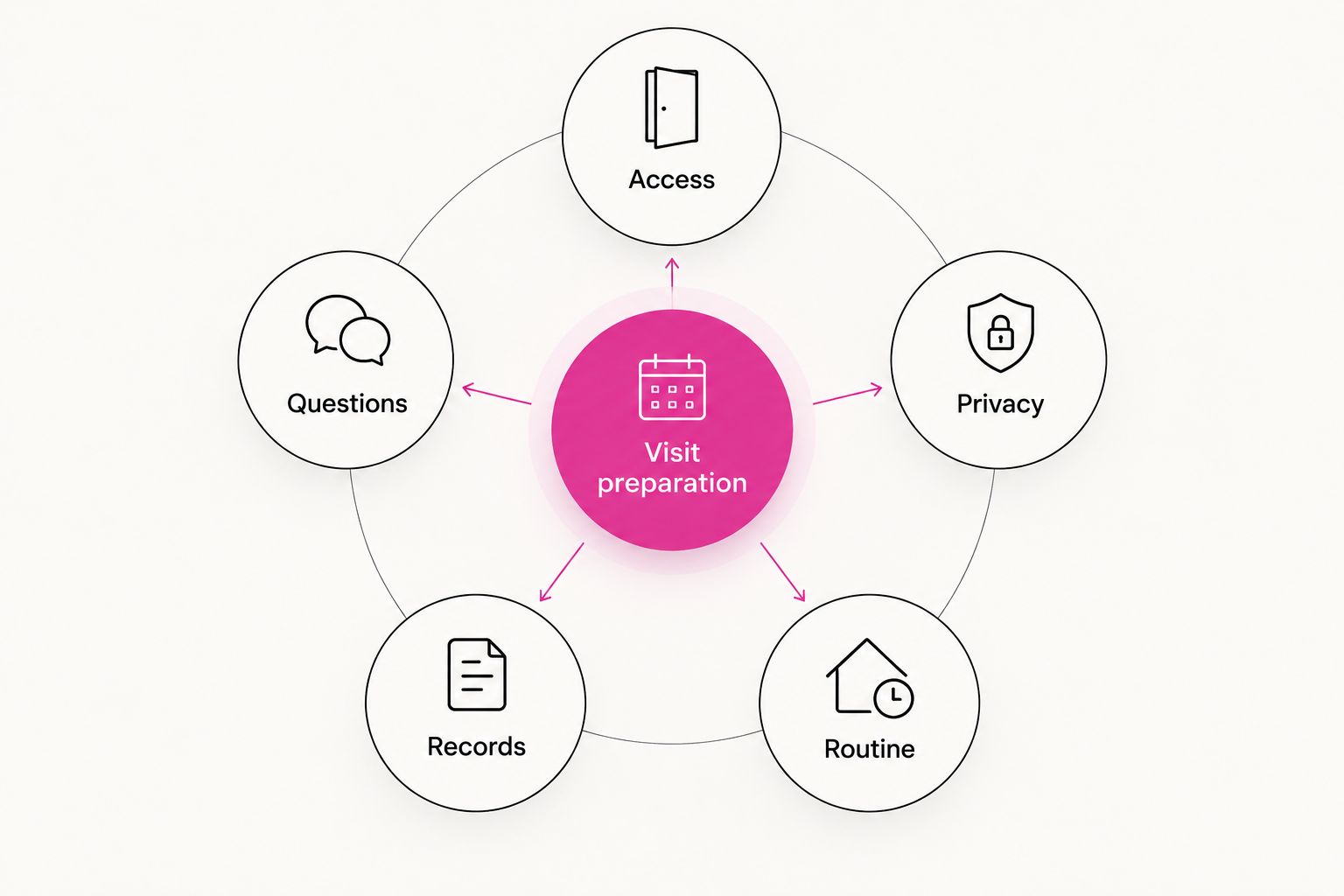
You do not need to turn the home into a treatment room. Ask the practitioner what preparation is needed, then organise access and a suitable place to talk. Keep the person’s comfort, privacy and preferences central to the plan.
Let the practitioner know about entry arrangements, stairs, pets or other practical matters that affect the visit. If a staff member will attend, agree on their role beforehand. Their contribution might be explaining the usual routine, helping the person communicate or receiving instructions with consent.
Avoid staging a demanding task to demonstrate a problem. Describe the concern and let the practitioner decide what is appropriate to assess. Staff should not introduce an unfamiliar exercise or change an assistance method in preparation for the appointment.
- Access: confirm entry instructions and the on-site contact.
- Privacy: agree who will be present for discussions.
- Routine: explain how the relevant activity usually happens.
- Records: have authorised documents ready if requested.
- Questions: write down what the person wants to ask.
These preparation areas keep the visit focused on the person, rather than leaving staff to resolve practical questions at the door.
6. Agree on the handover and review process
Before the appointment ends, establish what the person and staff need to know next. Ask for clarification if an instruction is unclear, and distinguish advice for the client from tasks that staff are authorised and trained to support.
A physiotherapy plan should not become an informal message passed between shifts. Use your organisation’s approved records and handover process, respecting the person’s consent. If different instructions appear to conflict, seek clarification rather than choosing whichever seems easiest to apply.
Ask how questions or changes should be communicated between appointments. Review should relate to the person’s agreed goal and current needs, not an automatic expectation that the same approach continues indefinitely.
- Confirm the agreed goal and next actions.
- Ask what staff should support and what they should not attempt.
- Record instructions through the approved care-documentation process.
- Identify who will raise questions with the practitioner.
- Confirm how and when the plan will be reviewed.
Compare assessment settings for your client
For your 2026 planning, compare the setting against the person’s needs rather than choosing on convenience alone. The options below are starting points for discussion, not a ranking of clinical quality. Confirm suitability with the practitioner and client before booking.
| Option | Best for | Practical benefit | Key limitation |
|---|---|---|---|
| Mobile physiotherapy | Older people seeking assessment in their own surroundings | The practitioner can see the home setting relevant to the concern | Requires home access, privacy and appointment coordination |
| Clinic physiotherapy | People who prefer or can manage attending a clinic | Keeps the appointment outside the home | Requires travel; the home setting is not directly visible |
| Video consultation | People considering remote discussion where the practitioner confirms suitability | Allows discussion without an in-person visit | Does not provide hands-on assessment or treatment |
For mobile care, the main advantage is the connection between assessment and the person’s everyday surroundings. The trade-off is that a home visit needs suitable access and agreement about who will attend. Ask about those details as carefully as you ask about treatment.
A video consultation is not a substitute for every in-person assessment. Ask whether it suits the particular concern and whether support is needed to communicate or use the device. Do not assume Foveria Health offers every appointment format listed here.
Common mistakes aged care staff make
Referring a task instead of a person
A request to improve transfers can leave out the person’s priorities and preferences. Describe the specific difficulty, the current support and what the person wants to change. The goal belongs to the client, even when several professionals contribute to the plan.
Treating the appointment as staff training
An individual home assessment and a workplace training session serve different purposes. Do not assume a client appointment includes a formal staff manual-handling programme or competency assessment. Ask separately about the purpose and scope of any staff involvement.
Assuming an existing arrangement covers the visit
Previous treatment or an existing care arrangement does not answer every administrative question about a new booking. Check authorisation, documentation and payment responsibility for the individual appointment. Avoid giving the client reassurance about coverage before it is confirmed.
Sharing instructions without enough context
A brief message such as practise standing does not explain who should help, what has been agreed or where staff responsibilities end. Ask for clear instructions and use the approved handover process. Never fill gaps by copying another client’s exercises or assistance plan.
FAQ
What does physiotherapy for aged care staff mean in this guide?
This guide covers aged care staff arranging physiotherapy for older clients, not treatment for staff members’ own injuries. The staff role centres on consent, useful observations, appointment coordination and appropriate handover.
Is mobile physiotherapy better than a clinic for an older person?
Neither setting is automatically better; the choice depends on the person’s needs, preferences and the practitioner’s assessment of suitability. Home visits allow the practitioner to see the relevant home surroundings, while clinic appointments require travel.
Can aged care staff attend a home physiotherapy appointment?
Ask the client and practitioner to agree on staff attendance before the visit. Confirm consent, privacy and whether the staff member will explain routines, support communication or receive agreed instructions.
Do I need a referral to arrange physiotherapy at home?
Confirm referral requirements directly with the practitioner and anyone responsible for authorising the appointment. Requirements for the individual arrangement should be settled before the booking is confirmed.
Will aged care funding pay for a home physiotherapy visit in 2026?
Payment responsibility must be confirmed for the individual appointment. Ask the relevant provider or payer what authorisation and documentation are needed before making a commitment on the client’s behalf.
Does Foveria Health provide mobile physiotherapy outside Punchbowl?
Foveria Health provides mobile physiotherapy across Greater Sydney. Give the client’s suburb and care needs when enquiring, and confirm suitability and appointment availability directly.
Can staff start exercises while waiting for a physiotherapy visit?
Do not introduce a new exercise programme on the strength of this guide. Follow the person’s existing agreed care instructions and seek individual advice about new concerns or proposed changes.
One last thing
Write the handover question before the appointment. Ask: what do the people supporting this client need to understand about the agreed plan? That question helps turn an assessment into clear communication without assuming staff should take on treatment responsibilities.
For your next 2026 referral, put the client’s own goal at the top of the enquiry. It gives the person, family, coordinator and practitioner a shared starting point while leaving clinical decisions to the assessment.