

Parkinson’s disease physiotherapy is movement assessment and tailored physical rehabilitation aimed at supporting everyday mobility, confidence and independence. At home, it connects treatment to the places where you actually move: your chair, hallway, bathroom doorway and front steps.
- Physiotherapy for Parkinson’s disease should start with everyday goals, walking and balance, not a generic exercise sheet.
- Foveriahealth offers mobile physiotherapy in Greater Sydney; ask Simon whether your Parkinson’s-related needs fit the service.
- Home visits support assessment in your own surroundings; clinic care provides a different setting and equipment.
- Confirm clinical suitability, referral requirements and funding arrangements before booking.
Why physiotherapy matters for people with Parkinson’s disease
Parkinson’s disease can affect walking, balance, posture and the ease of everyday movements. Getting out of a chair or turning through a narrow doorway can become a task that needs more attention. Physiotherapy focuses on movement difficulties and practical goals; it does not cure Parkinson’s or replace your medical care.
For families planning care in 2026, the useful question is not simply which exercises to choose. It is which activities are becoming difficult, what happens during those activities, and what support is appropriate.
Foveriahealth mobile physiotherapy is best suited to Greater Sydney clients seeking assessment and treatment at home. For Parkinson’s-specific needs, discuss your movement difficulties with Simon before arranging care through Foveriahealth. A home-visiting service and a Parkinson’s specialist service are not automatically the same thing.
Home assessment is particularly relevant when your concern depends on the surroundings. Your usual chair, walking route and available support provide information that a description alone cannot capture. The limitation is equally important: some assessment, equipment or multidisciplinary care belongs in another setting.
How to arrange useful home physiotherapy in 2026
Start with the daily activities you want to change
Before choosing exercises, write down what you want to do more comfortably or confidently. You do not need clinical language. A note saying that turning beside the bed feels difficult gives a physiotherapist a useful starting point.
Choose up to 3 everyday goals for your initial discussion. This is an organising suggestion, not a treatment prescription. Keep your priorities personal: reaching the courtyard matters just as much as walking further if that is what makes your day better.
If you are arranging care for someone else, ask what matters to them before creating the list. Supporting independence includes respecting the person’s choices about help and participation.
- Describe the activity, such as standing from your usual chair.
- Explain where the difficulty happens.
- Record what assistance you currently use.
- Name the activity you most want to keep doing.
Record changes without testing yourself
A short written account helps explain movement difficulties without relying on memory during the appointment. Record what happened during ordinary activity; do not deliberately repeat an unsafe movement to demonstrate the problem.
Parkinson’s symptoms can fluctuate, including in relation to medication. Tell the physiotherapist about patterns you have noticed, but do not change medication or its timing to prepare for a visit. Medication questions belong with your prescribing clinician.
Include falls and near misses, even when there was no injury. If you suddenly become much less mobile or develop new symptoms, seek medical advice rather than assuming Parkinson’s progression explains the change.
- Note when walking or standing feels harder.
- Describe freezing, where your feet feel stuck despite wanting to move.
- Record falls, near misses and any resulting injury.
- Explain fatigue, dizziness or pain affecting movement.
- Bring your current medication list if available.
Ask whether the clinician matches your needs
Start by preparing your questions yourself, or with a family member or support coordinator. A clear enquiry helps establish whether an appointment is appropriate before you commit to it.
Foveriahealth provides mobile physiotherapy across Greater Sydney, with assessment and treatment at home. Ask Simon directly about experience with Parkinson’s-related walking difficulties, freezing, balance changes and transfers. Do not assume that offering general physiotherapy confirms expertise in every neurological condition.
If you live in Punchbowl, Bankstown or another Greater Sydney suburb, include your address area and access needs in the enquiry. Confirm appointment arrangements rather than treating a broad service area as a promise of a particular booking.
- Describe your diagnosis and main movement concerns.
- Ask about relevant Parkinson’s assessment experience.
- Explain stairs, entry access and who will attend.
- Ask how care is coordinated with your existing clinicians.
- Confirm whether another service would better match your needs.
Prepare for an assessment of your actual routine
You do not need to turn your home into a treatment room. Explain how you usually move around it and leave your usual walking aid available. Ask before buying equipment or rearranging furniture specifically for the visit.
A physiotherapist can assess walking, balance and transfers within the limits of a safe home assessment. Transfers means movements such as getting out of bed or standing from a chair. The assessment should guide treatment rather than serve as a test you need to pass.
Keep a 1-page summary of your goals, relevant health information and existing support. If walking is the main concern, the guide to home assessment of walking and balance explains the practical questions to raise.
- Keep your usual chair and walking aid accessible.
- Identify the everyday route you want to discuss.
- Put relevant referral letters and care information together.
- Tell the clinician about pets, entry instructions and access barriers.
- Invite a support person only with your agreement.
Agree on a plan you understand
Physiotherapy for Parkinson’s disease should be individualised. Depending on assessment, a plan can include movement practice, strengthening, balance work, walking strategies and advice for everyday activities. No exercise list suits everyone with the same diagnosis.
Ask the physiotherapist to explain what each activity is intended to help and how to do it safely. Some people benefit from movement cues, such as a deliberate rhythm or a visual target, but the choice and use of cues require individual assessment.
Your 2026 care plan should also explain what happens between visits. Do not practise a difficult balance task alone simply because it appears on a general exercise sheet. Ask what support is needed and when to stop.
- Request clear instructions in your preferred format.
- Confirm which activities require another person present.
- Ask how fatigue or symptom changes affect the plan.
- Clarify what discomfort or warning signs mean you should stop.
- Agree on how progress and difficulties will be reviewed.
Share the plan with the right people
With your consent, a shared plan helps family members, support workers and clinicians give consistent assistance. This matters when several people help with standing, walking or getting ready for appointments.
The plan should describe the assistance that has been assessed, not simply say that you need help. Support workers should not improvise a new lifting or transfer technique from an online article. Ask for guidance appropriate to their role and the person’s needs.
For your 2026 review, use 2 practical questions: is the agreed activity becoming more manageable, and is the current assistance still appropriate? A change in support needs deserves discussion even if you are completing the exercises.
- Name the person coordinating appointments and communication.
- Record consent for sharing relevant information.
- Share agreed movement instructions with authorised supporters.
- Report new falls, symptoms or difficulty following the plan.
- Review goals when health or daily routines change.
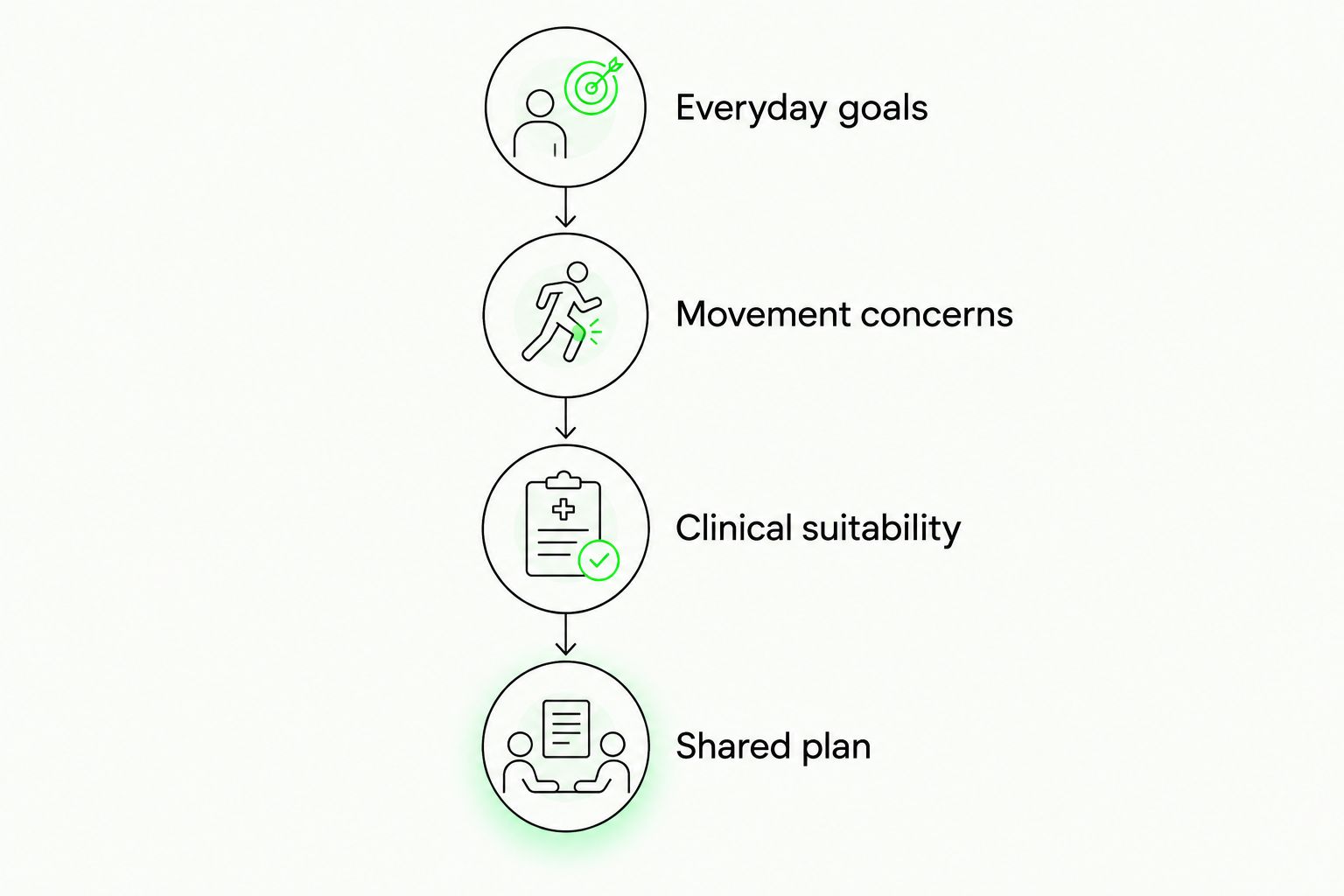
The sequence is simple: start with your priorities, describe the problem, check the clinician’s fit, then agree on care. You do not need to solve the movement difficulty before asking for an assessment.
Compare home, clinic and specialist options
Choose the setting that matches the assessment and support you need, not simply the setting closest to you. Home physiotherapy brings your environment into the assessment. Clinic and specialist services offer different advantages, and some people use more than one setting.
| Option | Best for | Main advantage | Key limitation |
|---|---|---|---|
| Mobile physiotherapy | People whose goals involve movement around their own home | Assessment can include usual furniture, access and walking routes | Equipment and assessment space depend on the home; relevant clinical experience still needs checking |
| Clinic physiotherapy | People able to attend appointments away from home | Access to the clinic’s assessment space and equipment | Travel is required, and household difficulties need to be described or recreated |
| Parkinson’s or neurological rehabilitation service | People seeking condition-focused assessment or coordinated rehabilitation | A focus on neurological movement needs | Referral pathways and suitability must be checked with the service |
| Individually prescribed home programme | People practising agreed activities between assessments | Practice can fit familiar routines | It does not replace reassessment when symptoms, safety or support needs change |
A home programme is not necessarily an alternative to face-to-face treatment. It often forms part of a wider plan. Likewise, general mobile care should not replace specialist input when the treating team identifies a need for it.
Confirm referrals and funding before booking
For appointments arranged in 2026, confirm the proposed payment pathway before treatment. A Parkinson’s diagnosis alone does not establish that a particular appointment meets a funding scheme’s requirements.
If you are using NDIS, aged care, Medicare or private insurance arrangements, ask the relevant provider, plan manager, insurer or clinician what documentation is needed. Then confirm the arrangement with the physiotherapy practice. Keep clinical suitability and payment approval as separate questions.
Professional referrers can make the enquiry more useful by supplying the person’s goals, relevant health history, current assistance and consent to share information. Avoid sending a diagnosis without explaining the functional concern.
- Confirm who is responsible for payment and authorisation.
- Ask whether a referral or supporting document is required.
- Clarify what written reporting is requested.
- Check consent before sharing health information.
Common mistakes when arranging Parkinson’s physiotherapy
Choosing an exercise sheet before an assessment
A generic routine cannot account for freezing, falls, dizziness, other health conditions or the help available at home. Use general information to prepare questions, not to prescribe your own balance or walking programme.
Treating every difficult day as progression
Movement can vary, and a sudden deterioration needs medical attention rather than an automatic increase in exercise. Describe what changed and when. Do not independently adjust Parkinson’s medication in response to an exercise session.
Assuming home visits mean specialist Parkinson’s care
Mobile describes where treatment happens, not the clinician’s particular experience. Ask about assessment skills and referral options. A clear recommendation to seek another service is useful care, not a failed enquiry.
Letting the family’s goals replace the person’s goals
Families often focus on safety, while the person wants privacy, confidence or access to a favourite activity. Discuss both. An achievable plan needs the person’s agreement as well as practical support.
FAQ
Can physiotherapy help someone with Parkinson’s disease at home?
Physiotherapy can support movement goals for someone with Parkinson’s disease at home. Assessment helps identify an appropriate plan for walking, balance, transfers and everyday activities; it does not cure Parkinson’s.
Is home physiotherapy better than going to a clinic?
Home physiotherapy is useful when assessment needs to include your usual surroundings, while clinic care offers a different space and equipment. The better setting depends on your goals, clinical needs and ability to travel.
Does Foveriahealth provide specialist Parkinson’s physiotherapy?
Foveriahealth provides mobile physiotherapy in Greater Sydney, but Parkinson’s-specific suitability needs to be discussed with Simon. Explain your symptoms and ask about relevant experience before booking.
What are the best exercises for Parkinson’s disease?
The best exercises are those selected for your assessment findings, goals and safety needs. A programme can include strength, balance, walking and movement practice, with instructions about assistance and when to stop.
Should my appointment be timed around Parkinson’s medication?
Tell your physiotherapist how your movement changes around your usual medication schedule so appointment timing can be discussed. Do not alter medication doses or timing without advice from your prescribing clinician.
Can a family member or support worker attend the visit?
Ask to include a family member or support worker if you want their involvement. Agree beforehand what information can be shared and whether they need guidance on providing assistance.
Will NDIS or Medicare cover Parkinson’s physiotherapy at home?
Coverage must be confirmed for your individual circumstances and proposed appointment. Check the relevant requirements and documentation with your funding contact and the practice before treatment.
One last thing
Describe the doorway, not just the diagnosis. Saying that your feet feel stuck when turning into the bathroom gives a physiotherapist a specific daily problem to assess. You do not need to demonstrate it unsafely or arrive with the solution.
For a first conversation with Simon, bring your priority activity, current support needs and questions about clinical suitability. That is a useful starting point for personal, goal-focused care.