

For GPs, mobile physiotherapy referrals are requests for assessment and treatment at a patient’s home, with the aim of addressing movement, recovery or everyday activity goals. This 2026 guide explains how to choose the setting, prepare a useful handover and coordinate the next appointment without assuming funding approval.
- Physiotherapy referrals for GPs should explain why home assessment suits the patient and identify an everyday goal.
- Foveria Health provides mobile physiotherapy across Greater Sydney, including care for aged care, NDIS, private and Medicare patients.
- Confirm consent, referral requirements and payment arrangements separately before booking.
- Agree who receives the assessment findings and which changes require contact with the GP.
Why mobile physiotherapy matters for GPs
A home referral is about choosing an appropriate setting, not simply avoiding a journey. For an older person, someone recovering after surgery or a person with disability, the relevant question might involve their own stairs, bathroom access or usual chair.
The GP’s handover helps connect the medical history with that everyday problem. A diagnosis provides context; explaining what the patient wants to do gives the assessment a practical focus.
Foveria Health is best suited to Greater Sydney patients seeking in-home physiotherapy rather than clinic-based appointments. The practice provides mobile assessment and treatment, including musculoskeletal care, manual therapy, dry needling and respiratory physiotherapy. These services are not a checklist of treatments every patient needs.
For a local referral, Foveria Health provides a starting point for discussing care at home with Simon. Confirm the patient’s suburb, needs and appointment arrangements before treating a referral as an accepted booking.
Prepare a useful home physiotherapy referral
The following steps separate clinical information, patient preferences and booking administration. Use your usual referral letter or practice template first; a useful handover does not depend on buying software or creating a new system.
Establish why a home visit suits the patient
Start with the activity that prompted the referral. Instead of describing only reduced mobility, explain whether the person is finding it difficult to reach the bathroom, leave the house or move between their usual seats.
Include the patient’s preference alongside the practical reason for home care. Difficulty travelling and a preference for familiar surroundings are different considerations; record whichever actually applies rather than assuming both.
Ask the patient to nominate 1 everyday goal in their own words. This is a suggested starting point, not a limit on the assessment or a promise of a particular outcome.
- State the main reason for physiotherapy assessment.
- Describe the activity the patient finds difficult.
- Explain why assessment at home is being requested.
- Record the patient’s priority and relevant preferences.
- Identify any question about suitability that needs discussion before booking.
Gather relevant history and current instructions
Use the existing clinical record to prepare a focused summary. Include information that affects the referral question, rather than copying an entire history without explaining its relevance.
For a postoperative referral, attach available discharge information and the treating team’s current instructions. Do not replace an unclear restriction with an assumption; identify the uncertainty so the appropriate clinician can clarify it.
Keep reported symptoms separate from confirmed diagnoses. A description supplied by the patient or family remains useful, but the receiving physiotherapist needs to know its source and when the change occurred.
- Summarise relevant diagnoses and the reason for referral.
- Include relevant medicines and medical precautions.
- Attach available operation, discharge or investigation information.
- Record current restrictions exactly as provided by the treating team.
- Describe recent changes and any assessment already completed.
Confirm consent and the right contact person
Explain why you are referring, what information you intend to share and who will receive it. Record the patient’s agreement using your practice’s consent process, and clarify any limits on sharing information with relatives or support staff.
A family member who arranges transport or appointments is not automatically the person the patient wants involved in clinical discussions. Where another person has authority to act, identify their role and provide the relevant documentation through the agreed process.
For Foveria Health mobile physiotherapy, ask how to send referral information and confirm who will coordinate the appointment. The guide to consent for a home physiotherapy referral offers a separate discussion point for families and referrers.
- Record the patient’s preferred contact person.
- Confirm permission before contacting family or support workers.
- Note communication, hearing or interpreter needs.
- Identify any representative and their stated role.
- Use the receiving service’s agreed method for sharing health information.
Separate the referral from funding arrangements
In 2026, keep the clinical request and the payment discussion distinct. A referral explains the reason for assessment; it does not, by itself, confirm that a particular appointment will be covered under a funding arrangement.
Foveria Health works with aged care, NDIS, private and Medicare patients. That service scope does not establish an individual patient’s eligibility, available budget, rebate or approval for a proposed appointment.
Ask the patient or authorised coordinator to confirm the intended payment pathway with the relevant parties. For Medicare, NDIS or aged care arrangements, check current requirements rather than reusing an old template without checking it.
- Identify the proposed payment pathway without promising coverage.
- Ask which current referral or supporting documents are required.
- Confirm who is responsible for authorising and paying for care.
- Clarify any provider or plan-manager coordination before booking.
- Keep funding discussions separate from recommendations about clinical need.
Arrange a workable home appointment
A clear referral still needs a practical handover. Confirm the actual address, suburb, building access and the person who will answer the door; the patient’s postal address alone might not explain where the visit should occur.
For Punchbowl, nearby suburbs and elsewhere across Greater Sydney, confirm the address and proposed visit directly. A service area description is not confirmation of a particular appointment time.
If the patient agrees, record 2 contact numbers: their preferred number and an alternative for appointment coordination. The alternative is a practical backup, not permission to share clinical information without consent.
- Confirm the visit address and preferred contact number.
- Explain entry instructions, stairs and relevant access arrangements.
- Note who the patient wants present during the visit.
- Identify communication or personal-care preferences relevant to the appointment.
- Confirm the booking before telling the patient it is arranged.
Agree on feedback and follow-up responsibilities
In the 2026 referral, specify what you want to learn from the assessment. A request to assess walking indoors is more useful when paired with a question about the patient’s current difficulties and recommended next steps.
Agree how the physiotherapist should contact the GP if clarification is needed. Do not assume a particular reporting timetable or response time; discuss arrangements that suit the patient’s care and the services involved.
Use 3 review questions to frame the handover: what was assessed, what plan was agreed, and what needs further medical input? These are suggested prompts, not a prescribed report format.
- State the assessment question and requested feedback.
- Provide the referring clinician’s contact details.
- Identify other involved clinicians, with appropriate consent.
- Clarify who will arrange any agreed medical follow-up.
- Record how changes or concerns should be communicated.
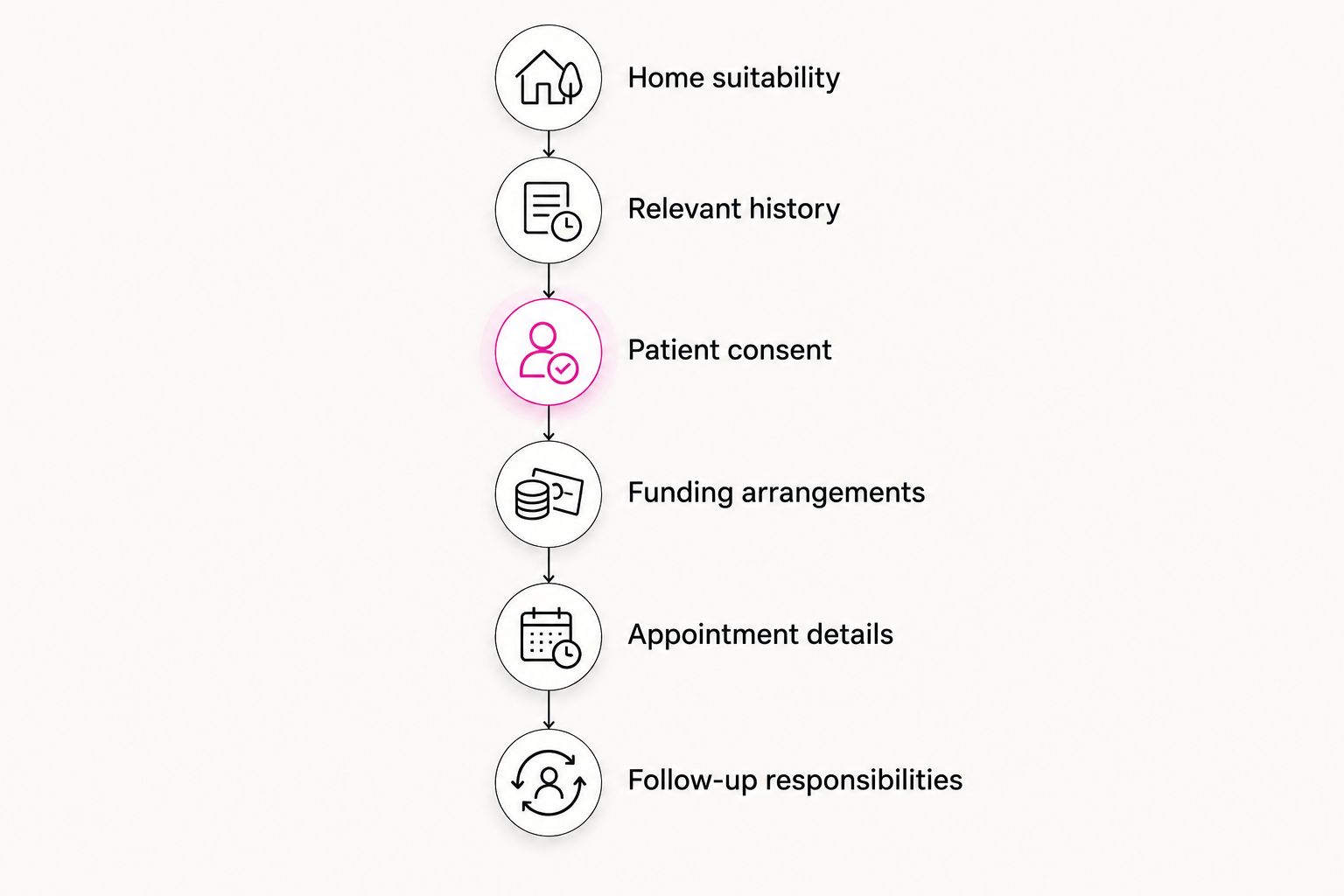
The referral does not need to answer every assessment question. It needs to make the reason for the visit clear and identify what still requires confirmation.
Compare assessment settings before referring
Choose the setting around the patient’s needs, not a general preference for home or clinic care. The options below are discussion points for referral planning, not substitutes for clinical judgement.
| Option | Best for | Practical advantage | Key limitation |
|---|---|---|---|
| Foveria Health mobile physiotherapy | Greater Sydney patients seeking assessment and treatment at home | The appointment takes place in the patient’s home environment | Address, suitability and appointment arrangements require confirmation |
| Clinic-based physiotherapy | Patients who can attend and prefer a clinic | Keeps assessment and treatment within a clinic setting | Requires travel and does not directly show the home environment |
| Remote physiotherapy consultation | Patients whose needs suit a remote discussion or review | Allows communication without a home or clinic visit | Cannot provide hands-on assessment; suitability and provider arrangements need checking |
| Medical or emergency assessment | Patients whose immediate need is medical assessment rather than routine rehabilitation | Directs the person towards the appropriate level of medical care | Is not a replacement for later rehabilitation planning when needed |
The benefit of a home visit is its setting. Its limitation is that home care must still fit the person’s clinical needs, practical circumstances and agreed arrangements; convenience alone does not settle that decision.
Common mistakes GPs make with home referrals
Sending a diagnosis without an assessment question
A diagnosis does not explain which everyday problem needs attention. Add the patient’s priority and what you want assessed, while leaving treatment selection to the assessment and shared discussion.
Treating a referral as funding approval
In 2026, keep funding confirmation outside the clinical recommendation. Avoid telling a patient that an appointment is covered until the relevant requirements and arrangements have been checked for that person.
Making the family the default decision-maker
A helpful relative is not automatically the patient’s chosen spokesperson. Ask who should receive appointment information, who can join discussions and what the patient wants kept private.
Omitting instructions after surgery
A request for postoperative rehabilitation needs the available treating-team instructions, not just the name of the operation. Flag unclear restrictions for clarification rather than passing an assumption along the referral chain.
Leaving follow-up ownership unclear
A referral can leave patients uncertain if nobody explains the next step. State who will contact whom, whether a booking is confirmed and which questions still need an answer.
FAQ
What should a GP include in a mobile physiotherapy referral?
Include the referral reason, an everyday goal, relevant medical history, current precautions, consent details and the preferred contact person. Add the home address, available supporting documents and the question you want the physiotherapist to assess.
Is home physiotherapy better than attending a clinic?
Home physiotherapy is a different setting, not automatically a better option. It allows assessment in the patient’s home, while clinic attendance suits patients whose needs and preferences fit that setting.
Does a GP referral confirm Medicare or NDIS coverage?
A GP referral alone does not confirm coverage for a particular appointment. Check the patient’s current arrangements, required documents and payment responsibilities with the relevant parties before booking.
Can a GP refer someone in Punchbowl for home physiotherapy?
GPs can discuss a home physiotherapy referral for a patient in Punchbowl with Foveria Health. The practice serves Greater Sydney; confirm the address, patient needs and proposed appointment directly.
Can a family member arrange the home appointment?
A family member can help coordinate an appointment with the patient’s agreement. Clarify separately whether the patient wants that person involved in clinical discussions or receiving health information.
Should a GP request a specific physiotherapy treatment?
A referral should explain the clinical question and relevant precautions rather than assume a particular treatment is required. Include any specific concern for the physiotherapist to consider during assessment.
What should happen if the patient needs urgent medical help?
Urgent medical needs should not wait for a routine home physiotherapy appointment. For a medical emergency in Australia, call 000; otherwise arrange the appropriate medical assessment based on the patient’s situation.
One last thing
Include the patient’s own description of the task they want help with. A referral can contain a detailed medical history yet leave the receiving clinician unsure what matters most to the person opening the door.
For your next referral in 2026, ask what the patient wants to find easier at home, then record the answer without promising an outcome. That small addition keeps the handover personal and gives the assessment a clear starting point.