

Seniors’ home physiotherapy is assessment and treatment delivered where an older person lives, with the aim of supporting their everyday movement goals. This guide to home physiotherapy for seniors helps adult children arrange care in 2026 while keeping their parent’s preferences, consent and independence at the centre.
- Home physiotherapy for seniors starts with the older person’s goals, consent and an assessment of their needs.
- Foveriahealth suits Greater Sydney families seeking personal, goal-focused mobile physiotherapy with Simon.
- Confirm referral requirements, funding arrangements and appointment details before booking; do not assume a contribution applies.
- Choose home visits, clinic appointments or telehealth according to assessment needs, travel demands and personal preference.
Why home physiotherapy matters for seniors
Arranging physiotherapy for a parent is not just a booking task. You need to consider getting to an appointment, sharing relevant health information and finding an approach your parent wants to follow. A home visit removes the journey to a clinic and places the conversation in familiar surroundings.
The home setting also gives the physiotherapist context: the chair your parent uses, the route to the bathroom and the doorway they find difficult. These details help connect the assessment to everyday priorities rather than an exercise goal chosen by someone else.
Foveriahealth is best suited to Greater Sydney families seeking personal, goal-focused physiotherapy at home with Simon. Its mobile physiotherapy service includes in-home assessment and treatment for private, NDIS, aged care and Medicare-funded clients. That service scope does not establish an individual person’s funding eligibility.
Home care still needs a suitability check. The practical advantage is avoiding travel; the limitation is that not every assessment or treatment requirement suits a home visit. Ask what can be assessed at home and whether another setting is needed.
How to arrange home physiotherapy for your parent
Agree on goals
Start with your parent’s own priorities, not a list of things you think they should improve. Ask which everyday activity feels difficult and what they would like help understanding. Getting out of a favourite chair or feeling more confident moving around the house gives the physiotherapist a useful starting point.
Write down up to 3 everyday goals for the initial discussion. This is a planning aid, not a clinical target or a requirement to achieve all three. Keep the wording concrete so your parent can recognise their own priorities in the plan.
If you are updating an existing plan in 2026, ask whether those goals still matter. A previous focus on outdoor walking might no longer reflect what your parent wants help with today. Do not turn family concern into pressure to accept treatment.
Close the conversation by checking what role your parent wants you to take. Some people want help organising an appointment but prefer to speak to the physiotherapist themselves.
- Ask what your parent wants to do more comfortably or confidently.
- Record up to 3 everyday goals in their own words.
- Separate your concerns from your parent’s priorities.
- Agree whether you will attend, organise or simply help with paperwork.
Gather relevant information
Prepare a short summary rather than a long family history. Include why you are seeking physiotherapy, what has changed and any existing instructions from treating clinicians. Tell the practice about recent hospital care, relevant health conditions and current difficulties before the visit.
Use information your parent agrees to share. Being the person who books an appointment does not automatically make you the decision-maker for treatment or give you access to every discussion.
Foveriahealth provides in-home assessment, so a useful enquiry explains both the concern and the home situation. Mention access issues, communication preferences and whether someone will be present to support the appointment. This helps the practice discuss suitability without you trying to choose a treatment technique.
Choose 1 family contact for appointment administration, with your parent’s agreement. A single contact reduces conflicting messages, but it does not replace the older person’s voice. Providers and support coordinators should also state their role and the reason for the referral.
- Summarise the main concern and any recent changes.
- Gather relevant discharge or referral documents already available.
- Note communication needs and your parent’s preferred name.
- Explain stairs, entry arrangements and other access considerations.
- Identify 1 agreed contact for appointment administration.
Check referral arrangements
Ask the practice what documents are needed for your parent’s particular circumstances. Do not assume that a referral rule for one funding arrangement applies to another, or that an existing referral covers the service you want to arrange.
Foveriahealth works with private, NDIS, aged care through Support at Home, and Medicare-funded clients. Those are different arrangements, not interchangeable labels. Confirm the proposed pathway with the practice and the relevant payer or coordinator before treating the appointment as funded.
For a 2026 appointment, use current confirmation rather than an old family member’s experience. Ask who approves the service, who receives the invoice and what written information is needed before treatment starts. Keep those answers with the appointment details.
Confirm the arrangement before booking, not after the invoice arrives. You do not need to understand every funding rule yourself; you need a clear answer about your parent’s proposed appointment. If the answer is unclear, ask the practice and payer to resolve it before proceeding.
- Confirm whether a referral is required for the intended arrangement.
- Ask which documents the practice needs before the appointment.
- Check who authorises the service and handles the invoice.
- Obtain confirmation of any proposed funding contribution.
- Clarify what happens if approval is not in place.
Choose the setting
Compare the setting against your parent’s needs rather than assuming home care is always the better option. Travel difficulty, the purpose of assessment and your parent’s preference all belong in the decision. Ask the physiotherapist what the proposed setting allows them to assess.
A home appointment is a practical choice when seeing movement in the home matters or travelling creates a burden. A clinic provides a different treatment environment. Telehealth avoids travel too, but it cannot provide hands-on assessment or treatment.
For families in Punchbowl, nearby suburbs and elsewhere in Greater Sydney, give the actual address when enquiring. Confirm that the proposed visit can be arranged there; a broad service area is not a promise of a particular appointment.
If your parent already attends a clinic, explain why you are considering a change. The reason might be the journey, a new home-based goal or a preference for support in familiar surroundings. Avoid booking overlapping plans without telling the treating clinicians.
- Explain how your parent manages the journey to appointments.
- Ask whether a home assessment suits the concern.
- Check whether hands-on assessment is needed.
- Confirm the address and proposed appointment arrangements.
- Discuss how existing physiotherapy care will be coordinated.
Prepare the visit
Make the appointment easy to enter and easy to understand. There is no need to turn the house into a treatment room. Ask the practice what space or preparation is needed, then focus on safe access and having relevant information available.
Let your parent know who is coming, why the visit is happening and whether you will stay. Ask permission before inviting another relative or support worker into the discussion. Too many voices can make it harder for the physiotherapist to hear the older person’s concerns.
Keep your 2026 appointment notes together, including the agreed goals, booking details and questions. Write down 2 priority questions so the discussion does not get lost in paperwork. For example, ask what the assessment will involve and how any suggested plan will fit into ordinary routines.
Do not buy equipment or begin exercises simply because they appear in an online guide. Any treatment advice should follow an assessment and clear instructions for your parent.
- Confirm entry details, parking information and access needs.
- Ask what space and preparation the practice requires.
- Have relevant documents and existing care instructions available.
- Prepare 2 priority questions for the appointment.
- Agree who will attend and what support they will provide.
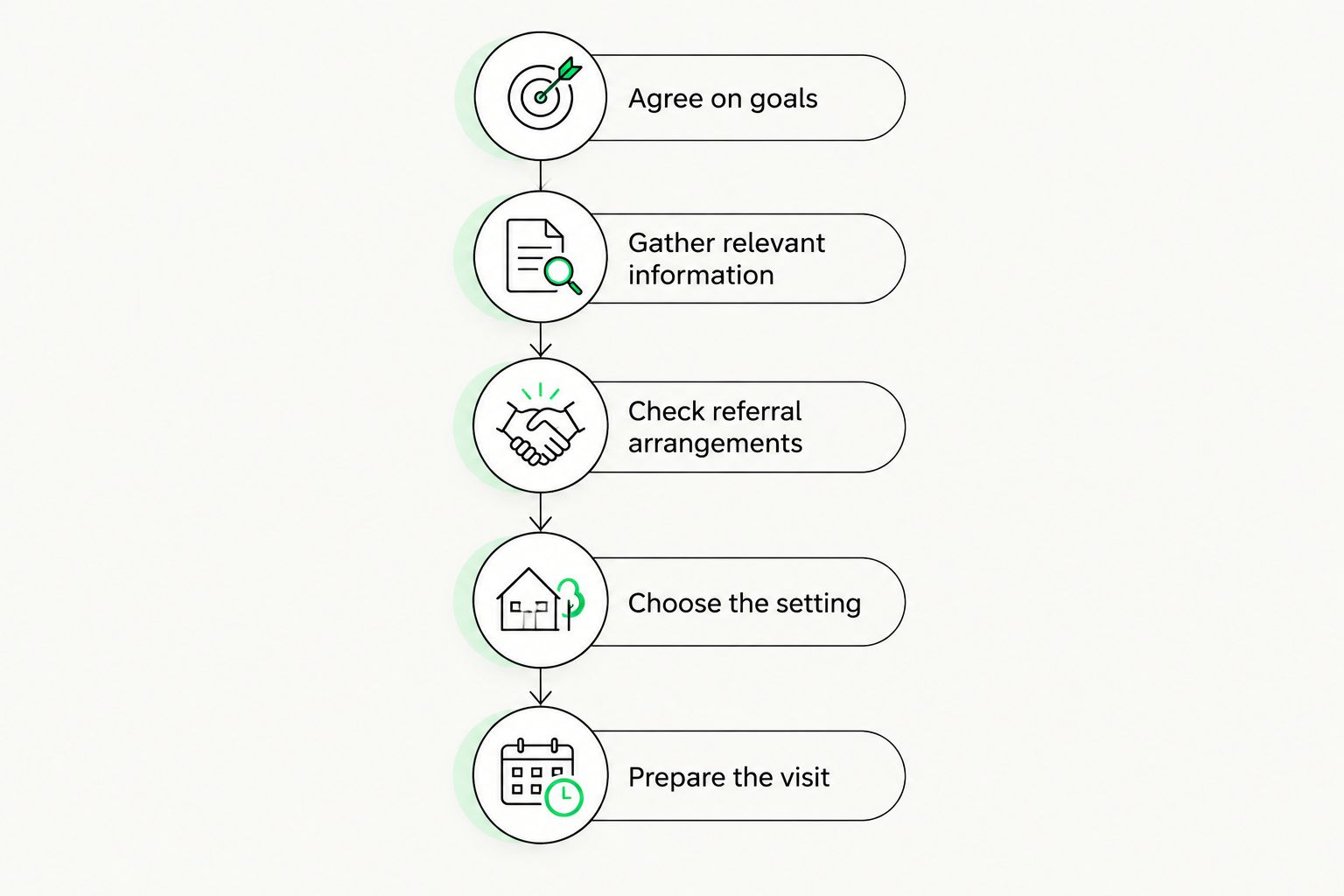
The preparation sequence is simple: agree on goals, gather information, check referral arrangements, choose the setting and prepare the visit. Keep your parent involved at each stage rather than completing the whole process on their behalf.
Review the plan
After the assessment, ask the physiotherapist to explain the proposed plan in everyday language. Your parent should understand what the plan addresses, what their choices are and what help is expected from family or support workers. Ask for clarification rather than filling gaps yourself.
A useful plan connects treatment to your parent’s daily goals. It should also explain how those goals will be reviewed. Avoid judging the plan only by the number of exercises or appointments; those details need to match the individual assessment.
Keep a short record of questions and changes your parent wants to discuss. If something is unclear or difficult to follow, contact the treating physiotherapist before altering the instructions. Do not add repetitions, substitute exercises or copy another person’s program.
For care providers, the handover needs to distinguish agreed support tasks from clinical decisions. For your family, it needs to be practical enough that everyone knows their role without taking control away from your parent.
- Ask how each part of the plan relates to an agreed goal.
- Clarify what your parent will do between appointments.
- Confirm what family or support workers are being asked to help with.
- Ask how and when the plan will be reviewed.
- Record questions for the treating physiotherapist.
Compare physiotherapy settings for your parent
The best setting is the one that fits the assessment need and your parent’s circumstances. Use this comparison to frame questions, not to choose treatment without professional advice. Confirm the details of the proposed service before making a decision.
| Option | Best for | Practical advantage | Key limitation |
|---|---|---|---|
| Home physiotherapy | Older people whose assessment needs or travel difficulties make home visits suitable | No journey to a clinic; discussion takes place in the home environment | Suitability depends on the assessment and treatment requirements |
| Clinic physiotherapy | Older people who can attend and whose needs suit a clinic setting | Assessment takes place in a dedicated treatment environment | Requires travel and any necessary transport support |
| Telehealth physiotherapy | People whose needs suit a remote consultation and who can participate | No travel required | Cannot provide hands-on assessment or treatment |
A family member’s convenience belongs in the discussion, but it should not decide the setting alone. Ask your parent which option they prefer and let the physiotherapist explain any assessment limits. A combination of settings should be discussed with the treating clinician rather than arranged as separate, unconnected plans.
Common mistakes adult children make
Booking before asking your parent
A well-intended booking can feel like a decision made about someone rather than with them. Explain the reason for suggesting physiotherapy, ask whether your parent wants to explore it and agree on your role. Consent matters throughout care, not just during administration.
Treating a funding label as approval
Having a care arrangement or discussing a funded service does not confirm that a particular appointment is covered. For bookings in 2026, check the proposed service, required paperwork and payer arrangements directly. Keep written confirmation where the family contact can find it.
Giving the physiotherapist only a diagnosis
A diagnosis does not describe what your parent wants help doing at home. Include everyday difficulties and personal priorities alongside relevant health information. A professional referrer should explain the referral question, not prescribe an assumed outcome.
Taking over the appointment
Answering every question for your parent can hide their preferences and concerns. Offer background when invited, then leave space for them to speak. If communication support is needed, explain that before the visit and ask how best to assist.
Expecting a generic exercise program
Your parent’s assessment should guide any recommendations. An exercise that helped a relative is not automatically appropriate for them. Ask for instructions specific to your parent and clear guidance about raising concerns with the treating physiotherapist.
FAQ
What is home physiotherapy for seniors?
Home physiotherapy for seniors is physiotherapy assessment and treatment delivered where an older person lives. It allows the discussion to focus on their movement concerns, home environment and everyday goals.
Is home physiotherapy better than going to a clinic?
Home physiotherapy is not automatically better than clinic care. The appropriate setting depends on the assessment needs, travel demands and the older person’s preferences; ask the physiotherapist to explain which setting suits the concern.
Can I arrange physiotherapy for my mum or dad?
You can help arrange an enquiry or appointment with your parent’s agreement. Ask how they want you involved, and confirm consent and information-sharing arrangements with the practice.
Does my parent need a GP referral for home physiotherapy?
Confirm referral requirements with the practice for your parent’s intended payment or funding arrangement. Do not assume that requirements for private appointments and funded services are the same.
Can aged care or Medicare pay for home physiotherapy?
Confirm any proposed contribution with the practice and the relevant payer before booking. Foveriahealth works with aged care through Support at Home and Medicare-funded clients, but that does not establish an individual person’s eligibility or appointment coverage.
What should we prepare before the first home visit?
Prepare your parent’s goals, relevant health documents, access information and questions for the physiotherapist. Ask the practice what space or other preparation is needed, and agree who will attend.
Does Foveriahealth offer home physiotherapy in Greater Sydney?
Foveriahealth is a Sydney-based mobile physiotherapy practice serving Greater Sydney. Give the practice the proposed address, including Punchbowl or nearby suburbs where relevant, and confirm arrangements for the requested visit.
What should a support coordinator include in a physiotherapy enquiry?
Include the person’s goals, the reason for seeking assessment, relevant documents shared with consent, access needs and the intended funding arrangement. Identify the authorised contact and confirm what paperwork is needed before booking.
One last thing
Before your parent’s 2026 appointment, ask: ‘What would make this visit useful to you?’ Their answer can be more helpful than a long list of family concerns. Write it down exactly as they say it and bring it to the assessment.
The goal is not to organise care around your parent. It is to organise care with them, with enough practical support that they can take part in the decisions.