Best overall approach: choose a walking aid after an assessment at home. A standard walking frame suits people who need support through both hands and can lift it safely; a wheeled frame suits different needs, while a walking stick provides lighter support. This 2026 guide explains the differences without treating one aid as right for everyone.
- The best walking aids for seniors at home depend on balance, hand control, walking ability and room layout.
- Standard walking frames require lifting; two-wheeled frames reduce that lifting demand.
- Four-wheeled walkers require steering and brake control; walking sticks provide less support than frames.
- Foveria Health offers home physiotherapy for older people and families seeking personal, goal-focused care in Greater Sydney.
Why this matters
A walking aid needs to suit both you and your home. An aid that feels manageable along a clear corridor still needs to work around your bed, bathroom doorway and usual chair.
Foveria Health provides mobile physiotherapy in Greater Sydney, with assessment and treatment in your home. Foveria Health is suited to older people seeking home physiotherapy focused on their everyday goals. With Simon, the conversation can start with what matters to you: reaching the bathroom, moving around the kitchen or feeling more confident between rooms.
This guide compares aid types, not individual models. Your physiotherapist should guide the final choice, fitting and practice, particularly after a fall, surgery or a change in walking ability.
What makes the best walking aids for seniors at home?
For your 2026 shortlist, judge each aid against these practical criteria before comparing features:
- Support needs: Does the aid provide the support your walking requires, rather than simply feeling familiar?
- Hand control: Can you grip, lift, steer or operate brakes as the design requires?
- Home fit: Can you move through doorways and turn beside furniture without awkward manoeuvres?
- Walking pattern: Can you use the aid in the sequence your physiotherapist recommends?
- Everyday usability: Can you manage the aid when approaching your chair, bed and bathroom?
- Condition and adjustment: Are the height settings secure, and are tips, wheels and brakes in good condition?
Bring your existing aid to the discussion, even if you think it needs replacing. The issue might involve fit, technique, wear or the demands of a particular task rather than the aid category alone.
Walking aids at a glance
The order below follows different support and handling needs. It is not a claim that the first aid is safest for every older person.
| Walking aid | Best for, after assessment | Standout feature | Key limitation |
|---|---|---|---|
| Standard walking frame | Support through both hands when lifting is manageable | A frame without wheels | Must be lifted to move forward |
| Two-wheeled walking frame | Frame support with less lifting | 2 front wheels with rear contact points | Turning and floor transitions still need checking |
| Four-wheeled walker | Walking with continuous rolling support and reliable brake control | 4 wheels and hand-operated brakes | Can move ahead of you if poorly controlled |
| Single-point walking stick | Lighter support using one hand | A compact, single ground-contact point | Provides less support than a frame |
| Quad stick | One-handed support with a broader base | 4 feet at the base | The wider base can catch or fit awkwardly |
1. Standard walking frame: best for support without wheels
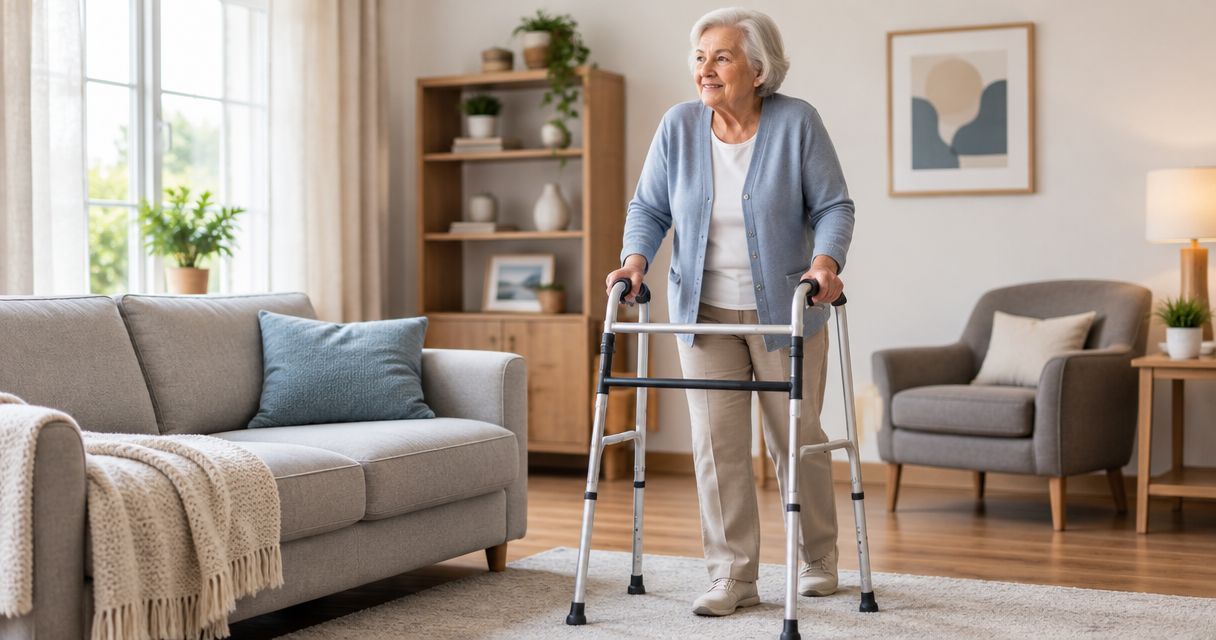
A standard walking frame has no wheels and is lifted forward before you step. It offers support through both hands, but you need enough arm control and coordination to move it safely.
Best for: Someone whose assessment identifies a need for frame support and who can lift and position the frame without losing balance.
Standard walking frame pros:
- Does not roll forward on wheels.
- Provides handles for support through both hands.
- Avoids the need to operate hand brakes.
Standard walking frame cons:
- Repeated lifting can be tiring.
- It needs sufficient space for placement and turning.
- It is unsuitable if lifting the frame disrupts your balance.
Check how you approach your usual chair, not just how you walk in a straight line. A frame that fits through a doorway still needs enough room for you to turn and position yourself.
Verdict: Hold until an assessment confirms you can lift and place the frame safely.
2. Two-wheeled walking frame: best for reducing frame lifting
A two-wheeled walking frame has wheels at the front and non-wheeled contact points at the rear. This design reduces the need to lift the whole frame with each forward movement.
Best for: Someone who needs support through both hands but finds repeatedly lifting a standard frame difficult, subject to assessment.
Two-wheeled walking frame pros:
- Requires less lifting than a standard frame.
- Keeps support available through both handles.
- Provides an alternative to a fully wheeled walker.
Two-wheeled walking frame cons:
- Rear contact points can drag or catch on surfaces.
- Turning requires space and practice.
- It does not remove the need for balance and walking assessment.
Check the exact model rather than assuming every two-wheeled frame behaves alike. Floor transitions, rugs and thresholds deserve attention because they affect how the aid moves through your home.
Verdict: Hold until you have tried the frame on your usual indoor routes with professional guidance.
3. Four-wheeled walker: best for controlled continuous movement
A four-wheeled walker, often called a rollator, rolls as you walk and uses hand-operated brakes. Some models include a seat, but features differ between models.
Best for: Someone who can steer, manage the brakes and control the walker while moving and stopping.
Four-wheeled walker pros:
- Does not need lifting with every step.
- Allows continuous rolling movement.
- Models with a suitable seat offer a place to rest when used according to instructions.
Four-wheeled walker cons:
- Requires reliable brake operation and steering.
- Can roll away if it is not controlled.
- Its turning space and overall width need checking indoors.
For your 2026 comparison, do not treat a seat or storage basket as evidence of suitability. First check whether you can stop, turn and position the walker safely; assess convenience features afterwards.
Do not use a rollator as a wheelchair unless its manufacturer explicitly approves that function. A seat does not automatically mean the device is designed to transport someone.
Verdict: Hold until brake control, steering and safe use have been assessed.
4. Single-point walking stick: best for lighter one-handed support
A single-point walking stick has one ground-contact point and is held in one hand. It is smaller than a frame, but that compact size comes with less support.
Best for: Someone assessed as needing lighter assistance rather than support through both hands.
Single-point walking stick pros:
- Takes up less room than a walking frame.
- Leaves one hand free while walking.
- Is simpler to position in narrow spaces than a wider frame.
Single-point walking stick cons:
- Does not provide the support of a walking frame.
- Requires suitable grip and coordination.
- A worn tip or incorrect height needs attention.
Ask your physiotherapist which hand to use and how to coordinate the stick with your steps. The right instructions depend on why you need the aid, including any pain or movement restrictions.
Avoid choosing a stick simply because it looks less noticeable. Your comfort with using an aid matters, but it should sit alongside an honest assessment of the support you need.
Verdict: Skip a walking stick if assessment shows you need support through both hands.
5. Quad stick: best for a broader one-handed base
A quad stick has a base with 4 feet rather than a single tip. That changes how it contacts the floor, but a broader base does not automatically make it the best choice.
Best for: Someone whose assessment supports using a broader-based, one-handed aid and who can position it correctly.
Quad stick pros:
- Offers a broader base than a single-point stick.
- Provides support through one hand.
- Gives another option when comparing stick designs.
Quad stick cons:
- The base can catch a foot or nearby furniture.
- Correct placement requires attention.
- Uneven surfaces can prevent all feet contacting the floor together.
Try the aid beside your usual furniture, not only in an open space. Check whether you can position the base without placing it in the path of your next step.
Verdict: Hold until correct placement and suitability have been checked in your home.
How this guide ranks walking aids
This 2026 guide compares established aid designs against support needs, hand control, home fit and everyday use. It does not rank manufacturers or claim that a particular model has been tested.
The standard frame appears first because it introduces support without wheels. The remaining options address different handling needs, not progressively lower quality. A walking aid earns its place by fitting your needs, not by having more features.
Check the aid against your actual home
Before choosing, explain where walking feels difficult and what happens there. “The frame catches beside the bed” gives your physiotherapist more useful information than “walking is hard”.
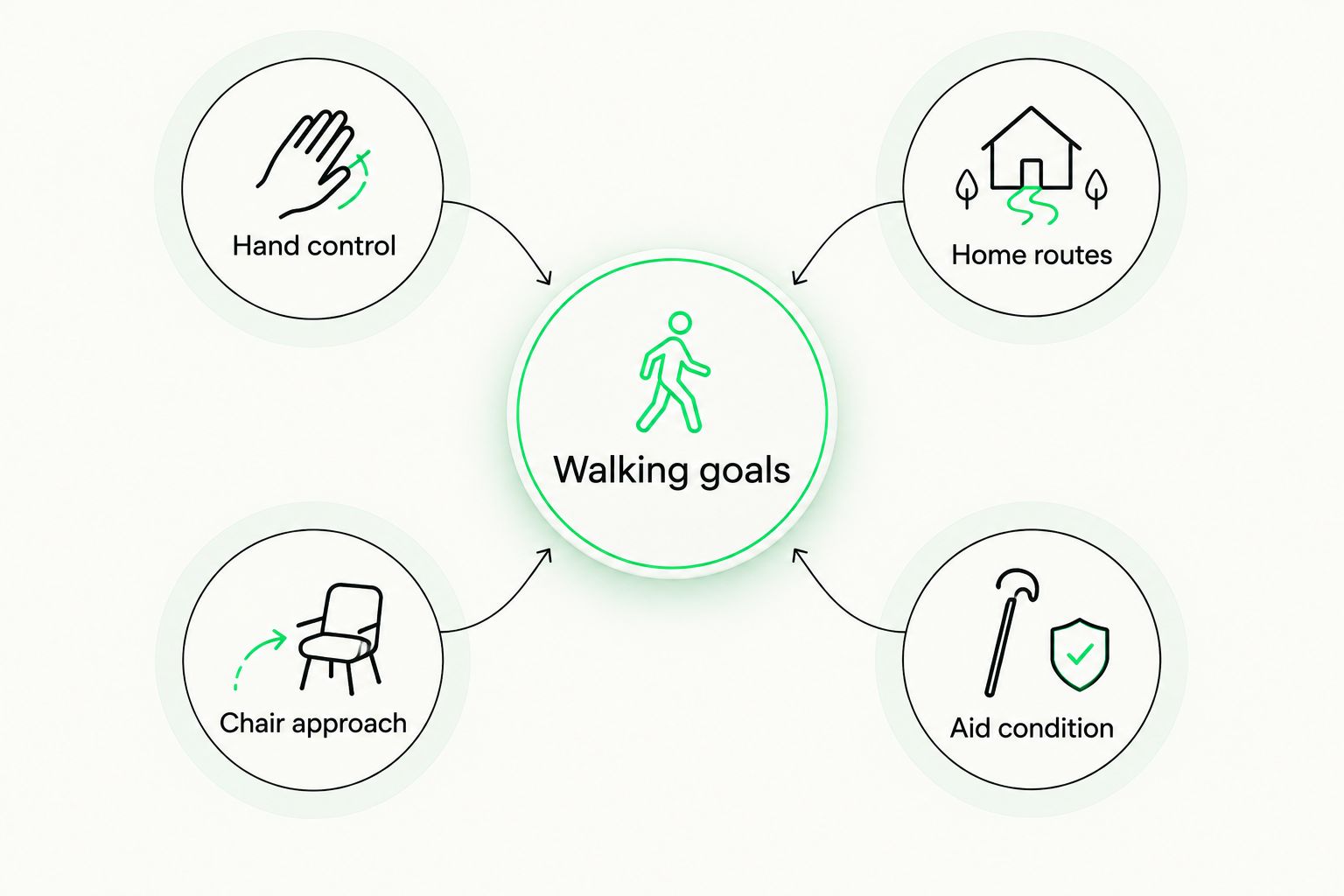
Use these prompts when preparing for an appointment:
- Walking goals: Name the everyday movement you want help with.
- Hand control: Mention pain, weakness or difficulty managing handles and brakes.
- Home routes: Identify doorways, turns and floor changes along your usual path.
- Chair approach: Explain any difficulty turning or positioning yourself before sitting.
- Aid condition: Point out loose adjustments, worn tips or brake concerns.
You do not need to demonstrate a difficult task alone before the visit. Describe the concern and leave an unsafe manoeuvre for professional assessment.
For more detail about the appointment discussion, read whether mobile physiotherapy can assess walking aids at home.
Information for families and professional referrers
Share the person's own goal, their current aid and any recent change in walking. Include relevant discharge instructions or movement restrictions, with the person's consent.
Families, home care providers and support coordinators can also explain who currently assists and which tasks cause concern. Avoid describing a person as independently mobile without explaining whether they need supervision, prompting or physical assistance.
Foveria Health provides home physiotherapy across Greater Sydney. For people in Punchbowl and nearby suburbs, an enquiry can begin with your location, the walking concern and what you hope to work towards with Simon.
Which walking aid should you choose?
If you are undecided, choose an assessment before choosing equipment. There is no single best walking aid for every senior at home in 2026.
A standard frame deserves consideration when support through both hands is needed and lifting is manageable. A two-wheeled frame changes that lifting demand; a four-wheeled walker adds steering and brake requirements. Sticks belong in a different support category and should not replace a needed frame simply to save space.
With Foveria Health, home physiotherapy can focus on your goals in the surroundings where you carry out everyday activities. Tell Simon what you want to do more comfortably or confidently, rather than arriving with a fixed decision about equipment.
FAQ
What's the best walking aid for an older person at home?
The best walking aid is the one that matches the person's assessed support needs, handling ability and home layout. A frame, wheeled walker and walking stick provide different kinds of assistance, so they are not interchangeable.
Is a walking frame better than a walking stick?
A walking frame provides support through both hands, while a walking stick provides one-handed support. The better choice depends on the support you need and whether you can manage the device safely.
Is a four-wheeled walker always easier to use?
No, a four-wheeled walker requires steering and reliable brake control. Not having to lift it does not remove those demands or establish that it suits your walking.
Can I use someone else's old walking aid?
A borrowed walking aid needs its suitability, adjustment and condition checked before use. Being the right general type does not establish that its height, tips, wheels or brakes are appropriate for you.
Should I change walking aids after a fall?
A fall is a reason to seek assessment rather than automatically change walking aids. Explain what happened, any new symptoms and whether your current aid was involved; new injuries or sudden changes need medical attention.
Can a physiotherapist help choose an aid in my home?
An in-home physiotherapy assessment can consider your walking alongside your actual surroundings. Discuss the routes and tasks that matter to you, including doorways, turns and approaching your usual chair.
What should I ask before arranging home physiotherapy in 2026?
Ask whether the appointment can address your walking-aid concerns and what information to prepare. Confirm appointment arrangements, referral requirements and any funding questions directly for your circumstances before booking.
One last thing
The moment you approach your chair deserves as much attention as walking across the room. An aid must be manageable when you stop and turn, not just when you move forwards.
At your next assessment, name one everyday destination that matters to you. “I want to reach my bathroom more confidently” gives you and Simon a clear starting point for personal, goal-focused care.