Best overall starting point: resistance bands, when they suit your assessed needs. Best for seated movement: a pedal exerciser. Best for avoiding hand-held weights: cuff weights. The best home exercise equipment for NDIS participants fits the person, their goals and their home—not a standard shopping list.
- The best home exercise equipment for NDIS participants matches assessed needs, everyday goals and the home environment.
- Resistance bands suit adaptable resistance exercises; grip, positioning and safe setup still need checking.
- Pedal exercisers suit seated movement, but chair stability and equipment positioning matter.
- Foveria Health offers home physiotherapy assessment and treatment for NDIS participants across Greater Sydney.
- Confirm equipment suitability and any funding arrangements before buying; inclusion here does not establish eligibility.
Why this matters
Equipment is only useful when you can set it up, use it as intended and put it away safely. A small item that needs awkward bending or constant help is not necessarily a practical choice.
Foveria Health suits NDIS participants seeking physiotherapy assessment and treatment at home in Greater Sydney. An assessment with Simon is a place to discuss your goals, current equipment and the support involved in exercising at home. You can enquire through Foveria Health.
This 2026 guide compares equipment categories, not individual products. It does not prescribe an exercise programme or establish whether a purchase can be funded through your NDIS plan.
What makes the best home exercise equipment?
Use these criteria before comparing features:
- Goal fit: Identify the everyday activity you want to work towards, rather than buying equipment without a purpose.
- Safe positioning: Check the chair, floor, equipment placement and any support needed during use.
- Accessible handling: Consider grip, reach, vision, understanding instructions and help with setup.
- Appropriate resistance: Choose equipment that matches an assessed exercise, not simply the heaviest option.
- Home practicality: Include storage, walking routes, cleaning and who will move the equipment.
- Review and adjustment: Ask how you will recognise when an exercise or equipment setup needs changing.
For your 2026 shortlist, separate exercise suitability from purchasing arrangements. A recommendation about movement does not, by itself, answer questions about funding.
Home exercise equipment at a glance
| Equipment | Best for | Standout feature | Key limitation |
|---|---|---|---|
| Resistance bands | Adaptable resistance exercises | Flexible resistance without a rigid weight | Grip and safe positioning need checking |
| Pedal exerciser | Seated repetitive movement | Pedalling from a separate chair | The chair and unit need a suitable setup |
| Cuff weights | Resistance without holding a weight | Fasten around a limb | Fastening and positioning can require assistance |
| Dumbbells | Measurable hand-held resistance | A stated load for each weight | Require suitable grip and controlled handling |
| Exercise mat | A surface for assessed floor exercises | Separates your exercise space from the floor | Does not solve difficulty getting down or up |
The order favours adaptable equipment before more specific choices. It is not a progression: you do not need to work through every item or buy the whole list.
1. Resistance bands: best for adaptable resistance exercises
Resistance bands provide resistance as you stretch them. Different shapes, lengths and resistance levels suit different exercises, so the word “band” does not describe a single interchangeable product.
Their appeal is flexibility. Their limitation is that the exercise still depends on your grip, starting position and control as the band returns.
Resistance band pros:
- Compact enough to store without a dedicated exercise area.
- Available in different forms, including loops and handled designs.
- Allow resistance exercises without holding a rigid weight.
Resistance band cons:
- Holding or positioning a band can be difficult with limited hand function.
- Damage, slipping or an unsuitable anchor creates a safety concern.
Do not choose a band by colour alone; resistance labels are not interchangeable across manufacturers. Ask which design suits the exercise, how to check its condition and whether any anchor is needed. Do not improvise a household attachment point.
Best for: Participants whose assessed programme includes band-based resistance and who can manage the setup independently or with agreed assistance.
Verdict: Buy only after the band type, resistance and setup are agreed.
2. Pedal exerciser: best for seated repetitive movement
A pedal exerciser lets you pedal while sitting in a separate chair. It is different from a full exercise bike because your own chair forms part of the setup.
That makes positioning central to the decision. Seat height, foot placement, reach to controls and movement of the unit all deserve attention before purchase.
Pedal exerciser pros:
- Supports a seated movement option without mounting a full exercise bike.
- Keeps the chair separate from the exercise unit.
- Offers repetitive movement when pedalling suits the participant's programme.
Pedal exerciser cons:
- A sliding unit or moving chair can interrupt safe use.
- Reaching down to position feet or adjust controls can require help.
Ask to consider the complete setup rather than the device alone. A product photograph cannot tell you whether your chair, available space and movement needs work together. Plan where the unit will go afterwards so it does not obstruct a walking route.
Best for: Participants seeking an assessed seated movement option with suitable chair support and equipment positioning.
Verdict: Hold until the chair-and-pedal setup has been checked.
3. Cuff weights: best for resistance without gripping a weight
Cuff weights fasten around a limb rather than being held in the hand. They offer a different way to add resistance when gripping a dumbbell is not suitable for a particular exercise.
They are not a substitute for checking movement technique. The weight, fastening and position all affect how the exercise feels and how you manage it.
Cuff weight pros:
- Remove the need to hold a separate weight during the selected exercise.
- Leave the hands available rather than occupied by dumbbells.
- Provide a stated load for an agreed exercise.
Cuff weight cons:
- Fastening and removing the cuff can require assistance.
- Poor fit or placement can cause discomfort or movement of the cuff.
Ask who will put the cuff on, how its position will be checked and whether you can remove it comfortably. Do not assume a weight intended for a specific exercise should be worn while walking or throughout daily activities.
Best for: Participants whose physiotherapist has selected cuff-based resistance for a particular movement.
Verdict: Buy only for a specified exercise, fit and load.
4. Dumbbells: best for measurable hand-held resistance
Dumbbells provide a stated hand-held load. They suit exercises where holding and controlling the weight is part of the intended movement.
The selection involves more than the weight printed on the end. Handle shape, storage height and getting the dumbbell into position also matter.
Dumbbell pros:
- Make the selected load easy to identify.
- Offer a straightforward option for hand-held resistance exercises.
- Allow separate weights to be used for different prescribed movements.
Dumbbell cons:
- Require enough grip and control for the chosen exercise.
- Can create a dropping or trip hazard if handled or stored poorly.
If you compare 2 models, consider handling as well as load. Ask whether you can pick up, position and put away each model without adding an awkward task. Adjustable designs also need a check of how their locking mechanism operates.
Best for: Participants whose assessed exercises involve hand-held resistance and who have a suitable handling and storage plan.
Verdict: Buy the prescribed load and a manageable design—not a complete set by default.
5. Exercise mat: best for assessed floor-based exercises
An exercise mat provides a separate surface for floor-based movement. It does not make getting onto the floor, changing position or standing back up safe by itself.
Choose the exercise position first. If floor access is difficult, ask whether the planned activity belongs on another suitable surface instead.
Exercise mat pros:
- Provides a dedicated surface for floor exercises.
- Defines an exercise area that can be cleared after use.
- Can be stored away when the design and available space allow.
Exercise mat cons:
- Requires a suitable way to get down and back up.
- Edges, movement or storage in a walkway can introduce hazards.
Thickness alone is not a useful buying rule. Consider how the mat behaves under you, whether its edges lie flat and whether someone needs to unroll or store it. Keep the assessment focused on the whole task, including leaving the floor.
Best for: Participants with assessed floor-based exercises and a suitable plan for floor transfers.
Verdict: Skip if getting onto or off the floor has not been addressed.
How to narrow your shortlist before buying
For a 2026 equipment decision, take a short list to your physiotherapist rather than arriving with a completed purchase. Photos of the intended exercise area and equipment you already own can help explain the practical questions.
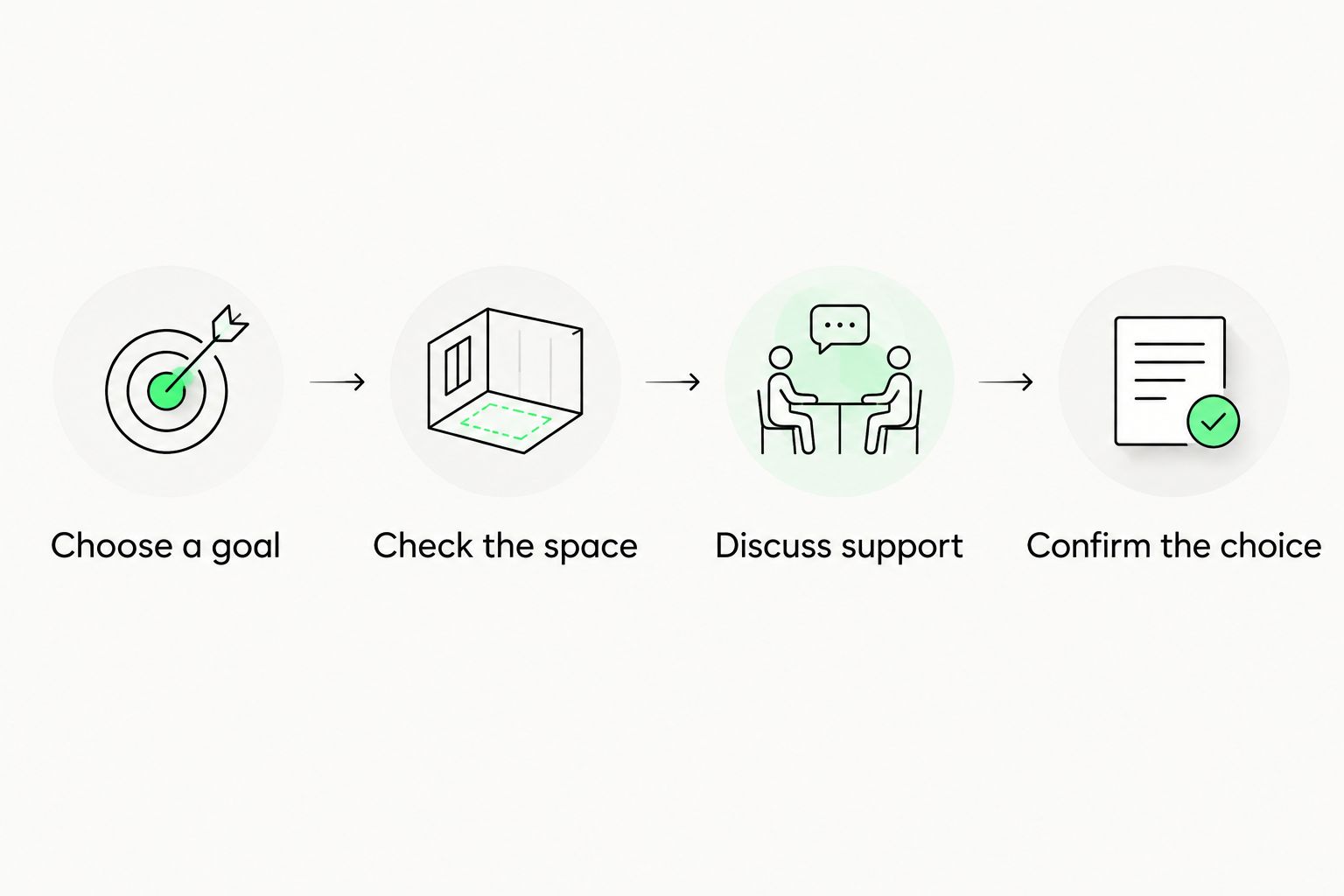
Use this sequence:
- Choose a goal: Start with 1 daily task you want to work towards, such as getting out of your usual chair.
- Check the space: Consider the exercise position, access around furniture and a clear walking route.
- Discuss support: Identify who will help with setup, instructions or putting equipment away.
- Confirm the choice: Agree on the equipment features and the questions that need answering before purchase.
You do not need to create a home gym before discussing exercise. The guide to preparing for your first physiotherapy visit at home can help you organise the appointment.
Keep suitability and funding questions separate
Before arranging a purchase in 2026, ask 3 questions: What exact item is being recommended? What information is needed to consider the purchase? Who needs to confirm the arrangement?
Do not treat the words “NDIS equipment” in a product listing as confirmation about your plan. Confirm the proposed purchase and any documentation requirements with the people responsible for your funding arrangements before committing.
For support coordinators and home care teams, record the participant's goal, the proposed item and who will help with setup. Avoid passing on a general instruction such as “buy some weights” without the details needed to choose appropriately.
How these options were ranked
This 2026 ranking uses goal fit, accessible handling, positioning, home practicality and the ability to review the exercise. It is a category guide, not a product test or a claim that one item produces better clinical outcomes.
Resistance bands lead as an adaptable starting point for discussion. Pedal exercisers, cuff weights, dumbbells and mats each address a different setup; none earns a place simply because it looks more advanced.
Which equipment should you choose?
Start with the exercise goal, then choose the smallest suitable equipment list. If you are undecided, discuss resistance bands first—but do not buy them until grip, positioning and the intended exercise are clear.
Foveria Health provides NDIS home physiotherapy across Greater Sydney, including assessment and treatment at home. For participants in Punchbowl and nearby suburbs, discussing everyday tasks with Simon keeps the equipment conversation connected to life at home.
Discuss your home exercise needs
Ask about a home physiotherapy assessment with Simon in Greater Sydney.
FAQ
What's the best home exercise equipment for NDIS participants?
The best equipment matches your assessed needs, everyday goals and home setup. Resistance bands are an adaptable starting point for discussion, but grip, positioning and support needs determine whether they suit you.
Should I buy exercise equipment before my first home physio appointment?
Discuss equipment at your assessment before buying it. Tell your physiotherapist what you already own and which everyday activities you want to work towards.
Are resistance bands better than dumbbells?
Neither is better for everyone. Resistance bands and dumbbells require different handling and positioning, so the intended exercise and your ability to manage the equipment should guide the choice.
Is a pedal exerciser suitable if I use a wheelchair?
Wheelchair use alone does not establish whether a pedal exerciser is suitable. Ask your physiotherapist to assess seating, foot positioning, movement needs and the stability of the complete setup.
Can I assume my NDIS plan will pay for this equipment?
No—this article does not establish funding eligibility for any item. Confirm the proposed purchase and any required documentation with the people responsible for your funding arrangements before buying.
Do I need an exercise mat for physiotherapy at home?
You only need a mat if it suits the exercises and positions selected for you. Discuss floor access and getting back up before planning floor-based exercise.
Can a support worker help me use home exercise equipment?
Discuss the support worker's role with your physiotherapist and support team before starting. Agree on setup, instructions, assistance and what should prompt stopping and seeking advice.
One last thing
Putting equipment away is part of choosing it. Before buying, describe the whole task: taking it out, setting it up, exercising and storing it without blocking access.
A useful question for Simon is: “What do I actually need for this goal, and what can I leave off the list?” Foveria Health home physiotherapy keeps that discussion grounded in your own surroundings rather than a catalogue.