
Best for light walking support: a walking stick. Best for walking without lifting a frame at every step: a two-wheeled walking frame. Best for bathroom seating: a shower chair. The best mobility aids for seniors at home in 2026 depend on the person, the task and the space—not a single winning product.
- The best mobility aids for seniors at home match assessed support needs, everyday tasks and room layout.
- A walking stick, walking frame and rollator provide different support; they are not interchangeable.
- Bathroom aids support specific tasks but need suitable positioning, fit and installation.
- Foveria Health offers in-home physiotherapy for older people and families seeking personal, goal-focused care.
Why this matters
An aid that suits a straight hallway might be awkward beside a bed or inside a bathroom. Choosing equipment means considering where you turn, sit, stand and reach—not just how you walk.
Foveria Health is suited to older people in Greater Sydney seeking mobility-focused physiotherapy assessment in their own homes. You can discuss your goals with Simon through Foveria Health, including the everyday activities you want help with.
This guide compares equipment categories, not individual models. It supports a conversation with a physiotherapist or occupational therapist; it does not replace individual assessment or instructions following surgery.
What makes the best home mobility aid in 2026?
Use these criteria before choosing equipment:
- Appropriate support: The aid must match your balance, strength and any restrictions given by your treating team.
- Manageable operation: Consider grip, hand comfort, brakes and the ability to follow the operating steps.
- Home fit: Check doorways, turning spaces, floor surfaces and the places where you need support.
- Task fit: Walking to the kitchen, showering and standing from a toilet need different equipment.
- Correct sizing: Check the adjustment range and manufacturer’s user-weight limit rather than choosing by appearance.
- Practical upkeep: Inspect tips, wheels, brakes and fixings as relevant, following the manufacturer’s instructions.
Home mobility aids at a glance: 2026 shortlist
The order below follows everyday tasks, starting with walking and then bathroom use. It is not a recommendation to progress through increasingly substantial equipment without assessment.
| Mobility aid | Best for | Standout feature | Key limitation |
|---|---|---|---|
| Walking stick | Assessed light walking support | Operated with one hand | Less support than a walking frame |
| Fixed walking frame | Frame support without wheels | Stationary contact points when placed | Requires lifting and repositioning |
| Two-wheeled walking frame | Frame walking without lifting the whole frame each step | Front wheels assist forward movement | Turning and thresholds need checking |
| Four-wheeled rollator | Walking with a wheeled aid and suitable brake control | Wheels and hand-operated brakes | Can move away without adequate control |
| Fixed grab rails | Support at a specific bathroom location | Support fixed to a suitable structure | Installation and positioning are critical |
| Raised toilet seat | Reducing the depth of lowering onto a toilet | Raises the sitting surface | Compatibility and foot support need checking |
| Shower chair | Sitting during showering | Provides a shower seating surface | Does not solve shower access difficulties |
1. Walking stick: best mobility aid for light walking support
A walking stick provides support through 1 hand. It suits some people who need limited additional support, but it is not a substitute for a frame when greater assistance is needed.
A physiotherapist can check the height, grip and walking technique. Do not assume a relative’s spare stick fits you.
Walking stick pros:
- Less bulky than a walking frame.
- Leaves the other hand free when appropriate.
- Simple construction makes the tip and shaft straightforward to inspect.
Walking stick cons:
- Provides less support than a frame.
- Requires suitable grip, coordination and technique.
Best for: Someone assessed as needing light walking support who can manage a stick safely.
Verdict: Buy only after fit and walking technique are checked.
2. Fixed walking frame: best for support without rolling wheels
A fixed walking frame has no wheels and must be lifted and placed forward. Once positioned correctly, its feet provide stationary contact with the floor.
The lifting requirement matters. A frame that feels steady while standing still is not necessarily manageable across a whole room.
Fixed walking frame pros:
- Does not roll forward during use.
- Provides support through both hands.
- Has no wheel brakes to operate.
Fixed walking frame cons:
- Requires sufficient ability to lift and reposition it.
- Can be awkward in tight spaces or across thresholds.
Best for: Someone assessed as needing frame support who can lift and place the frame safely.
Verdict: Hold until you have trialled the lifting and turning involved.
3. Two-wheeled walking frame: best for moving a frame forward
A two-wheeled walking frame has 2 wheels at the front and non-wheeled rear contact points. It allows forward movement without lifting the entire frame at every step.
The rear contact design varies between models. Check the actual equipment on your flooring rather than assuming every two-wheeled frame behaves alike.
Two-wheeled walking frame pros:
- Reduces the need to lift the whole frame.
- Provides support through both hands.
- Combines front wheels with rear floor contact.
Two-wheeled walking frame cons:
- Rear tips or glides require inspection and maintenance.
- Thresholds, floor changes and turning spaces need a practical trial.
Best for: Someone assessed as needing a frame who finds repeated lifting difficult and can control this design.
Verdict: Buy only after a trial on the surfaces you use daily.
4. Four-wheeled rollator: best for wheeled walking with brake control
A four-wheeled rollator moves on 4 wheels and uses hand-operated brakes. Some models include a seat, but features differ and should be checked individually.
A rollator is not automatically safer because it looks substantial. You need to control its movement and use its brakes as instructed.
Four-wheeled rollator pros:
- Rolls without repeated lifting during ordinary forward walking.
- Uses brakes to control or secure movement as designed.
- Models with a seat provide a resting option when used according to instructions.
Four-wheeled rollator cons:
- Requires suitable hand function, judgement and brake control.
- Turning space and overall width can limit use indoors.
Best for: Someone assessed as able to control a wheeled aid and operate its brakes reliably.
Verdict: Hold until brake use, turning and any seat use have been checked.
5. Fixed grab rails: best for support at a specific location
Fixed grab rails provide a handhold where support is needed, such as beside a toilet or in a shower. Their usefulness depends on the person’s movement and the rail’s position.
An occupational therapist can help assess bathroom tasks and suitable placement. Installation must suit the wall structure and the rail manufacturer’s requirements.
Fixed grab rails pros:
- Provide support at a chosen point of use.
- Do not need to be carried between tasks.
- Can be positioned around an assessed movement need.
Fixed grab rails cons:
- A poorly positioned rail can be difficult to use.
- Require appropriate fixings and installation; a towel rail is not a substitute.
Best for: Someone needing a reliable handhold at an assessed bathroom location.
Verdict: Wait for positioning and installation advice before purchasing.
6. Raised toilet seat: best for reducing lowering distance
A raised toilet seat increases the height of the toilet’s sitting surface. It changes the distance involved in sitting down and standing up, but suitability depends on your movement and the bathroom setup.
Check compatibility with the toilet and whether your feet remain supported. A higher seat is not automatically a better seat.
Raised toilet seat pros:
- Reduces how far you lower onto the toilet.
- Changes the seat height without replacing the toilet itself.
- Different designs allow compatibility to be considered individually.
Raised toilet seat cons:
- An unsuitable height can leave feet poorly supported.
- Fit, attachment and cleaning requirements vary by design.
Best for: Someone whose toilet transfers have been assessed and who would benefit from a suitable higher sitting surface.
Verdict: Hold until height, attachment and toilet compatibility are checked.
7. Shower chair: best for sitting during showering
A shower chair provides a seat for washing in a shower. It addresses the need to sit; it does not remove the difficulty of stepping over a shower edge or moving onto the chair.
Consider the shower footprint, drainage, access and space needed by anyone assisting. Follow the manufacturer’s instructions for adjustment and use.
Shower chair pros:
- Provides a dedicated sitting surface for showering.
- Allows seated washing when that suits the person’s assessed needs.
- Can be considered alongside other bathroom supports.
Shower chair cons:
- Takes up space inside the shower.
- Does not independently solve access or transfer difficulties.
Best for: Someone assessed as needing seated showering who can access and use the chair safely.
Verdict: Buy only after checking shower access, fit and transfers.
How to choose an aid for your actual home
Start with the activity that feels difficult, not a product catalogue. For example, “I want to reach the toilet at night” gives your clinician more useful information than “I think I need a walker”.
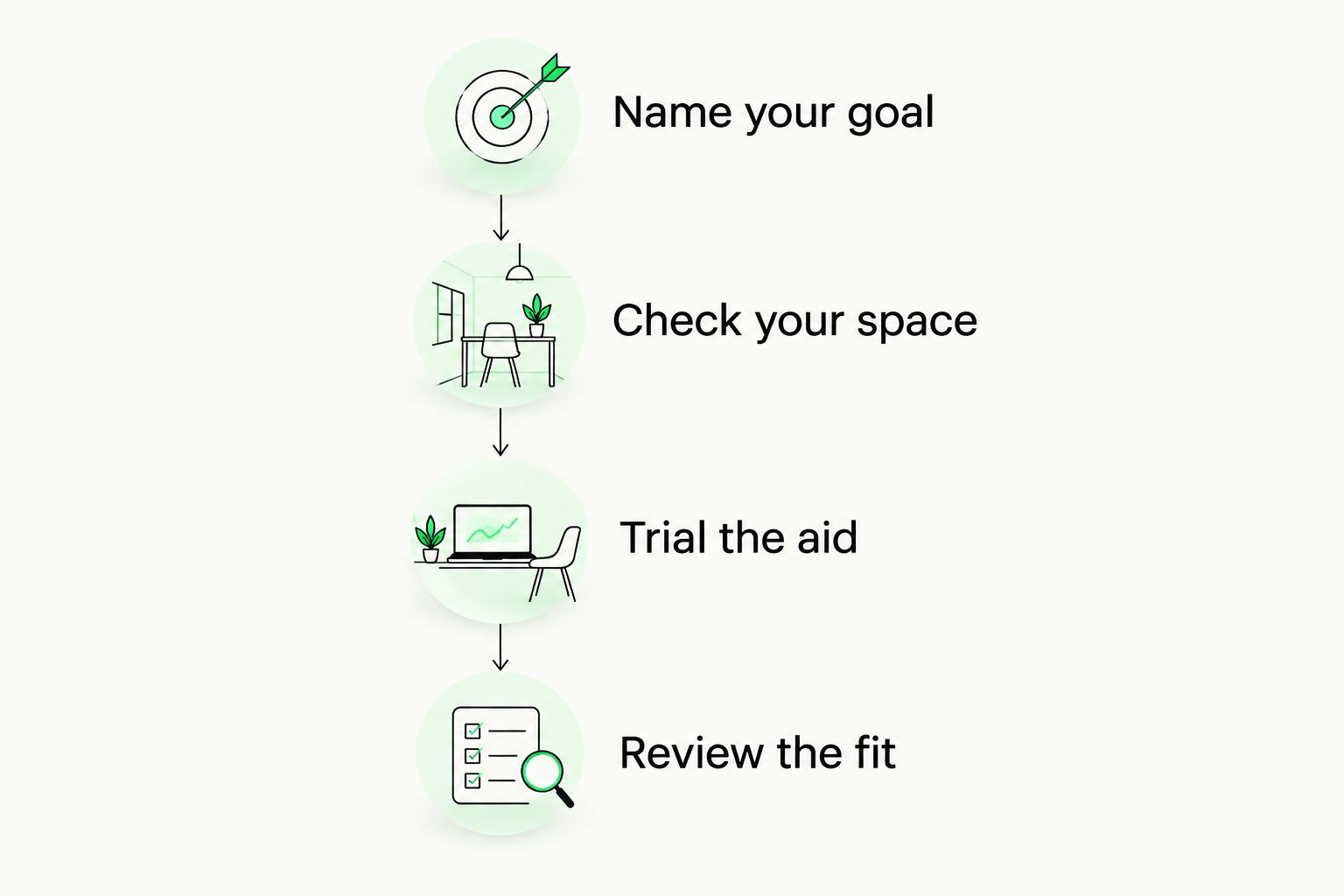
Use this sequence with your treating professional:
- Name your goal: Describe the task, where it happens and what assistance you currently need.
- Check your space: Consider doorways, furniture, floor changes and the place where the aid will be stored.
- Trial the aid: Practise relevant tasks with suitable supervision, including turning and approaching a seat.
- Review the fit: Confirm adjustments, operating instructions and when another review is needed.
The trial should reflect everyday use, not just a straight walk across an uncluttered room. Bring up hand pain, fatigue, vision difficulties or trouble remembering instructions so these are part of the decision.
For families arranging an appointment, this guide explains walking-aid assessment at home. Foveria Health provides in-home physiotherapy across Greater Sydney, including care focused on personal goals with Simon.
Information for home care teams and referrers
With the person’s consent, share their main goal, current equipment, usual assistance and relevant discharge instructions. Explain the specific difficulty rather than selecting equipment on their behalf.
Keep funding questions separate from clinical suitability. Confirm any equipment or appointment funding arrangements with the relevant provider before making commitments.
How this 2026 shortlist is ranked
These categories are matched to distinct tasks using support needs, operation, home fit, sizing and upkeep. No brand or model receives a recommendation, and the list does not claim that equipment was personally tested.
Walking aids come first because they address movement between rooms. Bathroom aids follow because they support particular activities rather than replacing walking assistance.
Which mobility aid should you choose?
For 2026, the default recommendation is an assessed equipment choice—not a particular walking aid. If you need only light support, ask whether a walking stick is appropriate; if you need both hands for support, ask for a frame assessment.
For showering or toilet difficulties, describe that task separately. A walking frame does not replace a bathroom assessment, and a shower chair does not make the route to the bathroom safe.
FAQ
What's the best mobility aid for an older person at home?
The best mobility aid matches the person's assessed support needs, daily tasks and home layout. A walking stick, frame and bathroom aid solve different problems, so there is no single best choice for every older person.
Is a walking frame better than a walking stick?
A walking frame provides support through both hands, while a walking stick provides support through one hand. The right choice depends on balance, strength, coordination and the ability to manage the aid.
Is a four-wheeled rollator safer than a two-wheeled frame?
A four-wheeled rollator is not automatically safer than a two-wheeled frame. A rollator requires suitable movement control and brake operation; both designs need assessment in the intended setting.
Can I buy a walking aid for my parent without an assessment?
An assessment before choosing a walking aid helps establish the support, size and operating features your parent needs. Involve your parent in the decision and arrange a practical trial rather than choosing only from photographs.
Does a shower chair replace bathroom grab rails?
A shower chair and grab rails perform different jobs. A chair provides seating, while a rail provides a handhold; an individual bathroom assessment determines whether either or both are suitable.
What should I tell a physiotherapist about mobility problems at home?
Describe the tasks that are difficult, the equipment already used and any recent changes in walking or assistance needs. Share relevant treatment restrictions and explain the person's own goals.
Can Foveria Health help with mobility concerns at home?
Foveria Health offers in-home physiotherapy assessment and treatment across Greater Sydney. Discuss your mobility concerns and equipment questions with Simon when arranging an appropriate appointment.
One last thing
Check where the aid will be when you need it. An otherwise suitable walking aid is not useful if it is left across the room when you stand up.
Include storage and access in the assessment, especially beside the bed and bathroom. That small practical detail deserves the same attention as the equipment itself.