Best for chair transfers: sit-to-stand. Best for supported standing balance: weight shifts. Best for calf strength: supported heel raises. These are useful starting points when choosing the best exercises for fall prevention in seniors at home in 2026, but your balance, health and need for assistance determine which exercises belong in your plan.
- The best exercises for fall prevention in seniors at home combine balance practice, strength and individual assessment.
- Sit-to-stand suits chair-transfer goals; supported weight shifts practise moving your weight while standing.
- Foveria Health provides home physiotherapy in Greater Sydney for older people and families seeking individual assessment.
- After a fall or new unsteadiness, seek assessment before trying harder balance exercises.
Foveria Health offers mobile physiotherapy across Greater Sydney, including care for older people at home. Foveria Health home physiotherapy suits older people who want their movement assessed in the place they use it every day.
Why this matters
Getting out of a chair, turning towards the bathroom and reaching the kitchen bench involve different movement skills. A useful exercise plan connects practice with the daily tasks you want to manage, rather than treating every older person as having the same needs.
Exercise is only part of fall prevention. Medicines, eyesight, footwear, dizziness and hazards around the home also need attention. An exercise list cannot establish why someone has fallen.
Do not begin standing exercises alone if you need another person to help you stand or walk. New or worsening unsteadiness needs assessment, not a harder exercise challenge.
What makes the best home fall-prevention exercises?
Choose exercises for your 2026 plan using these criteria:
- Everyday relevance: The movement supports a task that matters to you, such as standing from your usual chair.
- Appropriate challenge: You can practise without losing control or needing to grab suddenly for support.
- Stable support: A fixed bench or suitable rail is available where standing practice requires it.
- Individual adjustment: Your physiotherapist can change the movement, assistance or difficulty to suit you.
- Clear instructions: You and anyone helping understand the exercise, when to stop and how to report concerns.
- Repeatable setup: You can use the agreed space without moving heavy furniture or relying on unstable objects.
A dining chair that slides, a towel rail or a wheeled walking aid is not a substitute for a secure exercise support. Ask your physiotherapist to check the setup rather than testing its stability while exercising.
Home fall-prevention exercises at a glance
The order below starts with everyday tasks and supported movements. It is not a progression everyone should follow.
| Exercise | Best for | Main purpose | Key limitation |
|---|---|---|---|
| Sit-to-stand | Chair transfers | Practises rising and sitting with control | Requires a suitable chair and enough assistance |
| Supported weight shifts | Standing balance | Practises moving weight between your feet | Not suitable for unsupported practice when unsteady |
| Supported heel raises | Calf strength | Works the muscles that lift your heels | Requires controlled standing and secure support |
| Supported side stepping | Sideways movement | Practises stepping along a clear route | Needs space without crossing your feet |
| Supported marching | Foot clearance | Practises lifting each foot while standing | Briefly increases the demand on the supporting leg |
| Supported heel-to-toe stance | Narrow-base balance | Makes standing balance more challenging | Too difficult for some people, even near support |
1. Sit-to-stand: best for practising chair transfers
Sit-to-stand practises getting up from a chair and lowering yourself back down. It connects exercise with a movement you use throughout the day.
Use a firm, stable chair, with your feet supported on the floor. Your physiotherapist can determine the chair height, hand support and assistance you need; using your hands is not a failure.
Sit-to-stand pros:
- Relates directly to chair transfers.
- Includes both standing up and sitting down.
- Allows the chair setup and assistance to be adjusted.
Sit-to-stand limitations:
- A low or soft chair increases difficulty.
- Pain, dizziness or difficulty controlling the descent needs assessment.
Best for: Older people whose goal is getting out of their usual chair more confidently.
Verdict: Choose sit-to-stand when chair transfers are a priority and the setup has been checked. Do not practise repeated attempts alone if you normally need someone to help you rise.
2. Supported weight shifts: best for standing balance
Supported weight shifts involve gently moving your weight from one foot towards the other while keeping both feet on the floor. The purpose is controlled movement, not leaning as far as possible.
Practise only with the support and supervision agreed with your physiotherapist. Keep the movement within a range you can control without suddenly grabbing or stepping to recover.
Supported weight shifts pros:
- Keep both feet in contact with the floor.
- Practise an element of moving between steps.
- Allow movement size and hand support to be adjusted.
Supported weight shifts limitations:
- Standing symptoms can make this unsuitable.
- Large movements increase the balance demand.
Best for: People who need a supported introduction to moving their weight while standing.
Verdict: Choose supported weight shifts before attempting unsupported balance challenges, if assessed as suitable. Stop if you feel dizzy or cannot control the movement.
3. Supported heel raises: best for calf strength
Supported heel raises involve lifting your heels while keeping the front of your feet on the floor, then lowering with control. They work the calf muscles used during standing and walking.
Use secure support and follow the version prescribed for you. Do not add weights or change to standing on one leg simply because a general exercise video suggests it.
Supported heel raises pros:
- Target calf strength.
- Need little floor space.
- Allow the amount of assistance to be adjusted.
Supported heel raises limitations:
- Require enough standing control to lift and lower safely.
- Foot or ankle symptoms need individual advice.
Best for: People whose assessment identifies calf strengthening as a useful goal.
Verdict: Choose supported heel raises for an identified strength need, not as a complete fall-prevention programme. Strength practice does not replace balance training or a review of other fall risks.
4. Supported side stepping: best for sideways movement
Supported side stepping practises moving sideways along a clear route beside suitable support. Keep your feet from crossing unless a physiotherapist has specifically prescribed a different movement.
The exercise should match the available space. A kitchen with loose mats, open cupboard doors or someone moving behind you is not a ready-made exercise area.
Supported side stepping pros:
- Practises movement in a different direction from forward walking.
- Connects with moving along a bench or around furniture.
- Allows step length and assistance to be adjusted.
Supported side stepping limitations:
- Needs a clear route and appropriate support throughout.
- Turning at the end requires separate consideration.
Best for: People working towards safer sideways movement around the home.
Verdict: Choose supported side stepping only when the route and turning plan are safe. Ask for a demonstration before a family member or support worker assists.
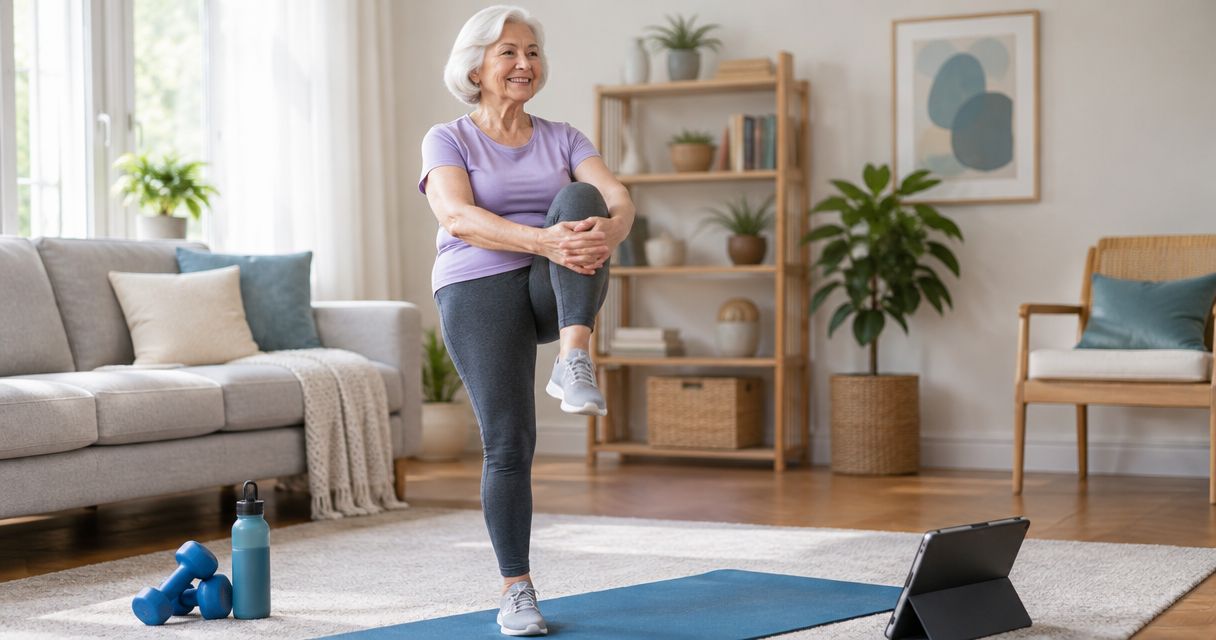
5. Supported marching: best for practising foot clearance
Supported marching involves lifting one foot and replacing it before lifting the other. It practises clearing the floor while your weight moves onto the supporting leg.
A small, controlled lift is different from trying to raise your knees as high as possible. Your physiotherapist should decide whether standing marching, another movement or additional assistance suits you.
Supported marching pros:
- Practises lifting each foot deliberately.
- Needs a small exercise area.
- Allows lift height and pace to be adjusted.
Supported marching limitations:
- Places more demand on the supporting leg.
- Can become uncontrolled if rushed.
Best for: People whose assessment identifies a need to practise foot clearance in supported standing.
Verdict: Choose supported marching only if you can manage the prescribed weight transfer. If your toes catch while walking, arrange assessment rather than assuming marching will address the cause.
6. Supported heel-to-toe stance: best for a narrower balance challenge
Heel-to-toe stance places one foot in front of the other, making your standing base narrower. This is a more demanding option, not a starting exercise for everyone.
Your physiotherapist can select a less narrow position and the necessary support. There is no need to close your eyes or remove hand support to make the exercise count.
Supported heel-to-toe stance pros:
- Provides a specific standing balance challenge.
- Uses little space.
- Allows foot position to be adjusted.
Supported heel-to-toe stance limitations:
- Can be too challenging despite nearby support.
- Does not directly practise walking or chair transfers.
Best for: People assessed as ready for a narrower standing position.
Verdict: Hold until assessed if your balance is uncertain. Skip online challenges that ask you to remove support before you have an individual plan.
How these exercises are ranked
This 2026 guide ranks exercises by everyday relevance, adjustable support and the movement skill each practises. It does not claim that one exercise prevents more falls than another, or that everyone needs all of them.
The World Health Organization's Guidelines on physical activity and sedentary behaviour (2020), covering older adults aged 65 years and over, recommend varied activity emphasising functional balance and strength on 3 or more days a week. They also recommend muscle-strengthening activity on 2 or more days a week and 150–300 minutes of moderate-intensity aerobic activity a week.
Those are population-level recommendations, not a starting prescription for someone recovering from illness or a fall. People unable to meet the recommendations should be active according to their abilities; an individual plan determines where to begin.
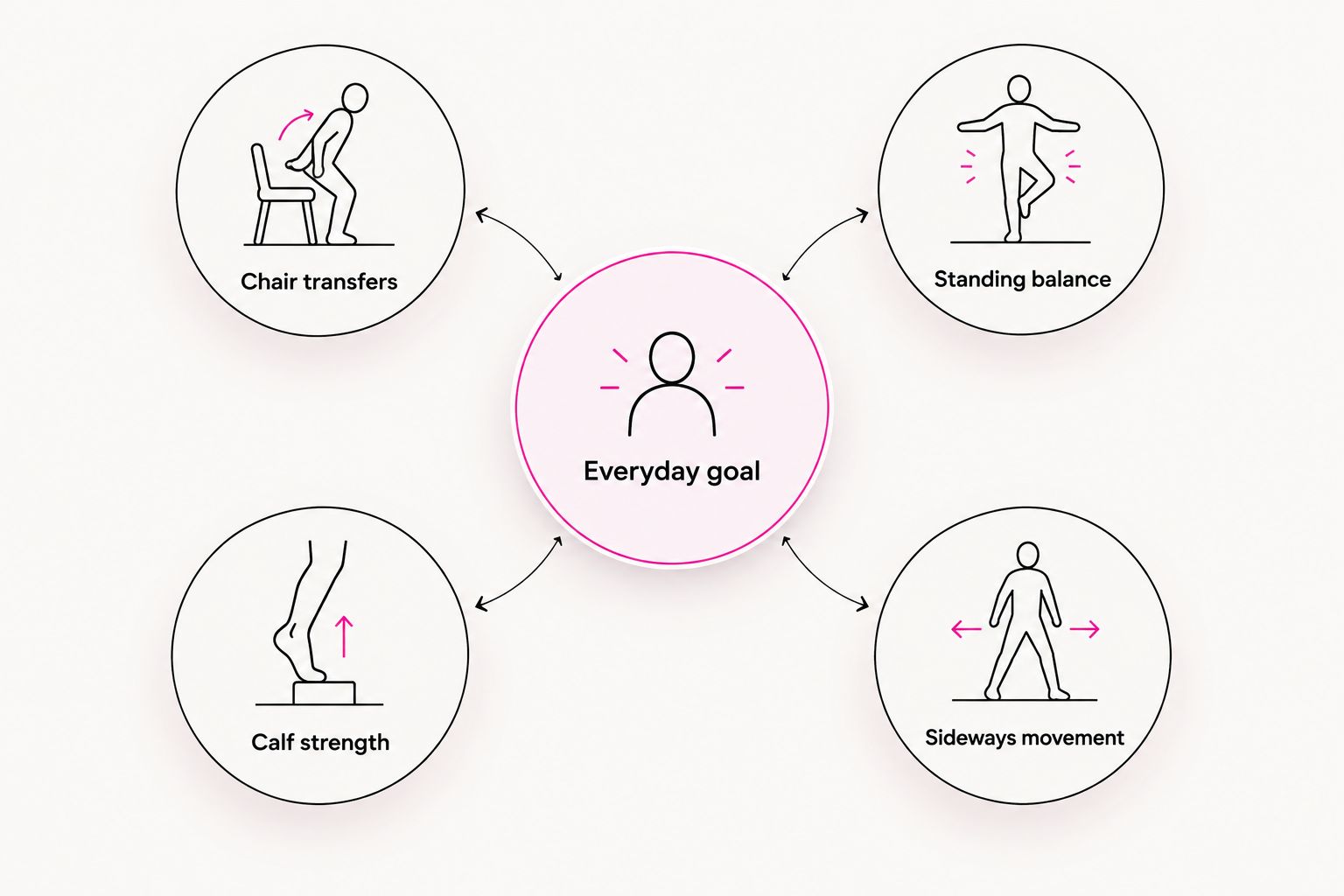
Match the exercise to your everyday goal
Start your conversation with the task, rather than asking for the hardest exercise:
- Chair transfers: Explain which chair is difficult and whether someone helps you stand.
- Standing balance: Describe when you feel unsteady, including any dizziness.
- Calf strength: Ask whether lower-leg strength needs attention after assessment.
- Sideways movement: Show the route you use beside the bed or kitchen bench.
Your goals help Simon understand what matters to you. Foveria Health home physiotherapy offers the opportunity to discuss those goals in your own surroundings.
Arrange support before increasing difficulty
For a home assessment in 2026, describe recent falls or near falls, your usual walking aid and whether you need help with transfers. Mention symptoms, recent surgery and any instructions from your treating team.
Families, home care providers and support coordinators can help by sharing the person's goals with consent. Ask for clear instructions about supervision and assistance; being nearby is not the same as knowing how to help safely.
Foveria Health provides mobile physiotherapy across Greater Sydney. If you live in Punchbowl or a nearby suburb, ask about an appropriate appointment and discuss your home setup rather than assuming a general exercise list is enough.
Discuss physiotherapy at home
Share your movement goals and ask about an appropriate home assessment with Simon.
Which exercises should you choose?
Choose the movement that matches your main daily difficulty, after checking that it is safe for you. Sit-to-stand is the most directly relevant option for chair-transfer goals; supported weight shifts address a different task.
For your 2026 plan, agree on the exercise, support, frequency and stopping instructions together. Do not add every exercise in this guide at once. A manageable plan you understand is more useful than a long list you cannot follow safely.
FAQ
What's the best exercise to prevent falls at home?
There is no single best exercise for every older person. Balance and strength activities should match your assessment and everyday goals; sit-to-stand is directly relevant when chair transfers are the main difficulty.
Is walking enough for fall prevention?
Walking alone does not cover every component of fall-prevention exercise. A suitable plan also considers balance and strength, alongside health factors and hazards around the home.
Should I exercise after a fall?
Seek assessment before starting or increasing exercise after a fall, especially if you have pain, an injury or new unsteadiness. A fall with a suspected serious injury needs urgent medical assessment rather than an exercise session.
How often should seniors do balance exercises?
WHO guidance recommends varied activity emphasising functional balance and strength on three or more days a week for older adults. Your starting frequency and exercise dose should reflect your health, abilities and assessment.
Can I hold the kitchen bench while exercising?
A secure bench can provide support for some prescribed standing exercises. Ask your physiotherapist to check the space and explain how much hand support to use; do not use nearby support as permission to attempt an unsuitable exercise.
Can a family member help with home exercises?
A family member can help when the person agrees and the required assistance has been explained. Ask for a demonstration rather than improvising lifting, pulling or balance support.
Can Foveria Health assess balance at home in Sydney?
Foveria Health offers in-home physiotherapy assessment and treatment across Greater Sydney. Discuss your walking, balance and daily movement concerns when arranging an appropriate appointment with Simon.
One last thing
Show your physiotherapist the chair you actually struggle with. Practising from a different chair does not explain the full problem. Seat height, softness, armrests and the space around your feet all belong in the conversation.