

Instead of repeating your hospital story at every appointment, arrange home physiotherapy after hospital discharge around a shared handover: your discharge instructions, your everyday goals and the help you have at home. Confirm that a home visit suits your needs, then pass on the relevant information before your first assessment.
- Home physiotherapy after hospital discharge starts with a clear handover, not a generic exercise routine.
- Foveria Health offers in-home physiotherapy across Greater Sydney; confirm suitability and appointment arrangements directly.
- Keep discharge instructions, current restrictions and follow-up details together for your physiotherapist.
- Confirm referral requirements and payment arrangements before booking; hospital discharge does not confirm funding.
Why this matters
Hospital discharge and settling back at home are different tasks. Your hospital team explains the discharge plan; your home physiotherapist needs to understand how that plan relates to getting around your own rooms, managing steps and returning to everyday activities.
Foveria Health home physiotherapy suits Greater Sydney clients seeking personal, goal-focused care with Simon at home. You can learn about Foveria Health before discussing whether a home assessment fits your discharge needs.
A home visit removes the journey to a clinic, but it does not replace hospital follow-up, medical review or other services in your discharge plan. For your 2026 discharge arrangements, make the next appointment, the responsible contact and any outstanding questions clear before you leave hospital.
Before you start
Have these materials and arrangements ready before requesting the appointment:
- Discharge information and permission to share it. Gather your discharge summary, relevant physiotherapy instructions and follow-up details. If you are arranging care for someone else, establish how they want to be involved and who has permission to receive information.
- Practical appointment details. Have the home address, access instructions, preferred contact person and relevant referral or payment documents ready. Ask which documents the practice needs rather than sending your entire medical history.
- Any unresolved restrictions. A referral does not necessarily explain movement restrictions, required assistance or when treatment should begin. If the discharge instructions are unclear or conflict with another document, ask the hospital team to clarify them before treating either version as the current plan.
You do not need to create a treatment programme yourself. Your job is to make the handover clear enough for the physiotherapist to assess what is appropriate.
Discharge information
Gather the instructions that affect care at home
- Ask for the discharge documents. Keep the hospital discharge summary and any written physiotherapy instructions together. Ask who to contact if a document is missing or difficult to understand.
- Identify current restrictions. Ask the treating team to explain any limits on movement, walking, lifting or using the affected area. Have unclear instructions clarified in writing rather than relying on a family member's memory.
- Record follow-up arrangements. Include appointments already organised, the team responsible and any instructions about review before progressing activity.
- Write down what matters at home. Describe the actual task you want help with, such as reaching the bathroom or managing the entrance. Distinguish what you did before admission from what you can manage now.
Keep a short summary on 1 page, with the original hospital documents alongside it. This is an organisational suggestion, not a replacement for the clinical record.
Expected result: you have a readable handover that separates hospital instructions, everyday concerns and unanswered questions.
Keep different instructions separate
A discharge summary, exercise sheet and appointment letter serve different purposes. Do not assume that an exercise sheet explains every restriction or that an appointment letter confirms a home physiotherapy referral.
For documents issued in 2026, check the date and the treating team's details so an older instruction is not mistaken for the latest advice. Keep earlier documents available, but identify which instructions were given most recently.
Appointment arrangements
Confirm the right service before booking
- Describe the reason for admission. Tell the practice why you were in hospital, when you returned home and what support the hospital recommended. Explain any unresolved concerns rather than assuming the referral covers them.
- Confirm the address and access. Include your suburb, stairs, building entry arrangements and anything that affects entry to the home. For Punchbowl, nearby suburbs or elsewhere in Greater Sydney, confirm the specific address directly.
- Ask about referral requirements. Explain whether you are enquiring privately or through an existing care arrangement. Ask what referral or supporting documentation applies to your circumstances.
- Confirm payment responsibilities. Establish who will receive the invoice and whether another organisation needs to authorise the appointment. Obtain confirmation before relying on a proposed payment arrangement.
- Agree on information sharing. Confirm how to send relevant documents and who should receive updates, with the client's consent.
Expected result: the practice has enough information to consider the enquiry, and you know what must be settled before the appointment is confirmed.
A useful enquiry is specific: explain the hospital admission, the task causing difficulty at home and the instructions you have received. You do not need to choose a treatment technique before the assessment.
Check whether home or outpatient care fits the discharge plan
These are care settings, not interchangeable promises of treatment. Follow the hospital's recommendations and ask the treating team when the appropriate setting is unclear.
| Care setting | Best for | Practical benefit | Limitation to discuss |
|---|---|---|---|
| Home physiotherapy | People seeking assessment in their everyday home environment | The physiotherapist can consider the rooms and access you actually use | A home visit does not provide every facility or service available elsewhere |
| Hospital outpatient physiotherapy | People whose discharge plan directs them to hospital-based follow-up | Care takes place through the nominated hospital service | You need to arrange travel and clarify how home difficulties will be communicated |
Choose the setting that fits the discharge plan and your needs, not simply the easiest appointment to arrange. If both services are involved, tell each clinician so their roles can be clarified.
Home preparation
Prepare the person, the space and the paperwork
- Choose a suitable area. Identify somewhere you can talk comfortably and show the everyday tasks you want assessed. Tell the practice beforehand if space or access is difficult.
- Keep usual equipment available. Have the walking aid or other equipment you currently use nearby, along with any instructions supplied by the hospital. Do not buy additional equipment just to prepare for the appointment.
- Arrange support if wanted. Ask whether a family member, carer or support worker should attend. Make sure the client is comfortable with their involvement.
- Have documents within reach. Include the discharge information, current exercise instructions and questions you have not had answered.
Expected result: the appointment can focus on your needs rather than locating paperwork or explaining access problems at the door.
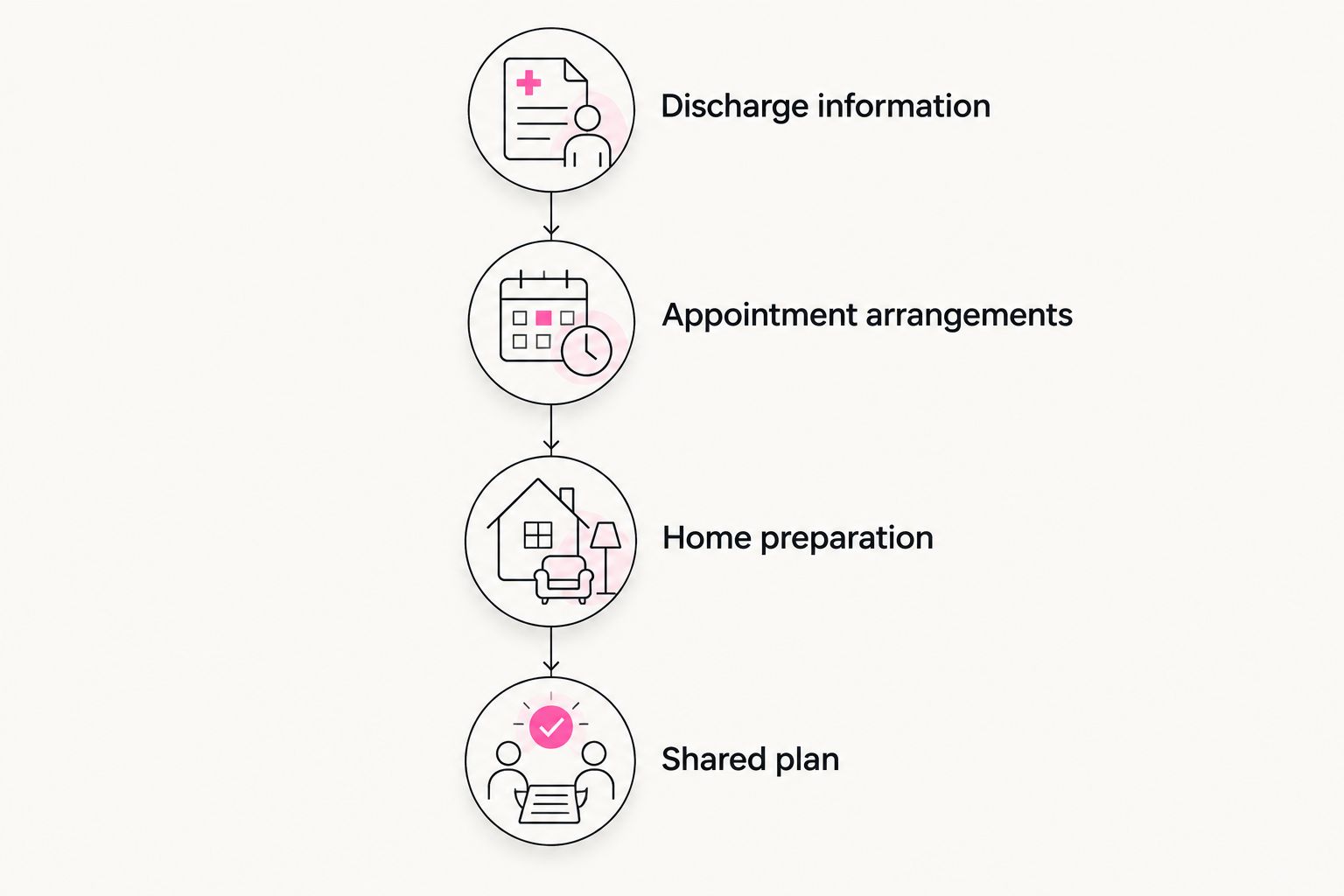
The overall sequence is Discharge information, Appointment arrangements, Home preparation, then Shared plan. Each stage gives the next person something clear to work with.
Shared plan
Leave the assessment knowing what happens next
- Explain your priorities. Tell the physiotherapist which everyday activity matters most to you. Include concerns about confidence, assistance or managing when a carer is not present.
- Review the hospital instructions together. Point out restrictions and anything you do not understand. Ask the physiotherapist to identify questions that need clarification from the treating team.
- Ask for clear instructions. If activities are prescribed, ask how to perform them, what assistance is needed and what to do if you cannot manage them as explained.
- Agree on communication. Decide who needs an update, what information can be shared and how questions between appointments should be directed.
- Clarify the next review. Ask what will be reviewed and how the plan will be reconsidered. Do not assume a fixed course of appointments or a guaranteed recovery date.
Expected result: you understand the agreed next steps, who is responsible for them and where to direct questions.
Before the physiotherapist leaves, ask 3 questions: What should I work on? What help do I need? Who should I contact if something changes? These questions support understanding; they are not a substitute for individual clinical instructions.
When a discharge plan changes
A second workflow is needed when new instructions arrive after the initial handover. This includes updated advice from a hospital review or a change in the support available at home.
- Identify the change. Record who provided the update and when, and keep the written instructions if supplied.
- Notify the relevant clinician. Tell the physiotherapist about updated restrictions or follow-up advice before continuing with an assumption based on the previous plan.
- Clarify the current instructions. Ask the treating clinicians to resolve conflicting advice rather than choosing between it yourself.
- Update the shared record. With consent, give the relevant family member, carer or provider the revised instructions they need for their role.
Keep your 2026 home-care paperwork together so an update does not remain in a separate email while everyone else follows the earlier version.
Expected result: everyone supporting the agreed activities works from the current instructions, with unresolved questions clearly identified.
Troubleshooting your discharge-to-home arrangements
The discharge paperwork has not arrived
Contact the hospital's nominated discharge contact or treating team and ask how to obtain the relevant documents. Tell the physiotherapy practice what is missing; do not fill the gap with a guessed diagnosis or restriction.
Different people have given different instructions
Write down the conflicting advice and identify its source. Ask the responsible treating team to clarify the current instruction, and make sure the clarification reaches the physiotherapist.
Nobody knows who is arranging the appointment
Nominate 1 contact person for appointment coordination, with the client's agreement. State whether that person is making the enquiry, supplying documents or confirming arrangements; these are separate tasks.
The appointment is booked but payment is unresolved
Contact the practice and the organisation expected to pay before the visit. A hospital referral, plan document or previous approval does not by itself confirm the arrangements for this appointment.
Your condition changes while you are waiting
Use the contact instructions in your discharge plan rather than waiting for the home visit to address a new concern. For a medical emergency in Australia, call 000; a routine physiotherapy booking is not an emergency response service.
Customise your workflow
For families, start with the person's own goals and preferred involvement. Foveria Health's personal approach with Simon fits a conversation about what matters at home, without making relatives responsible for designing treatment.
For professional referrers, make the handover useful: include the reason for referral, relevant discharge instructions, current assistance, access details and the client's goals. Confirm permission before sending health information; the guide to consent for a home physiotherapy referral explains the questions to work through.
For self-managed or plan-managed NDIS participants, private clients and people with aged-care or Medicare arrangements, ask what documentation applies to the proposed appointment. Do not infer eligibility or approval from the fact that the person has left hospital.
Use this 2026 checklist to organise the conversation, not to select exercises or decide when restrictions can change. Those decisions need individual assessment and the relevant treating team's advice.
FAQ
How do I arrange home physiotherapy after hospital discharge?
Gather your discharge instructions, contact the physiotherapy practice and explain your needs at home. Confirm suitability, referral requirements, payment arrangements and how to share relevant documents before the visit.
Can I book home physiotherapy before leaving hospital?
You can make an enquiry before discharge. Explain the expected discharge arrangements and ask what must be confirmed before an appointment can be booked.
Do I need a referral for physiotherapy at home?
Ask the practice what referral requirements apply to your appointment and payment arrangement. Keep any hospital referral available, but do not assume it includes every document needed.
When should physiotherapy start after I leave hospital?
The timing should follow your individual discharge instructions and clinical needs. Ask the treating team and physiotherapist to clarify timing if the paperwork does not explain it.
Can a family member attend my home physiotherapy visit?
Discuss attendance with the practice and the person receiving care. Agree on the family member's role and what information the client is comfortable sharing.
Does hospital discharge mean my home physiotherapy is funded?
Hospital discharge does not confirm payment arrangements for a home physiotherapy appointment. Check the relevant requirements and obtain confirmation before relying on another organisation to pay.
Does Foveria Health provide home physiotherapy in Greater Sydney?
Foveria Health provides mobile physiotherapy across Greater Sydney. Confirm your address, discharge needs and appointment arrangements directly with the practice.
One last thing
Make the first goal an everyday task, not simply a body part. Saying that you want help getting from your bedroom to the bathroom gives the physiotherapist a clear starting point for discussing your home needs. It does not promise a particular outcome, but it makes the purpose of the assessment personal and practical.