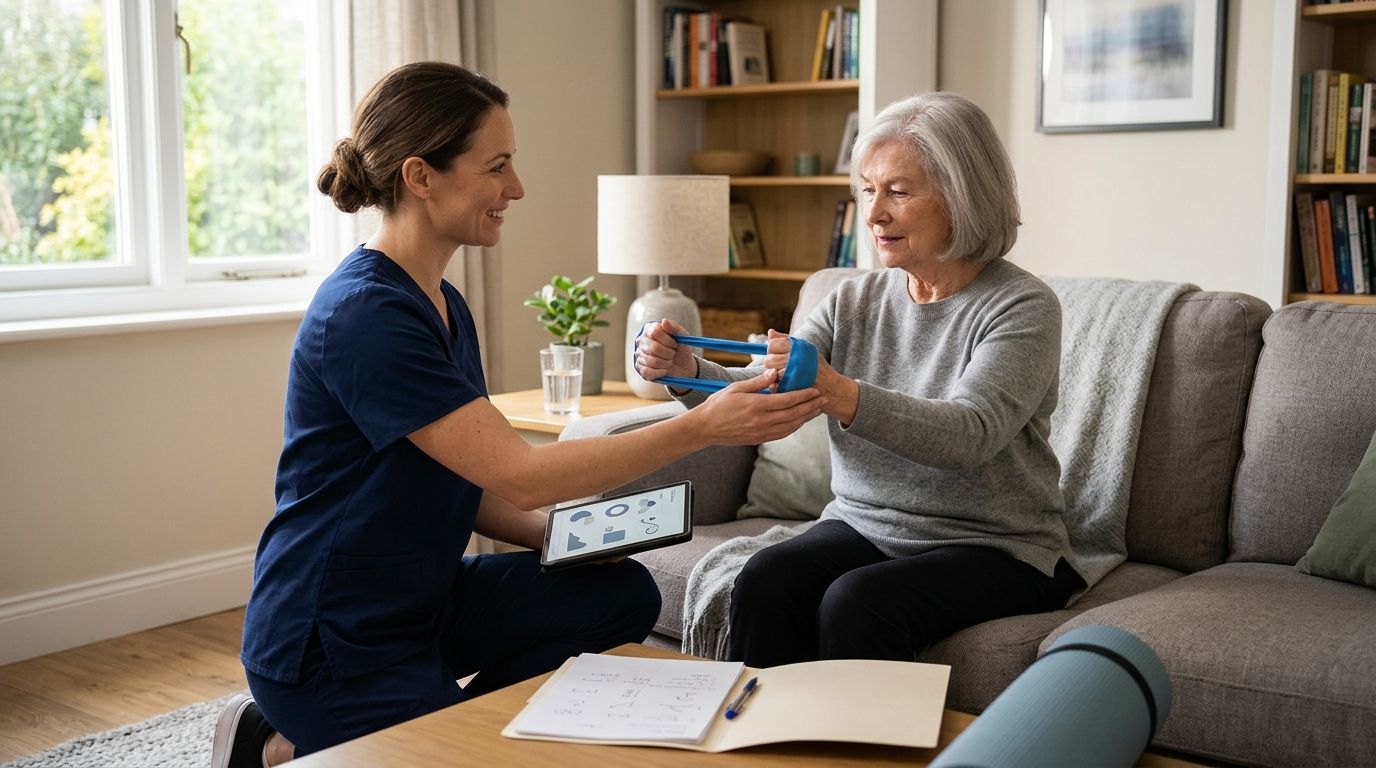

Aged care physiotherapy can support everyday transfers by assessing what makes movements such as getting out of bed or rising from a chair difficult, then planning treatment around your needs. At home, that assessment can consider your usual furniture, symptoms and available support; it does not mean every transfer is safe to practise without assistance.
- Aged care physiotherapy assesses everyday transfers alongside strength, balance, symptoms and the home environment.
- Foveria Health offers mobile physiotherapy for older people needing assessment and treatment at home in Greater Sydney.
- Family members should seek individual guidance rather than copy a lifting or transfer technique.
- A useful goal names the everyday task you want help with, not just an exercise.
How can aged care physiotherapy support everyday transfers?
The starting point is the movement you need help with, not a standard exercise sheet. A physiotherapist can assess the task, discuss what matters to you and recommend an approach that accounts for your health and surroundings.
Foveria Health provides mobile physiotherapy, including in-home assessment and treatment, across Greater Sydney. For an older person having difficulty with everyday transfers, a home assessment allows the conversation to focus on the setting where the difficulty occurs.
An assessment generally involves these steps, adjusted to what is appropriate for you:
- Discuss your goals. Explain which movement is difficult, what has changed and what you want to manage more comfortably.
- Assess the task. The physiotherapist decides whether and how to observe the movement, considering your symptoms and safety.
- Review your surroundings. Discuss the furniture, space, equipment and assistance involved in the transfer.
- Agree on next steps. These might include individual exercises, movement practice, advice for supporters or referral for further assessment.
Assessment is not a requirement to demonstrate a movement that feels unsafe. Tell the physiotherapist about your concerns before attempting it.
Why this matters
A transfer is often part of something more personal: getting to the toilet, joining family at the table or getting into bed at night. When that movement becomes difficult, the effect reaches beyond the movement itself.
For families arranging care in 2026, a useful question is: Which everyday task has become harder, and what help does the person currently need? That gives the assessment a practical focus without assuming that age alone explains the difficulty.
Your preferences matter too. The goal is not automatically to remove all assistance; it is to understand what support is appropriate and work towards goals that matter to you.
Which everyday transfers can you discuss?
Different transfers place different demands on you. Being comfortable getting up from one chair does not establish that getting off a toilet or out of a car is equally manageable.
Use the examples below to describe the problem. They are discussion points, not instructions for completing the movement.
| Everyday transfer | What to tell the physiotherapist | What needs individual consideration |
|---|---|---|
| Rising from a chair | Which chair is difficult and whether you need help | The seat, your symptoms, balance and current assistance |
| Getting into or out of bed | Which part of the movement is difficult | Bed height, positioning, space and physical ability |
| Getting on or off the toilet | Whether the difficulty changes during the day | Bathroom layout, privacy, equipment and support needs |
| Moving between a bed and chair | What help or equipment you currently use | The suitability of the existing transfer arrangement |
| Getting into or out of a car | Which vehicle and part of the movement cause difficulty | The vehicle, access space and your movement restrictions |
Choose the task that matters most rather than trying to solve every transfer at once. If getting out of bed is the immediate concern, explain how it affects your morning routine and who is usually there to help.
You do not need to recreate a difficult situation before the appointment. A clear description is useful, especially when attempting the task would create a risk.
What can a physiotherapy plan include?
An individual plan can address physical ability, the movement itself and the support around it. The assessment determines which parts are relevant; not everyone needs the same combination.
Strength and movement practice
Where appropriate, a physiotherapist can prescribe exercises and practise parts of an everyday movement with you. The choice of activity should account for your symptoms, health conditions and any restrictions following an injury or procedure.
The benefit of this approach is its connection to a meaningful task. Its limitation is that exercise alone does not address every obstacle: an unsuitable environment or a need for assistance still requires attention.
Balance and confidence
A physiotherapist can assess balance as part of understanding a transfer. You can also discuss fear, hesitation or a recent experience that has made the movement feel less manageable.
Confidence should not be treated as proof of safety. Equally, reluctance should not be dismissed as unwillingness; explain what worries you so the plan can address that concern.
Guidance for family and paid supporters
With your consent, a family member or regular support worker can contribute information about daily routines and existing assistance. Ask whether they should attend so guidance can be discussed together.
A written article cannot determine the right hands-on assistance for an individual. Do not copy a lifting technique or increase the amount of help you provide without appropriate assessment and guidance.
Equipment and environmental review
Sometimes the discussion needs to extend beyond exercises. A physiotherapist can identify concerns requiring further assessment and discuss whether another professional, such as an occupational therapist, should be involved.
Equipment is not automatically suitable because it helped someone else. Its fit, purpose, placement and the way it is used need individual consideration.
Why does the support needed for transfers vary?
The same movement can be difficult for different reasons. These factors help explain why a personalised assessment matters:
- Symptoms: Pain, stiffness, dizziness or breathlessness can affect how a movement feels and whether it is appropriate to attempt.
- Physical ability: Strength, balance and available movement contribute to what you can manage.
- Recent health changes: Illness, injury, surgery or a hospital admission can change the starting point for assessment.
- The home environment: Furniture, access space and the bathroom or bedroom layout affect the task.
- Existing support: The assistance and equipment already in use need to be understood before changes are recommended.
- Your priorities: Privacy, confidence and the activities you value should shape the agreed goal.
Variation is a reason to reassess, not to blame yourself. Tell the physiotherapist if a transfer is different at night, after activity or when particular symptoms are present.
How can you prepare for a transfer assessment in 2026?
Prepare information rather than practising the difficult movement. A few specific examples give the physiotherapist a clearer starting point than a general description such as struggling with mobility.
- Choose 1 priority task. Name the transfer that most affects your day, such as getting out of your usual armchair.
- Write down 2 everyday examples. Describe occasions when the task was easier or harder, without recreating them.
- Bring 3 questions. Ask what needs assessment, what assistance is appropriate and how the plan will be reviewed.
Have relevant health information, discharge instructions and details of current equipment available if you have them. Tell the service about access arrangements and whether another person needs to be present.
You do not need to buy equipment or rearrange your home before speaking with the physiotherapist. Explain the current setup first; unnecessary changes can make it harder to understand the original difficulty.
Foveria Health's in-home physiotherapy is suited to older people seeking assessment and treatment in their own homes across Greater Sydney. When enquiring about personal, goal-focused care with Simon, describe the transfer concern and your suburb, whether that is Punchbowl, a nearby suburb or elsewhere in Greater Sydney.
Discuss your home physiotherapy needs
Describe the transfer that concerns you, your suburb and the support you currently use.
Can physiotherapy help if someone already needs assistance?
Aged care physiotherapy can assess transfers even when assistance is already needed; independent movement is not the only relevant goal. The discussion can focus on understanding current ability, identifying concerns and clarifying an appropriate plan for the person and their supporters.
Needing help does not establish which technique or equipment is suitable. Keep the existing care team informed and seek individual guidance before changing the assistance provided.
Should a family member attend the assessment?
A family member can contribute useful observations if the older person wants them involved. Ask the service about attendance arrangements, and let the older person speak about their own goals and concerns wherever possible.
Explain what help you currently provide rather than demonstrating a lift unprompted. The physiotherapist can decide what is appropriate to observe.
When is a routine home appointment not enough?
A sudden change in the ability to stand or transfer needs prompt medical attention, particularly after a fall or alongside new symptoms. Do not assume that a new problem is simply part of ageing or wait for exercises to resolve it.
For severe chest pain, severe breathing difficulty or signs of stroke, call Triple Zero (000) in Australia. A routine physiotherapy appointment is not emergency care.
What should home care providers include in a referral?
For a referral prepared in 2026, describe the current situation rather than relying only on an older mobility note. State the everyday transfer concern, the person's goals and the assistance currently provided.
Useful information includes:
- The person's consent and preferred communication arrangements.
- The task causing concern and when the change was noticed.
- Relevant health changes, falls or discharge instructions.
- Existing equipment and current transfer guidance.
- Who usually assists and who coordinates the person's care.
- Access details and any practical concerns about the home visit.
Separate direct observations from assumptions. For example, reporting that someone now asks for help getting out of their chair is clearer than describing them only as having poor mobility.
If a care plan changes during 2026, make sure the relevant professionals receive the updated information. Ask how assessment findings and recommendations will be shared, with the person's consent, so supporters are not working from conflicting instructions.
FAQ
Can aged care physiotherapy help with getting out of a chair?
Aged care physiotherapy can assess why getting out of a chair is difficult and plan support around the findings. The assessment considers the person, the chair, symptoms and existing assistance rather than assuming a standard technique will suit everyone.
Will home physiotherapy make my parent independent with transfers?
Home physiotherapy does not guarantee independent transfers. An assessment helps establish appropriate goals, which can include understanding support needs as well as working on movement.
Should I help my parent practise standing before the appointment?
Do not introduce transfer practice based only on general advice when safety is uncertain. Explain the difficulty to the physiotherapist and ask what is appropriate before the assessment.
Can the physiotherapist assess the chair my parent normally uses?
A home assessment allows discussion of the usual chair and its surroundings. The physiotherapist decides whether observing the transfer is appropriate after considering symptoms and safety.
Do we need to buy equipment before a home physiotherapy visit?
You do not need to buy equipment simply to prepare for an assessment. Describe the equipment already in use and ask for individual advice before making changes.
What should I tell Foveria Health when enquiring in 2026?
Tell Foveria Health which transfer is difficult, what has changed, your suburb and the help currently available. Mention relevant health concerns or discharge instructions so you can discuss an appropriate appointment.
Does an aged care package automatically cover home physiotherapy?
Do not assume your arrangement covers a particular appointment. Ask your provider and the physiotherapy service to confirm the requirements and payment arrangements before booking.
One last thing
The most useful goal can be a very ordinary one. Getting to your favourite chair or managing the morning routine gives the assessment a clearer purpose than simply wanting better mobility.
When arranging aged care physiotherapy in 2026, start with that everyday detail. It helps keep the conversation centred on the person, their preferences and the support they need at home.